The 100 Greatest Jazz Albums Of All Time,
a list with commentary, by Richard Blute
My criteria for putting this list together:
-Try to feature as many different musicians as possible. (There are inevitably going to be a few musicians who show up several times.)
-Try to get a good balance of the old and the new.
-Feature as many styles of jazz as possible from as many eras as possible. You’ll quickly realize that my preference in jazz is for avant-garde or free jazz, and there is a special place in my heart for Blue Note albums of the 60s. But I put in a lot of effort making sure that the great masters of early jazz received the credit they deserve, even though it’s not really music I know well. There’s lots of bebop, hard bop, cool jazz and just plain old jazz to be found here as well.
-I hope fans of free jazz will find here an entry into some of the many other genres of jazz they may not be familiar with.
-I hope fans of mainstream jazz will find here an entry to the more “out” or free versions of jazz.
-I hope non-jazz fans will find a starting point here.
-I hope everyone finds at least one surprise here (pleasant, preferably).
-In each entry, I’ve named further albums to explore.
-Remember this list is just my opinion.
Without any further ado:
*****************************************************************************
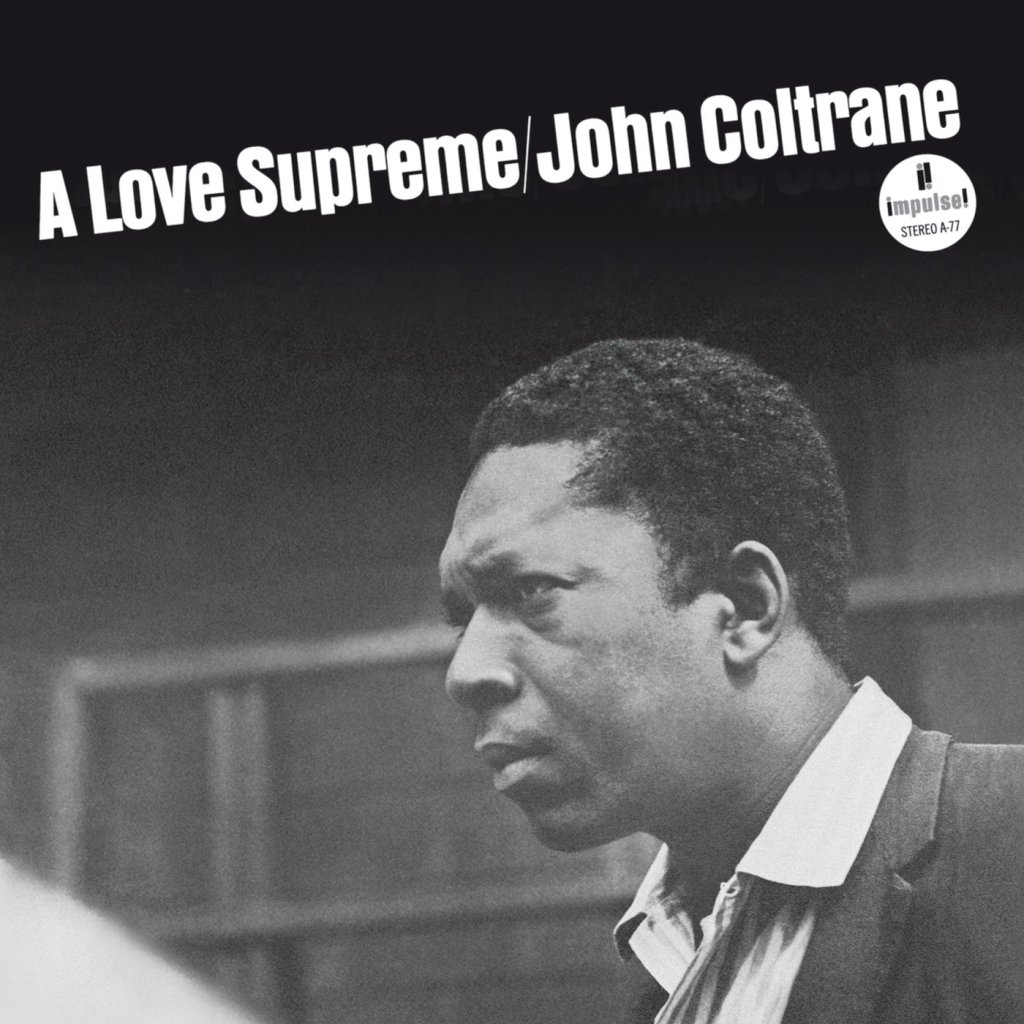
1-John Coltrane-A Love Supreme
“I’d like to point out to people the divine in a musical language that transcends words. I want to speak to their souls.”
-John Coltrane
Whatever your thoughts on the existence of a divine being, it is impossible to listen to this music and not feel you’re listening to something miraculous. While entire books have been written analyzing the music on A Love Supreme, there is a profound spirituality to the music that transcends all analysis.
This music is inextricably linked with Trane’s recovery from his heroin addiction. He gave up heroin cold turkey, locked in a room with his wife bringing him water. He emerged from this ordeal with a profound spiritual sense, which he tried to capture in all his music. Anyone recovering from a substance use disorder will recognize that moment when you come out alive on the other side and see an amazing future ahead that you hadn’t been aware of. Trane captured that moment here.
Everyone, regardless of how much music you’ve listened to or how much you know about jazz, can recognize how extraordinary this music is, a combination of beauty and intensity, played by 4 musicians who are among the greatest to ever play their instruments.
The opening notes of the album are a statement of almost hushed awe and are a clear sign of the extraordinary music to follow. Then bassist Jimmy Garrison kicks in with the 4 simple notes that define A Love Supreme. Trane sounds like he’s wrestling with the best way to express his devotion. The rhythm section (Garrison, McCoy Tyner on piano and Elvin Jones on drums) knows when to lend support to Trane’s yearning playing and when to step forward. I especially love Elvin’s playing on this album (and on pretty much every album he’s ever recorded).
Trane is the finest saxophonist of all time, with a revolutionary style frequently called “sheets of sound”. Here that style is very much used for a higher purpose. This is one of those very rare pieces of art that can restore your faith in humanity. It’s much needed these days.
Just give this album a listen. It’s that simple.
There is a recently discovered recording of the band playing this music live (It was in somebody’s closet for decades!), called A Love Supreme: Live in Seattle on the Impulse! label, which is well worth checking out. And there’s more Coltrane coming up on this list momentarily.
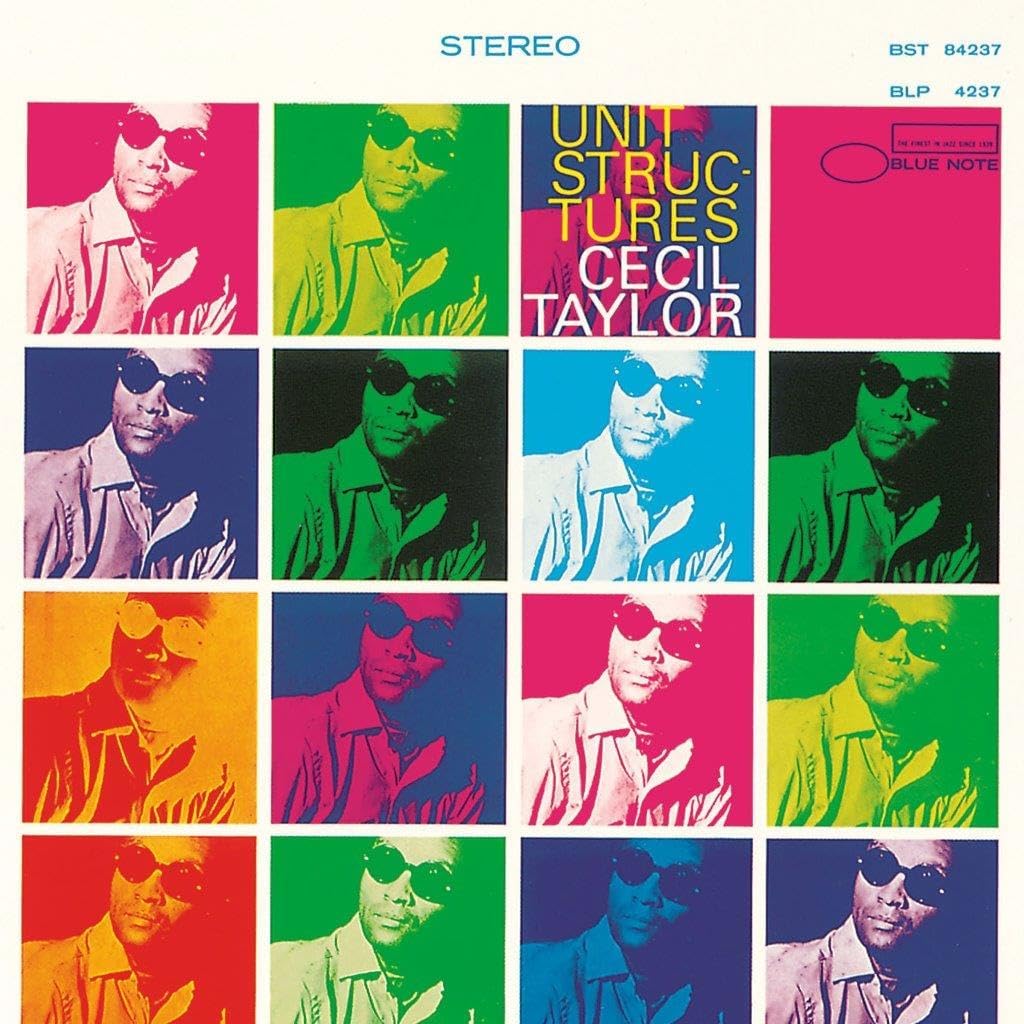
2-Cecil Taylor-Unit Structures
“I try to imitate on the piano the leaps in space a dancer makes.”
-Cecil Taylor
Cecil Taylor found a way to effortlessly synthesize ideas from contemporary European composers with American jazz and blues. He also took those new ideas and played them with a stunning level of ferocity. At times he seems to be treating the piano as a percussion instrument. Val Wilmer in the wonderful book As Serious As Your Life: Black Music and the Free Jazz Revolution, 1957–1977, describes Taylor’s playing:
“…he rushed all over the keyboard, hitting each note with an intense, percussive touch, as if they were eighty-eight tuned drums.”
I was stunned listening to this album for even just a moment. The music can be thoroughly disorienting, in part because it is determined to break away from the musical systems that dominated composition at the time and forge a new form of music. Listening to Taylor can be like trying to find your way without any kind of map or place of reference. In that lost feeling, there is much beauty to be found. But nothing comes easy in listening to Taylor, I have to put everything else aside if I want to appreciate the beauty of this album or any of his music.
Donald Ayler, brother of Albert and his frequent collaborator, beautifully described how to listen to the new music that artists like Cecil and Albert were producing:
“One way not to listen to it is to focus on the notes and stuff like that. Instead, try to move your imagination toward the sound. It’s a matter of following the sound. Follow the sound, the pitches, the colours. You have to watch them move.”
The band on this album consists entirely of the most forward thinking musicians, who are thoroughly in tune with Taylor’s ideas. There’s Eddie Gale on trumpet, Jimmy Lyons and Ken McIntyre horns, Henry Grimes and Alvin Silva on bass, Andrew Cyrille on drums. They are all superb on this album, especially Taylor’s long-time musical partner Jimmy Lyons.
A wonderful point made in the book In The Brewing Luminous: The Life And Music Of Cecil Taylor by Philip Freeman is that one of the reasons the collaboration of Taylor and Lyons was so successful was that while both were committed to the avant-garde and free jazz, they approached their music from a basis in classic bebop. You can frequently hear it in Lyons’s playing especially.
I highly recommend finding some video of Taylor playing. Even with the sound off, you’ll be floored by his physical command of the piano. I can only urge you to give this album a listen, it’s been a real life changer for me. For a long stretch of time, I only thought of free jazz as energy music. Taylor showed me it can be that, and much more as well.
An appreciation of Cecil Taylor has to begin with his collaborations with Jimmy Lyons. The extraordinary live album Nefertiti, The Beautiful One Has Come is essential. Conquistador, the album recorded right after Unit Structures and another live album, One Too Many Salty Swift And Not Goodbye, are almost as good.
One of Taylor’s most important projects was Cecil Taylor In Berlin ’88, a 13 disc box set where he played with virtually every European free jazz musician in multiple combinations. This includes 5 CDs of duets with different drummers, Gunter Sommer, Paul Lovens, Louis Moholo, Han Bennink and Tony Oxley. It’s fascinating to compare the different approaches that the different drummers bring out in him. There’s also a duet with Derek Bailey and a solo performance. It’s about the most complete documentation of this great musician one can imagine. One can also frequently find individual albums from the box set for sale.
Also check out any of his solo albums (more on those below) or his trio albums with The Feel Trio, where he plays with William Parker and Tony Oxley, especially their albums Celebrated Blazons and Looking (Berlin Version).
For more Jimmy Lyons, check out Jimmy Lyons & Sunny Murray Trio-Jump Up, a seriously under-appreciated album.
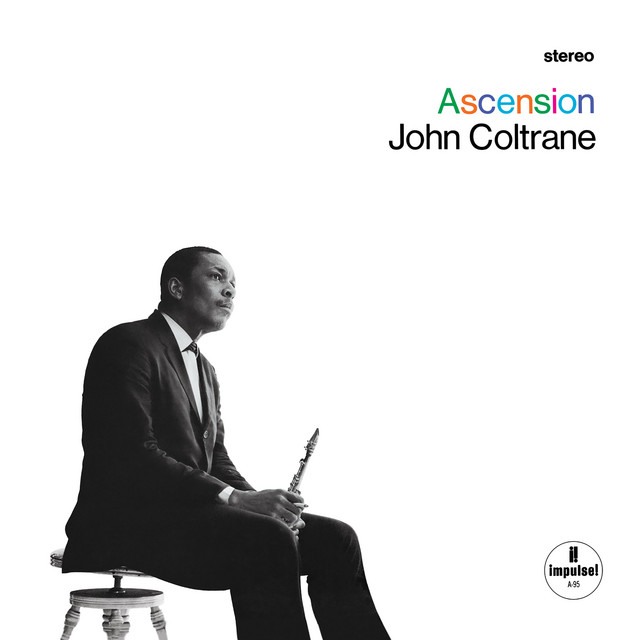
3-John Coltrane-Ascension
“John was like a visitor to this planet. He came in peace and he left in peace; but during his time here, he kept trying to reach new levels of awareness, of peace, of spirituality. That’s why I regard the music he played as spiritual music — John’s way of getting closer and closer to the Creator.”
-Albert Ayler
Ornette did it first, the album-length large group free improvisation, but Ascension is the finest example, remaining so even today. Up until 1965 or so, Trane was the greatest saxophonist in the world but playing music that was recognizable within the context of jazz. Even A Love Supreme, released a year earlier, was squarely in the jazz framework. Ascension blew the doors off the building. He supplemented his working quartet with 7 of the most daring musicians of the day. Here you’ll find Pharoah Sanders, Archie Shepp, Marion Brown, John Tchicai, Freddie Hubbard, Art Davis and Dewey Johnson, and they’re all extraordinary. Pharoah in particular played spiritual jazz inspired by A Love Supreme and this session for the rest of his career. This album more than any other is responsible for so much of the music I listen to today.
One of many remarkable things about Ascension is that despite the calibre of the musicians involved and the fact that there’s lots of solo space, the piece never degenerates into a blowing contest, the frequent fate of long jazz pieces. Ascension is much more a communion of like-minded musicians.
I have to include a description of Ascension by Chris Baber of JazzViews. It’s such a great line, it deserves to be quoted:
“The raucous clamouring of the ensemble could be interpreted as the anguished cries of souls in Hell, or as the rushing wings of approaching angels, or as the angry cries of people on earth witnessing the way the world stood in 1965.”
For more Coltrane, check out his duo with Rashied Ali, Interstellar Space, or the live album, Live At Birdland. Elvin’s drumming on the track Afro-Blue needs to be heard to be believed. He sounds like 8 musicians playing furiously at once, and in perfect sync.
Or you can go back further and check out Giant Steps, Blue Train or My Favorite Things. Trane’s studio take on My Favorite Things may be the one jazz track that everyone on the planet could love.
4-Charlie Parker-Complete Dial And Savoy Masters
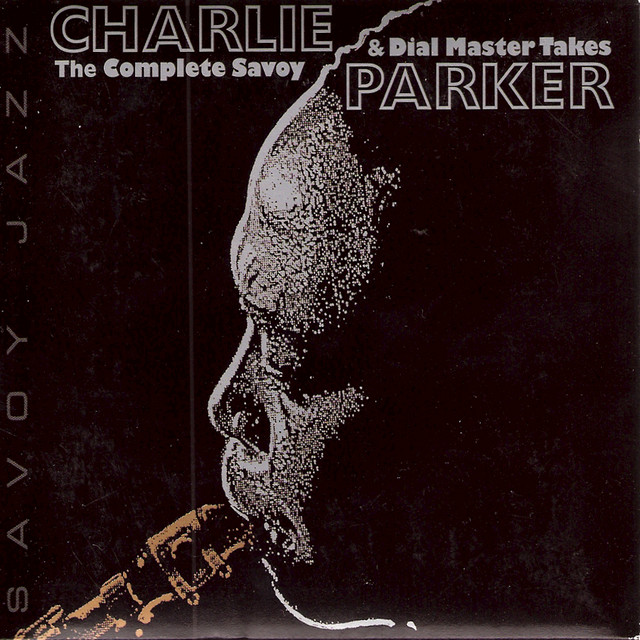
“You’ve got to learn your instrument. Then, you practice, practice, practice. And then, when you finally get up there on the bandstand, forget all that and just wail.”
-Charlie Parker
“They teach you there’s a boundary line to music. But, man, there’s no boundary line to art.”
-Charlie Parker
A few years ago, Charlie “Bird” Parker wouldn’t have made this list at all. I learned jazz backwards. Coming from extreme forms of rock, I was initially drawn towards the more fierce forms of jazz. (Peter Brotzmann’s Machine Gun will show up on this list momentarily.) So angrier, more impatient me failed to appreciate Bird when I first heard him. He wasn’t testing the extremes of his sax or bludgeoning the audience. He was expressing his heart with beautiful lines of music. I love Scott Yanow’s description of Bird’s playing:
“He could play remarkably fast lines that, if slowed down to half speed, would reveal that every note made sense.”
Bird’s ability to play complex lines at great speed led to the creation of a new form of jazz. This was eventually called bebop, possibly the greatest contribution of America to music. Bird, Dizzy Gillespie and Bud Powell were the pioneers and their compositions are still fundamental to any understanding of jazz.
Many of the great contributors to the foundations of jazz can be found here. In addition to Diz and Bud, there’s Miles, Max Roach, Duke Jordan, J.J. Johnson, John Lewis…
Academics aside, this music’s fun and soulful; it swings and it makes me wish I could have heard him playing in some dark smoky bar at 2AM. I wish I could experience the thrill of hearing Bird and Diz without any idea what I was about to hear. I’m glad I was eventually able to appreciate this music and the man, Charlie Parker.
This compilation is comprehensive, covering the majority of his most important studio recordings, with excellent sound. For an inexpensive sampling of Bird’s work, try 20th Century Masters: The Millennium Collection: The Best Of Charlie Parker.
For a modern interpretation of Charlie Parker’s music, check out The Charlie Parker Project, by Anthony Braxton.
Speaking of which:
5-Anthony Braxton-Willisau (Quartet) 1991
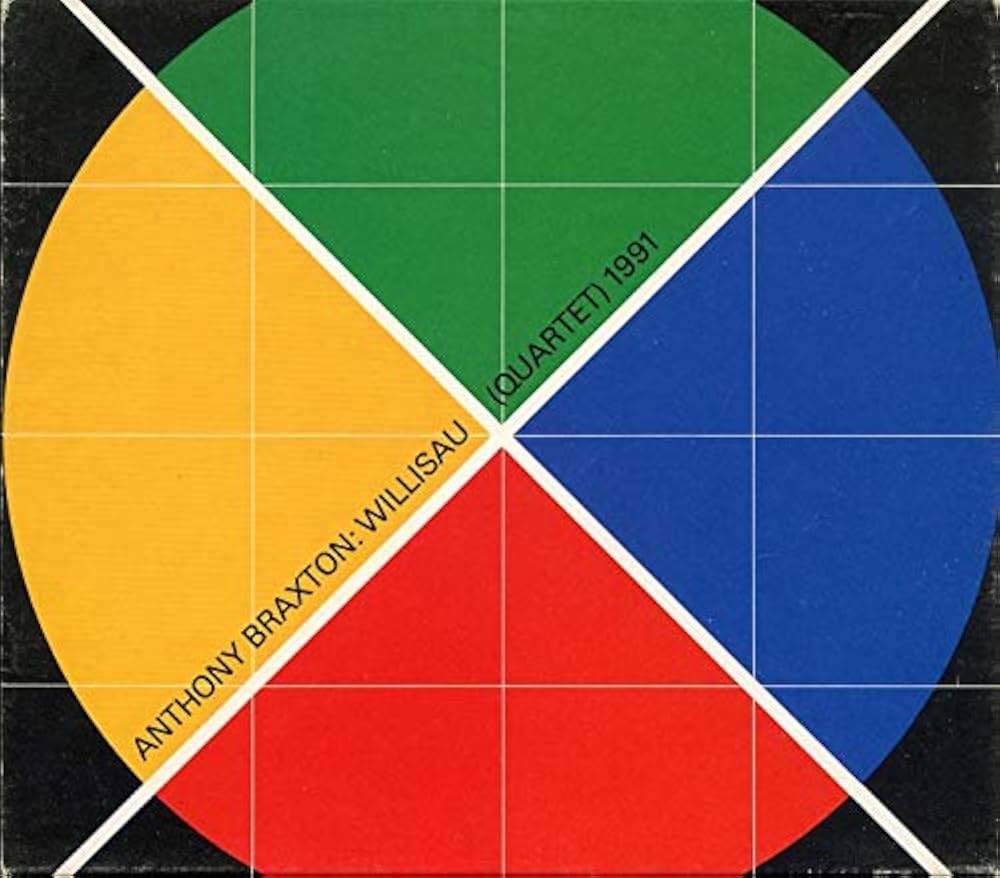
“There’s a lot of creative music happening in the underground, which is a very hopeful kind of sign….[These initiators are] usually kind of outcasts–for the most part no one can relate to them. And it’s all over the planet; you go and look in the alleys and under the doorways, in the coal mines–they’re there, lurking in the shadows; a significant amount of people in different parts of the planet who are genuinely creative. And I associate and attach myself to that. Usually when I go to any new place I try to find out from the musicians–they’ll usually say ‘this guy can’t play,’ or ‘he’s crazy,’ ‘he’s not doing anything,’ ‘he’s a sick, warped, demented fool’–and immediately I try to find him. He’s probably one of us.”
-Anthony Braxton
As The Penguin Guide To Jazz describes this one, it’s a whopper. Braxton’s greatest working group, with Marilyn Crispell on piano, Mark Dresser on bass and Gerry Hemingway on drums, play Braxton’s remarkable compositions over 4 CDs. Entire books have been written analyzing Braxton’s compositions. For example, check out New Musical Figurations: Anthony Braxton’s Cultural Critique by Ronald Radano. Braxton uses very non-traditional forms to write his music and gives many of his compositions pictorial titles. Radano does a great job of analyzing Braxton’s work and how he challenges traditional ideas of not just jazz, but all of music and culture. He has developed a whole new theory of composition which his bandmates must master. In particular, he has a number of “languages” which form the basic rhythmic structure underlying each piece. The book is highly readable and gives great insight into the thought process of one of jazz’s greatest musician/composers.
At the end of the day, what matters is the music and what I hear is music that is simultaneously highly intellectual and yet remarkably intense. It even manages to swing when you least expect it. The level of communication between these four great musicians borders on the telepathic and Braxton’s compositions always leave enough room for the musicians to explore each other’s new ideas. And what doesn’t get enough attention, Braxton plays his various saxophones with extraordinary skill and heart, as well as any musician on this list.
In another great book, Forces In Motion: The Music And Thoughts Of Anthony Braxton, Graham Lock describes Braxton’s influence beautifully:
“William Blake wrote that “The Imagination is not a State, it is Human Existence Itself”; Braxton’s imagination has, I think, enriched all of our existences. Like Blake, like Tarkovsky – and like Cecil Taylor and Sun Ra too – he is a metaphysician, an alchemist, a man who opens doors you didn’t know existed.”
One of the points both of the above authors make is that Braxton is a great innovator, but always respectful, even adoring, of the jazz tradition. See for example, the albums 6 Monk’s compositions (1987) or Ten Compositions (Quartet) 2000, in which he covers compositions by the great pianist Andrew Hill (who will appear later on this list) or The Charlie Parker Project.
For more Braxton, check out his first solo album, For Alto from 1971, which is probably the first solo saxophone album ever recorded. It’s also an amazing piece of music. I’m a big fan of his recent Zim recordings, where his band includes 2 harpists. I saw that band in concert, it was an extraordinary experience. His newest compositional system is called Lorraine and is well heard on Sax QT (Lorraine) 2022.
I love the above quote from Braxton. It captures this feeling that this music is very much the music of outsiders. I’ve attended concerts when I was a large percentage of the audience. I have so much admiration for musicians who can play in those circumstances and still make some beautiful noise.
6-Peter Brotzmann-Machine Gun

“We can make changes to the system. We can reach single souls. We can open up their horizons.”
-Peter Brotzmann
I’ve never been able to find the quote again, but someone wrote something to the effect of: if The Sex Pistols were a jazz musician, they’d be Peter Brotzmann. Reading this, I immediately went and bought this album, his finest work. This is jazz as rage, performed by the greatest European free jazz musicians, a Hall Of Fame roster for European free jazz, and every single musician here went on to contribute fantastic music to the free jazz canon. Several of these names will show up again and again on this list. There’s Willem Breuker, Evan Parker, Fred Van Hove, Peter Kowald, Buschi Niebergall, Sven-Åke Johansson and Han Bennink.
The first moments of this album are utterly shocking. The 3 tenor saxes, Breuker, Brotzmann and Parker, aim to knock you out of your seat and let you know right off where these guys are going. In his wonderful book, Peter Brotzmann: Free-Jazz, Revolution and the Politics of Improvisation, Daniel Spicer describes that opening moment and compares Machine Gun to Ascension, the other recent large-scale free improvisation:
“John Coltrane’s Ascension, recorded three years earlier, had provided a template of high-energy horns raised in mass communion, but where Coltrane’s cry was one of intense spiritual yearning, Brötzmann gives voice to altogether more earthly concerns. The opening moments of the title track remain one of the most powerful and shocking opening salvos ever recorded: three saxophones exploding in a low, menacing assault of aggressively snarling blasts, signalling the arrival of intense young men with urgent opinions.”
Ranking the European free jazz albums for this list was difficult, but picking the greatest was easy. Machine Gun manages to be both terrifying and beautiful. There’s never been anything else quite like it. If I was talking to someone who listened to punk and metal, but looking to expand their horizons, this is what I would recommend first.
For more Brotzmann, it’s important to find an album where his playing is more prominent. The one minor problem with Machine Gun is you don’t get to spend much time focussing on Brotzmann’s playing. So check out Mental Shake, with Steve Noble on drums, John Edwards on bass and Jason Adasiewicz on vibes. I saw this quartet in concert and it is one of the greatest concerts I’ve ever been to. Also on this list is the first Die Like A Dog Quartet album, which is a masterpiece.
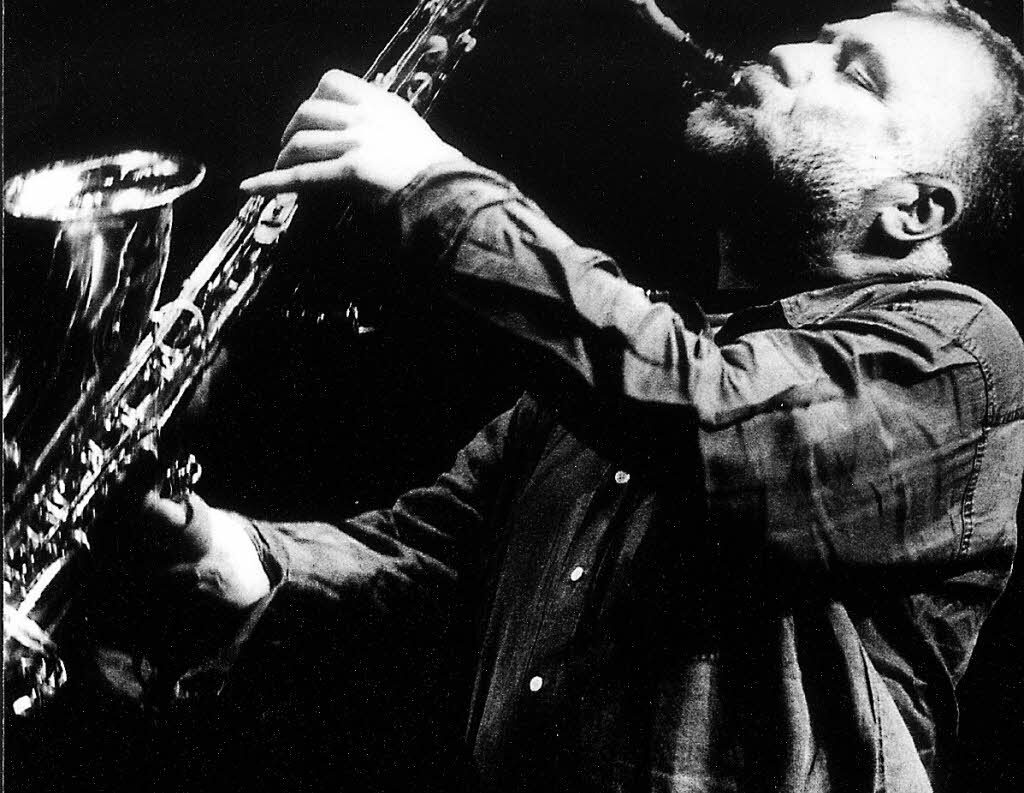
That’s Peter in the photo at the top of the page, I can almost hear him just looking at it.
And I don’t want to make you jealous, but my copy of Machine Gun was signed by the man himself.
7-Thelonious Monk-Genius Of Modern Music, Volumes 1 & 2
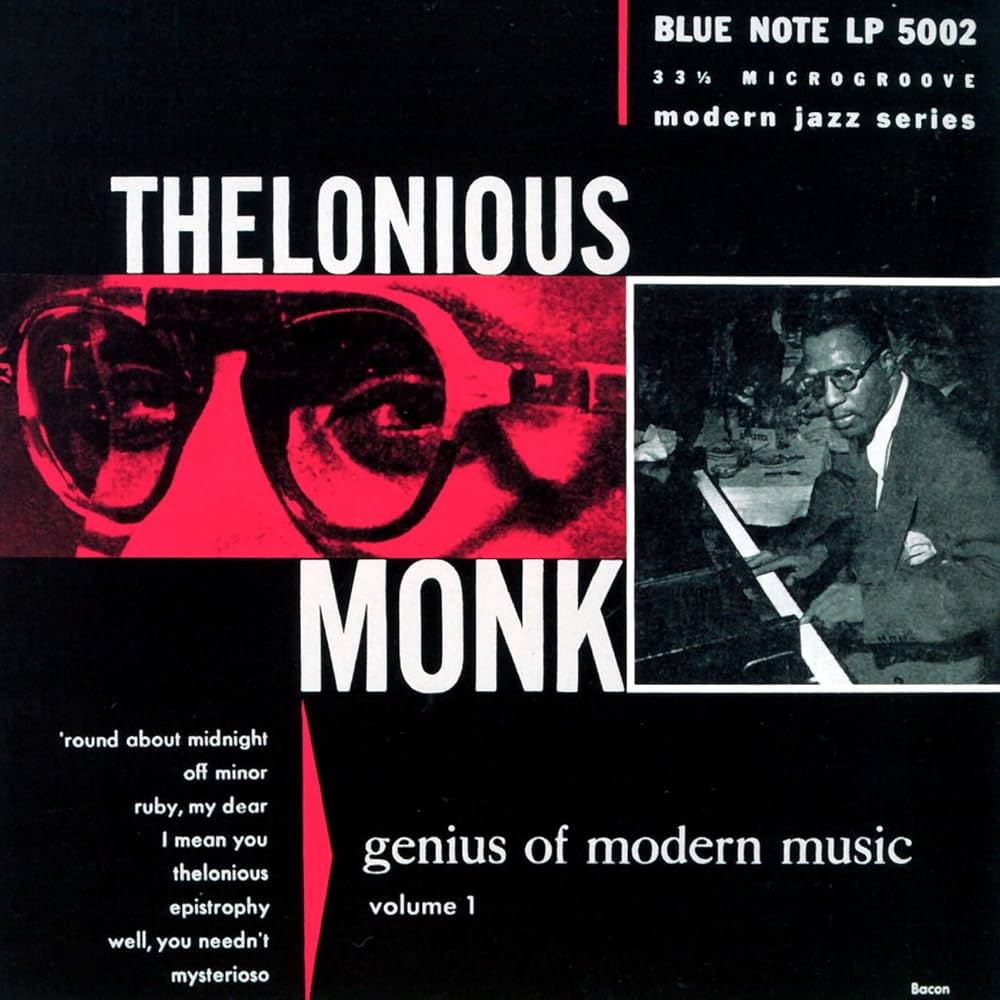
“Writing about music is like dancing about architecture.”
-Thelonious Monk
“The piano ain’t got no wrong notes.”
-Thelonious Monk
The first time I heard Monk I wondered if maybe he didn’t know the tune he was playing, it was all stuttery stops and starts. Eventually I realized that Monk understood time in a different way than any other musician. But while unusual intervals and rhythms were an important tool for Monk, he never forgot about melody, and his compositions are immediately recognizable and endlessly hummable.
His playing style was to play minimal notes in a percussive fashion with that Monkish sense of time-keeping, and this style matched his compositions perfectly. So many of these tunes have seeped into the bloodstream of jazz. There’s Ruby, My Dear, Epistrophy, ‘Round About Midnight, Well, You Needn’t, Straight, No Chaser and on and on.
His influence on modern jazz can’t be overstated as can be seen by the number of the very finest musicians who record their take on Monk. Be sure especially to check out Steve Lacy’s many albums covering Monk tunes. More on Steve Lacy below.
This double album is probably the best starting point, focusing on early takes of his compositions in small group settings, but any of his later studio albums with Charlie Rouse on sax are also well worth getting, as are the various live albums he made wth Coltrane (although watch out for bad sound quality on some of them). Also all of his solo studio albums are amazing. Finally be sure to check out Brilliant Corners, it’s one of his very best.
8-Duke Ellington-Never No Lament: The Blanton-Webster Band
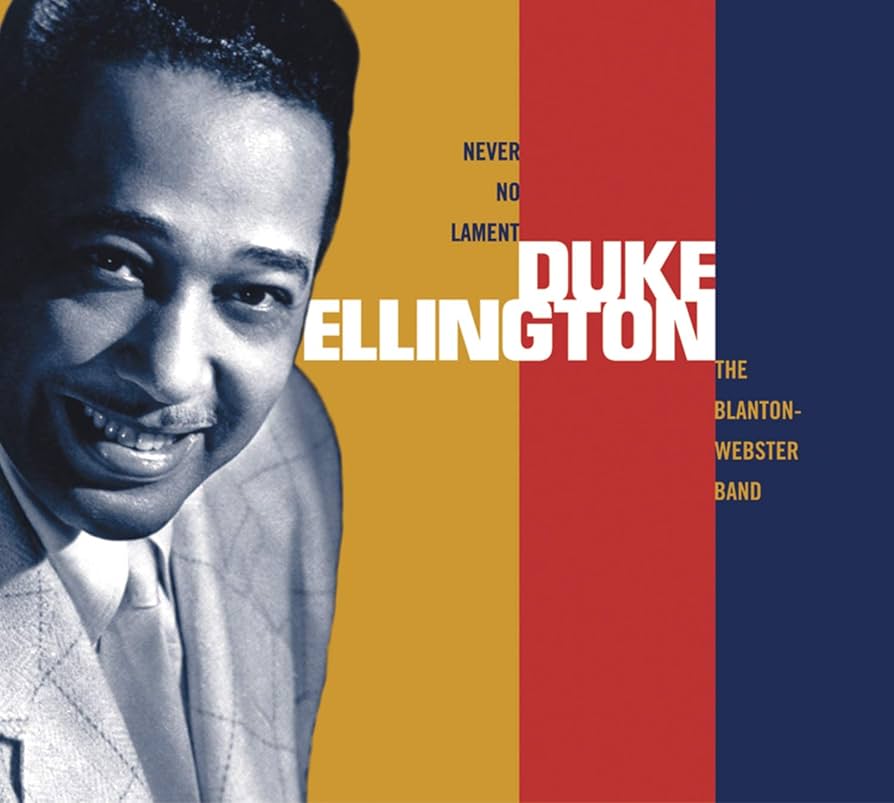
“I merely took the energy it takes to pout and wrote some blues.”
-Duke Ellington
“Art is dangerous. It is one of the attractions: when it ceases to be dangerous you don’t want it.”
-Duke Ellington
Duke Ellington is the most important figure in the history of jazz, except possibly for Louis Armstrong who will be along momentarily. He was a wonderful composer, arranger and ambassador for the music. His various big bands produced some of the greatest music of all time, including many of the most well-known songs in jazz history. But I was left with the question of what album to choose for the list. He recorded so much music over such a long period of time. I’ll add some other albums at the end of this commentary. But I went with this comprehensive compilation of Ellington’s big band music from 1939-1942. This version of the band was called the Blanton-Webster band in honor of bassist Jimmy Blanton and tenor saxophonist Ben Webster. Many Ellington experts, of which I am certainly not one, would argue this was the greatest version, and listening to this album it’s hard to argue.
Much as I love long jazz pieces, like Trane’s hour-long live versions of My Favorite Things or any number of hour-long Cecil Taylor pieces, there’s something to be said for brevity. Ellington had brevity forced upon him until around 1950. Until that time, all his recordings were released on 78 rpm albums, which gave him 3 or 4 minutes to work with. That format forced Ellington to essentially stick to one musical idea and then move onto the next song. His compositional skills are so strong that he is able to produce remarkable music in that restrictive format. And great music, this is. There’s Take The “A” Train, Sophisticated Lady, Ko Ko, I Got It Bad (And That Ain’t Good), Chelsea Bridge and on and on and on. All tunes that have seeped into the consciousness of the world. The sensational sound quality here is another bonus, RCA clearly spent a lot to present this music in the pristine version it deserves.
What else to get for Ellington? The next choice and an album that I almost put into this spot, is Ellington At Newport, from the 1956 Newport Jazz Festival. This album may have the most famous extended solo in the history of jazz, from Paul Gonsalves during the piece Diminuendo and Crescendo in Blue. It’s amazing to listen to the audience get increasingly frenzied with delight as the solo went on and on. It’s a subject of great speculation what led to the solo. One theory is that there was a beautiful woman in the front row that Gonsalves was trying to impress. But in any event, it is quite amazing, although not the greatest sound quality. This one performance led to a huge surge of new interest in Ellington’s work. (I can’t imagine how hard it must have been to keep such a highly skilled big band together and performing at such high levels for decades as Ellington did.)
For more Ellington, Such Sweet Thunder was a concept album based on various plays of Shakespeare. Johnny Hodges and Paul Gonsalves sound great on it. Ellington did a piano trio album with Mingus and Max Roach, called Money Jungle which is well worth a listen. He has a pair of great albums on Impulse! of the “Meets” variety with Duke Ellington & John Coltrane and Duke Ellington Meets Coleman Hawkins. A lesser known album I’ve always liked is Intimacy Of The Blues.
9-Alexander von Schlippenbach-Pakistani Pomade

“….music of a strength and intensity to mark me for life … l came back with my academic ambitions in tatters and a desperate dream of a life playing that kind of music – ‘free jazz’ they called it then.”
-Evan Parker, describing the first time he heard Cecil Taylor
I knew that I would put one of the European free jazz small groups in this slot, and I changed my mind on which one a hundred times. This trio, with AvS on piano, Evan Parker on sax and Paul Lovens on percussion, is one of the defining groups of the genre, and this is their greatest record.
More than anything, it is Evan Parker’s sax playing that makes this album one of the finest jazz albums of all time. He seems capable of making any kind of sound on his sax, and his beautifully long sinuous lines are mesmerizing. I saw the word “labyrinthine” used in a review of one of his albums. It’s just right. Parker was there from the very creation of European free jazz and has been its most important practitioner. He’s also been one of the leading experimenters in adding electronic music to the free jazz scene.
Alexander von Schlippenbach plays with a style similar to Cecil Taylor’s with very percussive, dense notes, coming sometimes at an almost frenzied pace, although there’s maybe less of a bop basis than in Taylor’s work. He complements Parker’s weaving lines beautifully. AvS has led this great trio, but also the incredibly important Globe Unity Orchestra (more on them later). Another masterpiece is Monk’s Casino, where he led a crack band to cover every Monk composition, with some remarkably novel approaches.
Paul Lovens pushes his bandmates by setting the rhythm within each piece, but changing it frequently either in response to what he’s hearing or urging them on. Lovens has played drums for pretty much everybody and his name is on many of the most important albums in the genre. Be sure to check out his duet with Cecil Taylor in the Berlin ’88 series mentioned above. He’s a great drummer and he always wears a tie.
Other albums by this trio are Elf Bagatellen, Physics and First Recordings, they’re all worth checking out. Another great European small group from the same time period is the Evan Parker-Barry Guy-Paul Lytton trio. Check out their albums Atlanta and Imaginary Values. Be sure to check out Parker’s solo albums Conic Sections and The Snake Decides.
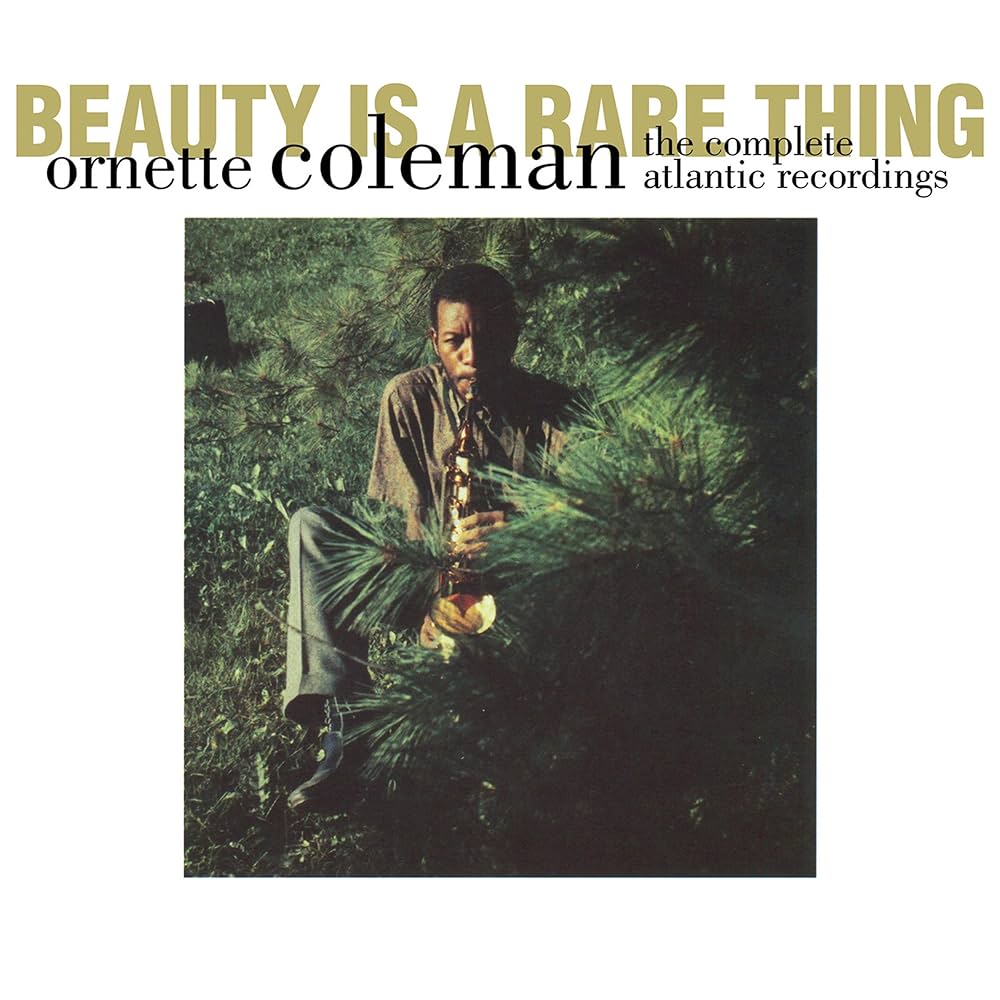
10-Ornette Coleman-Beauty Is A Rare Thing
“When you hear me, you probably hear everything I’ve heard since from when I was a kid. In fact, it’s a glorified folk music.”
-Ornette Coleman
This one is cheating. This is a box set which contains all of the brilliant albums Ornette recorded for Atlantic Records. That way I don’t have to pick one. Ornette was a divisive figure, repeatedly labelled a fraud; he was even assaulted on one occasion by some musicians who destroyed his saxophone.
But the founding of avant-garde or free jazz (the title of one of the albums) can be found here. With The Shape Of Jazz To Come, Ornette destroyed all of the standard conventions of jazz, with wildly off-kilter rhythms and melodies. But at the music’s heart was always deep emotion. The song Lonely Woman, from The Shape…, almost aches with sorrow. Ornette had the wisdom to surround himself with musicians who shared both his radical ideas and his skills, especially Don Cherry, who himself is one of the key figures in avant-garde jazz. Billy Higgins and Charlie Haden rounded out one of the most important bands in the history of jazz. (Ed Blackwell took over on drums for This Is Our Music.)
The 38 minute piece which made up the whole of the album Free Jazz: A Collective Improvisation was completely unprecedented, the first entirely free or improvised long form piece in the history of this music. It featured some of the greatest musicians of the era. In addition to his usual quartet, there was Scott LaFaro, Ed Blackwell, Eric Dolphy and Freddie Hubbard. Coleman and Dolphy blow me away every time I listen to this album. Crucial to propelling the music forward are the two basses, which are so well-recorded. This album led the way to much of the music on this list. (The album is also famous for featuring a great Jackson Pollock painting on the cover.)
If you can only pick one from the box set, I’d go with The Shape Of Jazz To Come. If you can only get two, also go for Change Of The Century, which contains my favorite Ornette song, Ramblin’. But also check out his Trio’s 2-volume live collection At The Golden Circle, Stockholm, on Blue Note. And be sure to check out the cover of This Is Our Music for the most badass band photo of all time.
11-Miles Davis-Filles de Kilimanjaro

“It’s not the note you play that’s the wrong note – it’s the note you play afterwards that makes it right or wrong.”
-Miles Davis
“Anybody can play. The note is only 20 percent. The attitude of the motherfucker who plays it is 80 percent.”
-Miles Davis
“If you understood everything I said, you’d be me”
-Miles Davis
The start of jazz-rock fusion. While it’s not a style I generally like, this album is brilliant, in part because it is the final time Miles’s great second quintet were all together. Miles had surrounded himself with 4 of the very best up and coming musicians, Herbie Hancock, Wayne Shorter, Ron Carter and Tony Williams. They made a spectacular series of albums which redefined jazz and especially how a rhythm section works. On this one, that classic group is augmented with a few more future stars, Chick Corea and Dave Holland. Electric instruments and rock influences show up for the first time and the result is this brilliant album.
A lot of jazz fans would choose either In A Silent Way or Bitches Brew as the best Miles from this era in place of this one. But it remains my favourite. Miles has invented several entire styles of jazz and is probably the most famous jazz musician, so it seems pointless to write a mini-history. So I’ll just say to check out Nefertiti, from the second quintet. And if you want older Miles, go for Birth Of The Cool, it’s one of many jazz styles that Miles pioneered.
Or maybe the first great quintet, which consisted of Miles, Trane, Red Garland, Paul Chambers and Philly Joe Jones. Especially look for their string of albums Cookin, Relaxin’, Workin’ and Steamin’ with The Miles Davis Quintet.
Or maybe any of his albums with Gil Evans. My favorite of those is Sketches Of Spain.
For some incredibly fun late-period Miles music, go for On The Corner. At the very least, check out that album cover.
Of course, every music fan should have Kind Of Blue in their collection.
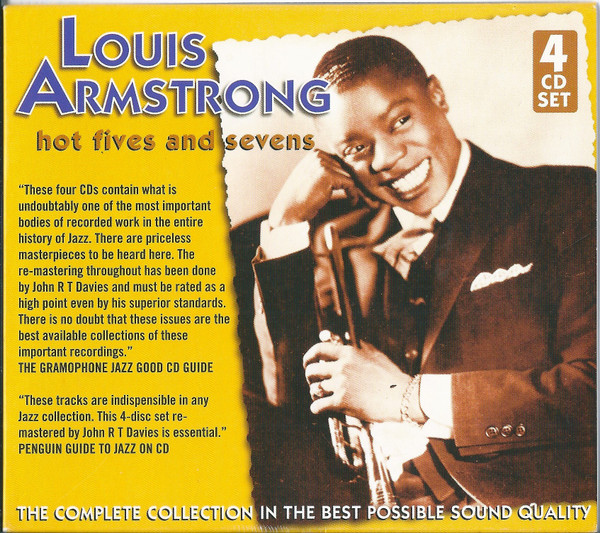
12-Louis Armstrong-Hot Fives And Sevens
“Music is life itself. What would this world be without good music? No matter what kind it is.”
-Louis Armstrong
“If you have to ask what jazz is, you’ll never know.”
-Louis Armstrong
“All music is folk music. I ain’t never heard a horse sing a song.”
-Louis Armstrong
Here jazz as we know it begins. Recorded between 1925 and 1928, the National Recording Registry describes this music by saying:
“Louis Armstrong was jazz’s first great soloist and is among American music’s most important and influential figures. These sessions, his solos in particular, set a standard musicians still strive to equal in their beauty and innovation.”
These were his first recordings as bandleader and you can actually hear him working out ideas about how jazz would be played forever after these moments. He first pushed the idea of soloists within jazz songs here, and of course, he was the very best soloist of all. The solos Armstrong takes here, when you focus on just his playing are remarkably detailed, to the extent that jazz musicians today want to live up to these standards.
For me these songs are just pure fun. Even the titles make me smile. There’s “Big Butter and Egg Man”, “Potato Head Blues”, “Gut Bucket Blues”, “Big Fat Ma and Skinny Pa”, “Struttin’ With Some Barbecue” and “Skid-Dat-De-Dat”. I had the privilege of seeing The Preservation Hall Jazz Orchestra, who play this music, in New Orleans once, and the joy the musicians felt in playing it matched the joy the audience felt in sharing it. This is Louis’s most wonderful contribution to the world.
While Louis was the leader and greatest musician on these recordings, he had some extraordinary bandmates making important contributions of their own. There’s Lil Armstrong, Henry “Red” Allen, Johnny Dodds, Kid Ory, Johnny St. Cyr and on and on.
I’ll leave this with a quote from Doug Ramsey for Jazz Times:
“In the best of these recordings, we witness Armstrong transforming jazz from attractive folk music performed by collectives into art music energized by the creative power of one man’s intuitive ability to make it swing. …Armstrong had established swing at a level of sophistication and subtlety that would not be equaled until Lester Young came along in the middle of the next decade. The rhythmic characteristics of his phrasing, even as early as “Butter and Egg Man,” forecast time conceptions in bebop. He set the direction and ideals for development of the music.”
I would urge anyone who loves music and has never heard these tunes to try a random sample of them on youtube or spotify. I predict you’ll be marvelling at the musicianship and finding yourself smiling, maybe without even realizing it.
For anyone not wishing to shell out for the whole box set, there are all sorts of samplers available. I discovered this music through the Columbia Jazz Masterpieces series, before buying this box set.
13-John Zorn, George Lewis, Bill Frisell-News For Lulu

“If someone is a straight jazzhead, or a straight metalhead, or straight classical, they have a very narrow range of what they allow into their lives. But the people who listen to what we put out into the world have to be open-minded. Because we’re so pluralist.”
-John Zorn
Who said free jazz can’t be fun? This album is a blast, and it’s impossible not to have a big smile on your face about 2 minutes into this album. 3 of the greatest modern jazz musicians get together to play compositions by some of the great hard bop musicians, Kenny Dorham, Hank Mobley, Freddie Redd and Sonny Clark. The interpretations here manage to both be reverential and have fun with the compositions. John Zorn is great as always, but to my mind, the star of the album is George Lewis on trombone.
George Lewis, in addition to being a great trombonist, is a composer, with a number of important large scale jazz compositions to his credit. He was also an early member of The Association for the Advancement of Creative Musicians (AACM), an organization devoted to “nurturing, performing, and recording serious, original music”. It has produced a staggering number of the very greatest of free jazz musicians, including Muhal Richard Abrams, Fred Anderson, Anthony Braxton, Roscoe Mitchell and on and on. It is one of the reasons Chicago is a hub of creative music to this very day.
There is always so much arguing in the press about free jazz vs. the tradition. The News For Lulu albums and a lot of Anthony Braxton’s work make it clear the two visions for jazz can live not just in harmony, but produce music that is that much better for having one foot in each camp.
Check out the sequel More News For Lulu as well. For more George Lewis, check out his great album Homage To Charles Parker. John Zorn and Bill Frisell will show up again momentarily.
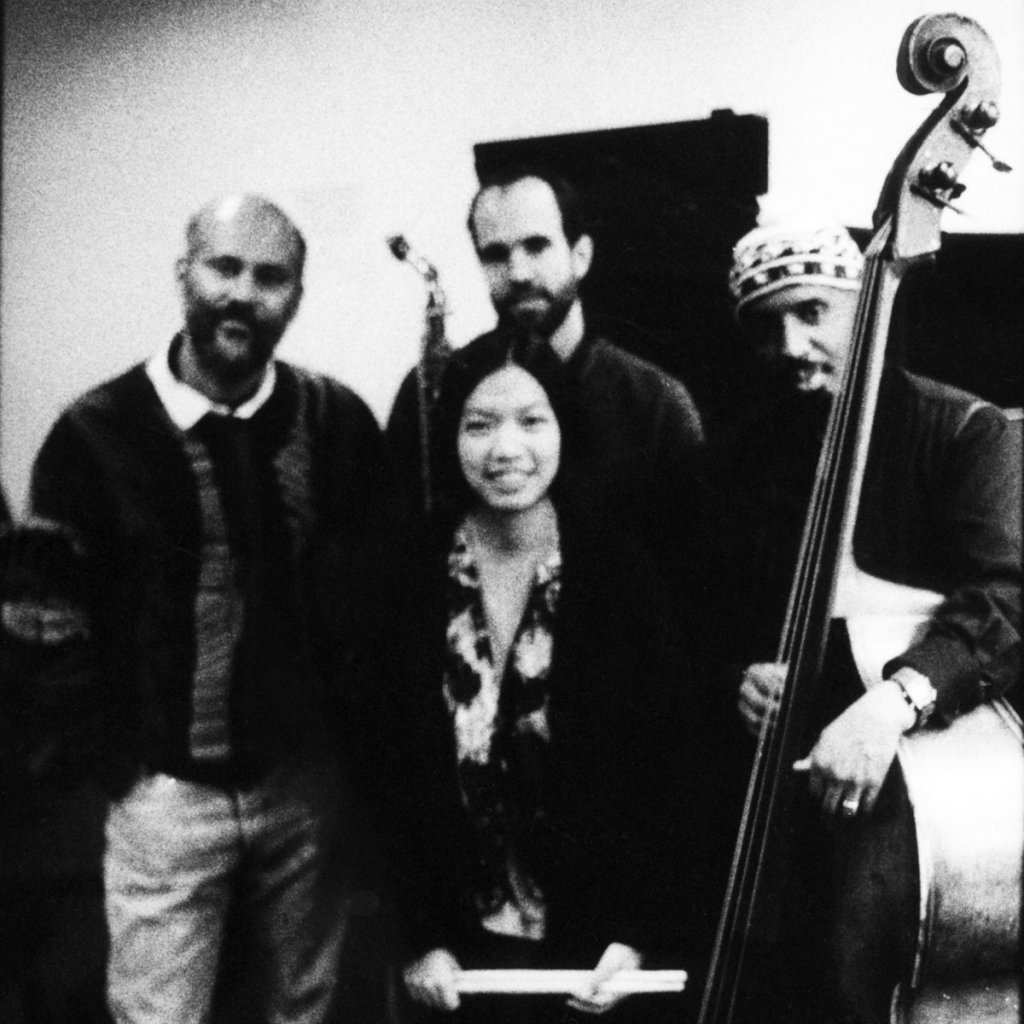
14-William Parker-The Peach Orchard
“Once I found out that music could uplift people and spiritually tap into things and help people get into their optimum self—to better their personalities, better their spirit, better their understanding, better their idea of why we’re here on Earth and why we want to live—that was the musical vision.”
-William Parker
It’s fitting that one of William Parker’s best albums and the one that introduces the In Order To Survive group heard here, Compassion Seizes Bed-Stuy from 1996, has the word “compassion” in the title, since compassion for his fellow humans can be found in every aspect of his music and speech. Further evidence of this can be heard in his recent album Cereal Music which features his poetry set to music. I’ve had the privilege of talking with him a few times, and he actually invited me to dinner at his house the next time I was in his neighbourhood. I have no doubt that if I ever showed up there, he wouldn’t remember me, but he’d happily feed me.
But of course it’s the music that matters. William Parker is the most important free jazz bassist in the history of the music. He’s worked with Cecil Taylor, Peter Brotzmann, David S. Ware and any number of other great free jazz musicians extensively. (In the interests of fairness, some, especially Europeans, might argue that Peter Kowald is the best. He played on Machine Gun and many other great albums, and will show up momentarily.) Parker’s solo albums are staggering achievements, as are his compositions.
Compassion… introduces a killer quartet with, in addition to Parker, Rob Brown on sax, Susie Ibarra on drums and Cooper Moore on piano. The band plays Parker’s angular, beautiful compositions with great skill and heart. These are 4 superb musicians who are well in tune with Parker’s compositional ideas.
On The Peach Orchard from 1998, we have the same quartet (with Assif Tsahar sitting in on one piece) and it’s evident that these musicians have spent a great deal of time playing together. Indeed The Peach Orchard feels like a culmination of Parker’s work to this point. One of the great things about this double album is the length of the pieces. This allows all four of the musicians to stretch out, but they are always aware that this is Parker’s show and he has the space to show off his skills as a musician and composer over and over on this remarkable album.
For more William Parker, check out any of his solo albums, I like Testimony or the hilariously titled Crumbling In The Shadows Is Fraulein Miller’s Stale Cake. He has a different quartet on O’Neal’s Porch. Another great album. He’s also recorded quite a bit of orchestral free jazz. Check out, for example, For Percy Heath.
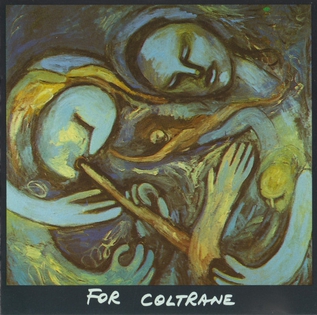
15-Marilyn Crispell-For Coltrane
“I told him, if I were going to improvise this is how I’d do it, and I improvised atonal stuff the way I do now. I said, it’s really crazy, nobody would listen; he said, it’s OK, you can do that, but I went no, no, no. Then later, I heard a Cecil Taylor record and it was – YES, YES, YES! Like a door opening.”
-Marilyn Crispell, describing a conversation with a classmate.
“I was listening to A Love Supreme one night and it changed my life. I decided to get back into music and I had this mystical experience where I felt the presence and guiding of Coltrane’s spirit in the room.”
-Marilyn Crispell, in the liner notes
Utterly beautiful solo piano music from the longtime pianist for Anthony Braxton. She covers 4 Coltrane compositions and adds her own improvised piece Collage For Coltrane. Her version of Trane’s Dear Lord may be the most beautiful piano music I’ve ever heard. She manages to capture the transcendent feeling of the original, but makes it very much her own. If I were making a list of greatest jazz songs, it would be very high on the list. Her take on Trane’s After The Rain is almost as good. One of the pieces attributed to Trane, called Coltrane Time, is her interpretation of some music Trane was experimenting with at the time of his death.
Marilyn Crispell came to prominence in the jazz world as a member of Anthony Braxton’s great quartet. Since then she has continued to make a great name for herself playing all kinds of different music. She can play beautiful piano music as she does here, and on Amaryllis or Nothing Ever Was, Anyway: The Music of Annette Peacock, both on the ECM label. But she can also bring the fire as she does on her album Hyperion with Peter Brotzmann and Hamid Drake, her work with the Parker-Guy-Lytton trio or on the enigmatically named Gryffgryffgryffs, with Mats Gustafsson, Barry Guy and Raymond Strid. She’s also worked extensively in more experimental music as on Santuerio or Stellar Pulsations/Three Composers, both on the Leo label. I had the great luck of seeing her in concert in a duet with Gerry Hemingway, where she showed all sides of her wonderful playing.
16-John Zorn-Naked City
“I’m constantly tortured, and that’s why I say happiness is irrelevant. Happiness is for children and yuppies.”
-John Zorn
“Music is about people for me. It’s not about sounds. It’s about people; it’s about putting people into challenging situations. And for me, challenges are opportunities.”
-John Zorn
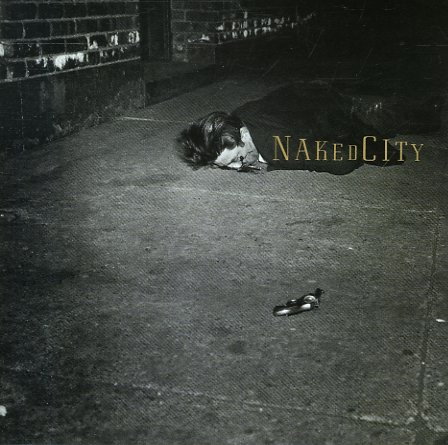
So there’s a saxophonist, in fact one of the very greatest of saxophonists, who’s also into punk and grindcore. His name’s John Zorn, and Naked City is the first of several jazz-as-hardcore-punk albums he produced. If you just came across this in a record store, you’d assume it was a punk album from the gory cover to the song titles (Igneous Ejaculation, Blood Duster, Demon Sanctuary, Fuck the Facts) to the song lengths (there are 4 songs of only 20 seconds or less). Zorn plays his sax like it was an electric guitar, slashing over the rhythm section like Steve Jones playing on Never Mind The Bollocks. There’s also the punk sense of humor on display. There’s a borderline sacrilegeous cover of Ornette’s Lonely Woman, and the James Bond Theme has never been played like this before.
And it’s a crack band. He’s joined by Bill Frisell again, with Fred Frith on bass, Joey Baron on drums, Wayne Horvith on keyboards and Yamatsuka Eye on, well, yelling. To quote critic Christopher Thelen “The resulting noise is sheer joy to those who get it, and sheer madness to those who don’t.” I, for one, get it.
For more John Zorn, it’s hard to know where to begin. He has recorded literally hundreds of albums in every conceivable style. Some of my favourites are Spy vs. Spy, an album of Ornette Coleman covers, and the Masada quartet recordings. He’s also written some fascinating guitar trio music. Check out, for example, Nove Cantici Per Francesco D’Assisi, played by guitarists Bill Frisell, Julian Lage & Gyan Riley. For the crazier end of the spectrum, try his Moonchild project with vocalist Mike Patton. The song Azazel, from the album, The Crucible, is a prime example. It’s utterly deranged (in a good way).
17-Keith Tippett-Mujician I, II & III
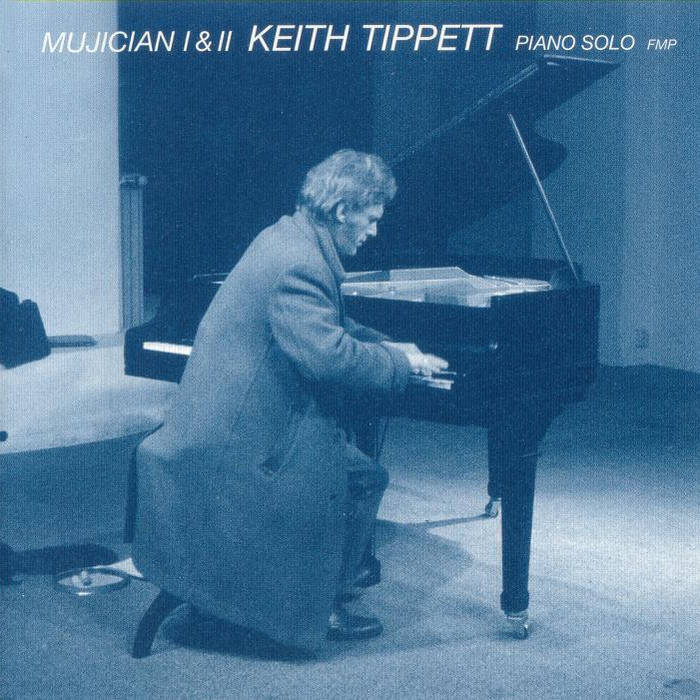
“Keith has often described his own motivation for making improvised music as a desire to “transport people out of chronological time”. Anyone who has seen Keith perform, will have observed the concentrated reverence and space that Keith affords which are both prologue and epilogue to these improvisations: eyes fully closed in respect for any sounds which have yet to arise, or at its close, to dissolve completely – and for other ‘inaudible’ elements that have been summoned during the course of the playing to leave the space in their own time.”
-Matthew Bourne, frequent collaborator of Keith Tippett
Keith Tippett has to be heard to be believed, and even after hearing him, you probably won’t believe this is just one man and a piano. These three solo albums are extraordinary. I’m listening to them while I write this, and I’m enthralled, as if I’m hearing this for the first time, even though that’s very much not the case. He liked to use extended techniques, placing various objects inside the piano, clipping several strings together, etc. But Tippett was adamant that people not spend their time trying to figure out how he made these remarkable sounds, but instead just enjoy the music. I’m letting the music simply wash over me and appreciating its beauty.
These albums were recorded in 1981, 1986 and 1987. But Tippett’s career goes back to 1969 when his first album came out. His ardent fans despair at how little recognition he’s received. One of his early albums was titled Dedicated To You, But You Weren’t Listening. Unfortunately that to a large extent describes his career. But if you know, you know.
Parts I and II were originally two separate albums, but you can now buy them as a single CD from the FMP label. Part III is also called August Air, and is also on FMP. Tippett eventually formed a band, also named Mujician. But he’s best heard solo. Another fine solo album of his is Une Croix Dans L’Océan, on the Victo label. Tippett was also involved in a number of prog rock albums, even playing with King Crimson on several occasions.
18-Fire! with Oren Ambarchi-In The Mouth A Hand
“I just totally fail to find anything enjoyable about this, or to see what this has to do with music as I understand it, or what in God’s name is going on in your head that you want to make such noises on a musical instrument…That this noise could give anyone any aesthetic pleasure is beyond my comprehension, truly.”
-Comic book artist and jazz buff Robert Crumb, after listening to a Mats Gustafsson album.
I think of Mats Gustafsson as very much the heir to Peter Brotzmann, both in terms of playing style and philosophy of music. I had the privilege of seeing them play together (with Ken Vandermark to boot, in the band Sonore), and it was a brilliant show.
Mats has two long-time trios, The Thing with Paal-Nilssen Love and Ingebrigt Håker Flaten, and Fire! with Johan Berthling and Andreas Werlin. He especially likes adding members to the basic Fire! trio. He’s actually extended it to an entire orchestra on several albums.
Here he adds guitarist and electronics wizard, Oren Ambarchi. Ambarchi plays with a number of drone metal bands like Boris, and is a master of feedbacky noise. So he’s a perfect foil for Mats’s searing sax work. Someone hearing the first track at a loud volume might be convinced the aliens were attacking. The Fire! trio, left to their own devices, play some blues-rock influenced soul jazz. Adding Ambarchi produces a band that seems like it could play any kind of music it wants. And what it wants is to bludgeon the listener. This is not for the faint of heart, but very much for lovers of intense sweat-drenched noise.
For more by Mats, check out his album with The Thing called Metal, which has bassist Barry Guy as a guest. But for a real experience, see him live.
FYI, Mats Gustafsson was so proud of the Robert Crumb letter which I quoted above that he put it on the cover of his next album.
19-Cecil Taylor-Silent Tongues
“Cecil Taylor’s life was a string of mysteries that made a beautiful necklace of precious sounds, dances and poetry he called music.”
-William Parker
“The question is simply this: is the secret in the symbol of the note, or is it the feeling that exists before you translate the note into music? Music proceeds from within. The note is merely a rather uninteresting symbol that equates to the sound. But sound is always with us.”
-Cecil Taylor, accepting The Kyoto Prize 2013
As I say above, to appreciate Cecil Taylor, you should start with his work with Jimmy Lyons. But at some point, you should also dive into his solo work which is voluminous and just as extraordinary. He has more than 20 solo albums by my count, and they’re all remarkable in their own way.
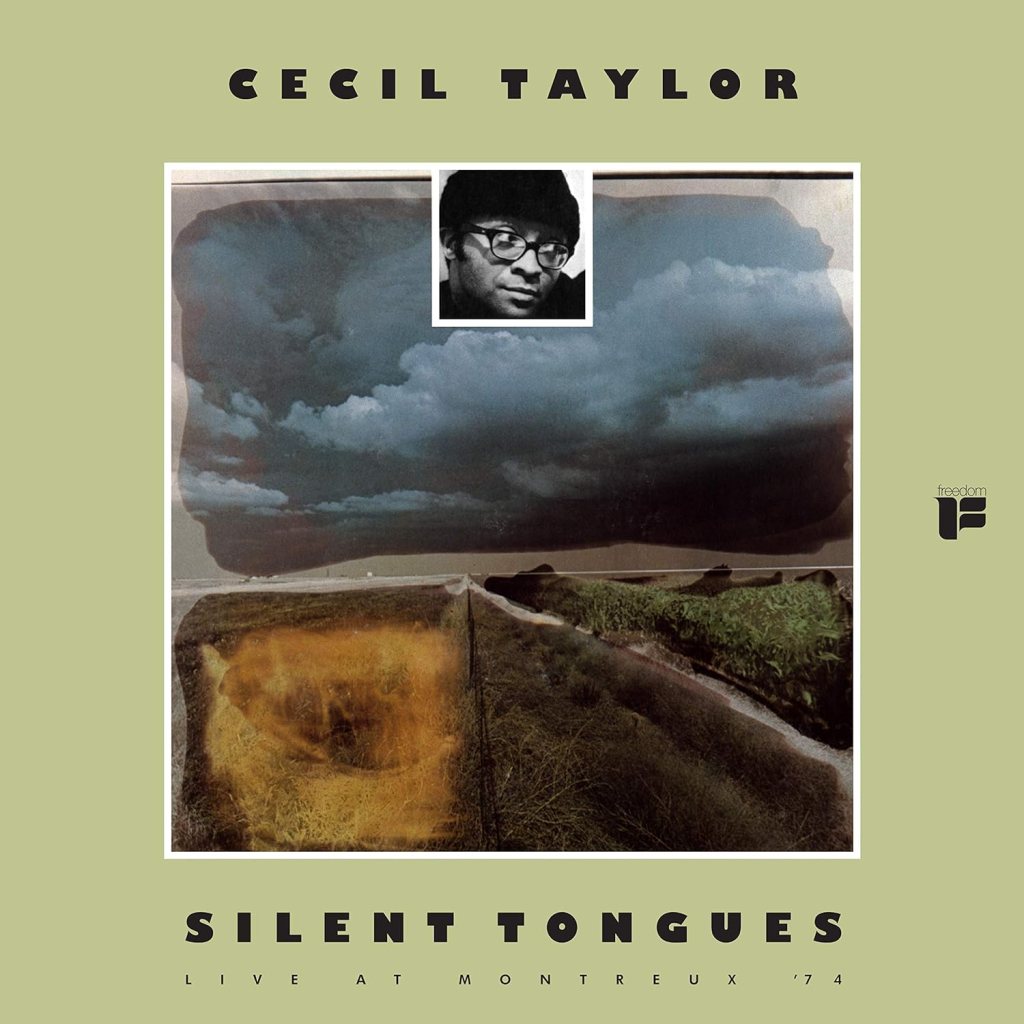
I spent a great deal of time listening to the various solo albums I have (a fun task, that) and settled on Silent Tongues from 1974. Taylor’s style is instantly recognizable in any of his solo albums. He’ll obsessively repeat a simple phrase and modify it slightly over and over, seemingly hunting for the perfect combination of notes. He is almost always playing percussively and relentlessly, and then there will be a brief pause in the torrent of notes which feels like a bit of peace in the storm. And then it’s back to building up to greater and greater intensity. Being a live album, we get to hear the audience reaction and get a small sense of how remarkable this must have been to attend.
One of the things so special about Silent Tongues is that the recording includes two encores. Philip Freeman’s description of them is beautiful:
“Taylor is releasing the audience, saying goodbye to them, and it’s a slow and patient process, like bringing someone out of a trance. It’s one of the most tender moments in his discography, ending with a single final chord that seems to echo in the listener’s mind for minutes after the sound of the cheering crowd has faded away.”
For more Taylor solo, check out Indent (1973), For Olim (1986), Tree Of Life (1991) and The Willisau Concert (2000).
As far as I can tell, The Willisau Concert is his final solo album. (Poschiavo was released later, but recorded earlier.) Here’s a great quote from George Grella about Taylor’s late period music, which I think applies to the Willisau album:
“This is late style; the seemingly effortless organization of material, assembling and reassembling sections of music with a mercurial quickness that belies the weight of the ideas; a transparent and far-seeking sense of structure that at the final moments brings together what might have seemed scattered and accidental into a succinct, coherent and powerful whole, an overall thinning of what were previously dense and massive keyboard structures, revealing the blues and the hard nuggets of rolling boogie-woogie that are at the root of Taylor’s music.”
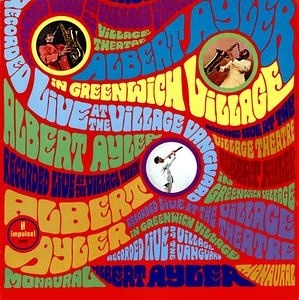
20-Albert Ayler-In Greenwich Village
“[Ayler] was rearticulating the spiritual in a music that, even today, often gets marketed as merely sexy and cool. Ayler asserted with terrifying but tender force that jazz was emphatically not ‘devil’s music’, that the cry of the blues was the same shriek he heard in the sanctified church.”
-Ted Joans
“Smooth, oh so smooth and easy did the music ease from the tenor’s bell, with such tone, with such feeling. The melody was a haunting little ditty, not remarkable technically but moving. But when he began to improvise, this is when I became startled by his music’s style. It was like the wind sometimes, moving fast. At other moments it hovered, and at others it oscillated back and forth with sounds that would strike the earth to its centre, or soar until the penetration of the sound would clear the sky of clouds. The sound was so pure, the disposition of the feeling so obvious, that I was entranced. He, the music, went directly to the feeling. He was speaking from or with his very soul, for himself and for me and for all the other people who wanted to discard certain values and judgements that had been deemed unalterable.”
-Errol Henderson
Albert Ayler’s story is a tragedy, an incredibly gifted musician who never had popular success and suffered from financial difficulties and the mental health issues that went with those difficulties and the lack of recognition. He died far too young, possibly of suicide. That pain is heard in his music. It’s spiritual but emotionally raw in a way that had never been heard before. It can be almost painful to listen to. Nils Edstrom, who met Ayler early in his career, described his music as “a raw blast coming from nothingness via the primeval backwoods and forests”.
Ayler has an unmistakable gospel influence to his playing as evidenced even by his song titles. There’s Spirits, Holy Holy, Saints, Truth Is Marching In, Our Prayer… This gives his music a beautifully yearning quality. Writer Peter Niklas Wilson describes Ayler’s music as “an instrumental speaking in tongues”. Even though the public never embraced him, his fellow musicians certainly did, especially John Coltrane. When Trane knew he was going to die of liver cancer, he requested that Ayler play at his funeral.
Practically every single jazz list-maker has Ayler’s Spiritual Unity on their list, but I much prefer In Greenwich Village. The instrumentation is more interesting, he’s accompanied by 2 basses, a violin, a cello and drums. There’s also a trumpet on 2 of the 4 tracks, played by his brother Donald. The bottom heavy instrumentation complements his playing nicely, which is as fiery as ever. And check out that groovy cover, man.
If interested in further work by Ayler, Spiritual Unity is the obvious choice. Ghosts is another good one. I also recommend the book Holy Ghost: The Life And Death Of Free Jazz Pioneer Albert Ayler, by Richard Koloda.
21-Eric Dolphy-At The Five Spot, Volumes 1 and 2, with Booker Little

“When you hear music, after it’s over, it’s gone in the air. You can never capture it again.”
-Eric Dolphy
“Eric is really gifted and I feel he is going to produce something inspired. We’ve been talking about music for years but I don’t know where he’s going, and I don’t know where I’m going. He’s interested in progress, however, and so am I, so we have quite a bit in common.”
-John Coltrane
A double tragedy on this one. The wonderful sax player Eric Dolphy died in Berlin at age 36, of complications of diabetes. His friend Ted Curson swears it was because the German doctors, knowing the stereotypes of jazz musicians, just assumed he was on heroin and didn’t treat him properly. (For the record, the hospital denied this.) Even worse, the wonderful trumpeter Booker Little died at age 23, of complications of uremia. But in their short time together, they were a force of wonder in the world of jazz.
This 2 volume live set features a great band. In addition to Dolphy and Little, there’s Richard Davis on bass, Mal Waldron on piano and Ed Blackwell on drums. The five of them had been working together for quite a while, and it shows. They just smoke live. These concerts must have been thoroughly amazing to witness. Dolphy’s playing is instantly recognizable, he seems to lurch into the fray and then unwinds a beautiful solo. But all the players are great. I love Blackwell on this, and the sound quality is very good for a live album so you can hear what he’s doing.
There are so many unfortunate “what if?”s in jazz. What if so and so had lived longer? Two of the saddest examples are heard on this album.
For more Dolphy and Little, check out Far Cry, a studio album from earlier in their careers. For still more Dolphy check out his three “out” classics, Out There, Outward Bound and Out To Lunch. Booker LIttle has a great “out” album as leader, Out Front, featuring Dolphy.
I also have to comment that I love this album cover, and I would have loved to be at that show, sitting in the front row.
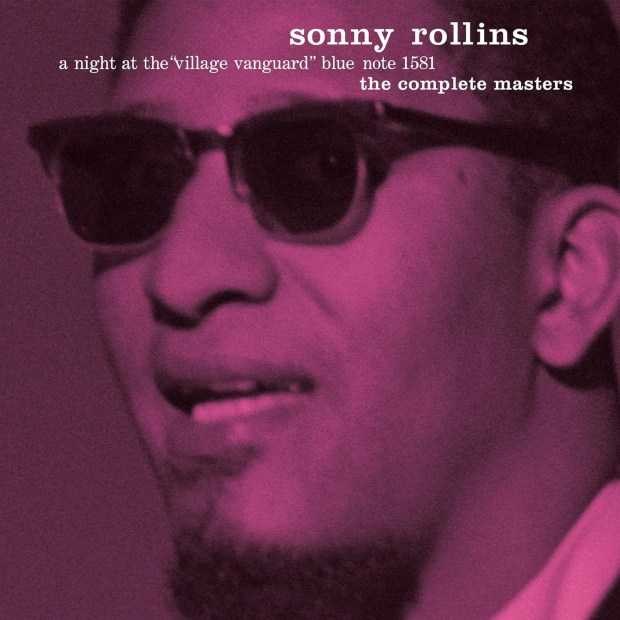
22-Sonny Rollins-The Complete Night At The Village Vanguard
“I’m not supposed to be playing, the music is supposed to be playing me. I’m just supposed to be standing there with the horn, moving my fingers. The music is supposed to be coming through me; that’s when it’s really happening.”
-Sonny Rollins
Sonny Rollins, the saxophone colossus, in a stripped down setting playing standards. It doesn’t get more simple or any better than that. Sonny Rollins was practically jazz royalty as soon as he stepped onto the scene, playing with Monk and Miles as a teenager. He quickly became a leader, releasing Sonny Rollins With The Modern Jazz Quartet at the age of 23 in 1953. That was really a compilation of a number of different recording sessions. But it was followed by Moving Out in 1956, and 1956 would go on to be an extraordinary year of music for Sonny, releasing 6 albums on the Prestige label, including the stone cold classics Tenor Madness (featuring Trane on one piece) and Saxophone Colossus, probably his most famous album. His take on Moritat (Mack The Knife) alone is worth the price of that one, and it also contains his classic calypso track St. Thomas.
But the Village Vanguard recordings are the choice for me. Recording an entire album with such a limited instrumentation was pretty much unheard of. But Rollins had the confidence that he could carry such a session, and he saw it as the perfect setting to show off his great skill. He also wisely chose to play all standards, so that he could show his ability to transform very familiar tunes and make them his own. At times, you can almost hear him thinking “You think you know this tune? Check this out!” He’ll state the main theme of one of these tunes, then jump away from it, and then return to it from a different angle than you could possibly expect. This technique leaves you at the edge of your seat the entire tune, and ultimately the entire album.
Of course he had some great help. He had two different rhythm sections, on set one it was Donald Bailey and Pete LaRoca. In the afternoon it was Wilbur Ware and Elvin Jones. I’m not familiar with Donald Bailey, but he does a great job here. The other 3 are stars and live up to that standard.
Perhaps the most remarkable thing about this great album is that it was all recorded in a single day, November 3, 1957. The idea that Rollins could sustain this much creativity and this much energy over the course of 2 long sets on a single day is a testament to his greatness.
For more Rollins, check out any of the above, but also Way Out West or Newk’s Time.
This album also has the distinction of being the first live album recorded at the Village Vanguard, a venerable institution when it comes to live jazz. You could make a pretty decent greatest albums list consisting entirely of Village Vanguard albums.
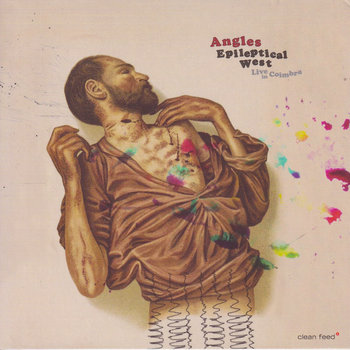
23-Angles-Epileptical West: Live In Coimbra
“Man erkennt langsam das Elend, dass über uns gekommen ist”
-A quote from saxophonist Martin Küchen’s father’s diary, written at the end of the Second World War. It means “the misery that has fallen upon us is slowly being recognised”.
Martin Kuchen’s ongoing project Angles may change in size, ranging from 3 members up to 11. But one constant is the quality of the music, and the strength of the band’s voice. Their music is a howl of rage at the horrors of war and injustice, stated by superb musicians who share the same sense of anger and despair. Stylistically, I’d call this post bop with some African rhythmic elements thrown in rather than free jazz (I saw the term “free bop” used once), but none of that matters as much as the message. The album previous to this one, Every Woman Is A Tree, is dedicated to the women of Iraq and song titles Peace Is Not For Us, My World Of Mines and The Indispensable Warlords reflect what the band was feeling, and their anger at the complacency of most everyone else is reflected in the title Let’s Talk About The Weather And Not About The War.
The followup is this live album, and this music is best heard live. It’s made by a sextet of brilliant Scandinavian musicians who are united in their voice, and determined to make their voice heard. The live setting suits the music beautifully. Kuchen is a brilliant saxophonist (check out his solo album Hellstorm), and I especially love vibraphonist Mattias Stahl here. It’s thrillingly daring music which never lets you forget it’s also making a statement. The world needs strong voices like that of Kuchen and his bandmates here now more than ever.
This is one of many albums I discovered because of the wonderful website, The Free Jazz Collective. I’ll let the founder of the website, Stef Gijsells, have the final word on this great album:
“To my great joy, they also play the title song of their previous album, an absolutely stunning, stirring, rousing composition, again a gloriously expansive piece, that is both sad and joyful, angry and inviting, full of powerful soloing.”
For more music by these musicians in various combinations, check out the bands Atomic or IPA. Kuchen has another band The Trespass Trio, which is equally brilliant. Mattias Stahl has a masterpiece of an album called North And The Red Stream, recorded with Red Trio. There’s a new Angles album, just released on July 30, 2025 called Tell Them It’s The Sound Of Freedom, a relevant message if ever I’ve heard one.
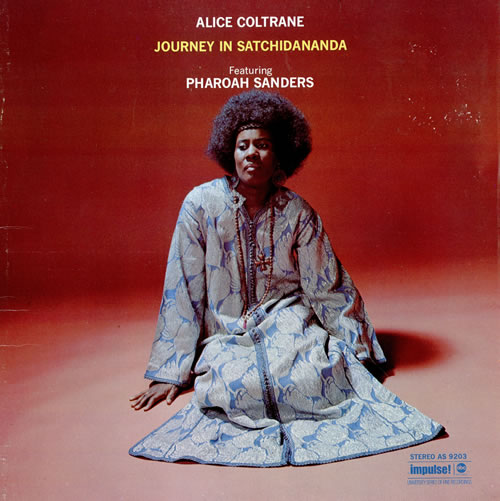
24-Alice Coltrane-Journey In Satchidananda, featuring Pharoah Sanders
“The music is within your heart, your soul, your spirit, and this is all I did when I sat at piano. I just go within.”
-Alice Coltrane
Alice Coltrane has the misfortune of primarily being known as John Coltrane’s wife, which ignores how wonderful and important a musician she was in her own right. She had her first major break when she replaced McCoy Tyner in Coltrane’s band as Trane was looking for a more radical approach to music that captured his increasing interest in spirituality. After John passed away, she saw herself as taking over for him in creating a spiritual form of jazz which she felt could heal the sick world. A compilation released after her death was called World Spiritual Classics: Volume I: The Ecstatic Music of Alice Coltrane Turiyasangitananda. “Ecstatic” is the perfect word for this music.
Much of her music was made with the great saxophonist Pharoah Sanders who was very much a partner in the creation of spiritual music. Their most famous work together was on Alice’s album Journey In Satchidananda, an absolute masterpiece. Alice plays piano and harp, and extends John’s ideas about spiritual music both with her playing and the instrumentation. Pharoah was the perfect choice for her accompanist. I like Sydnee Monday of NPR’s quote:
“Almost 50 years after Journey In Satchidananda was released, the album remains a vision of universal healing, spiritual self-preservation in times of trouble and the god that appears when you seek her out.”
And I think that describes all of Alice’s music just as well.
A good way to introduce yourself to Alice’s work is to check out The Impulse! Story, a compilation from all her albums on the Impulse! label, including Journey… For more Pharoah Sanders, check out his great album Karma.
25-Peter Kowald-Was Da Ist
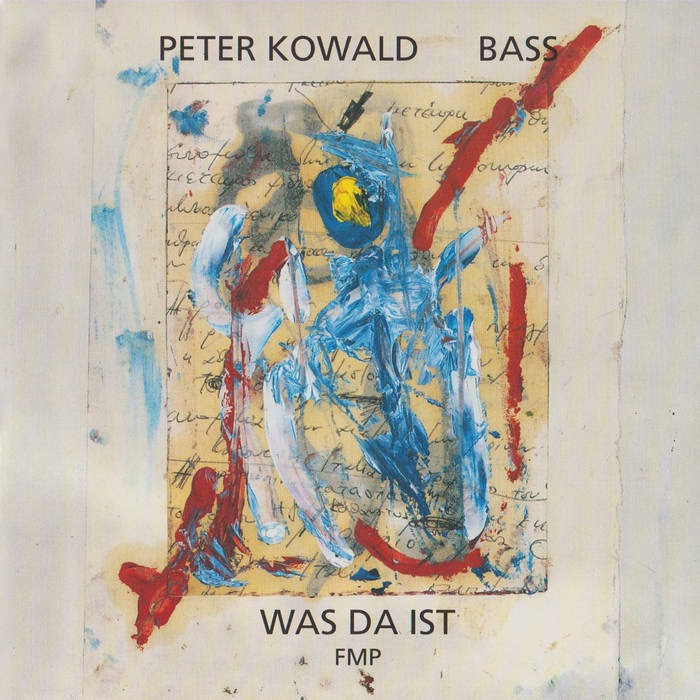
“When I was 17, I met Peter Brotzmann, who was 20 then. Everybody was telling me “why don’t you play with this guy, he can’t play the saxophone.” We played together for about 4 or 5 years in this little club in Wuppertal where nobody wanted to hear us because the music was so strange. So we played in this place every Tuesday and Friday and no one showed up for a year and a half, and then one person came to listen to us.”
-Peter Kowald
Yup, it’s a solo bass album. One of my more obscure collecting obsessions is solo bass albums. I have no idea how many I have, but it’s in the dozens, surely. This is the very best.
It’s not really fair to talk about American free jazz vs European free jazz, as if it were a contest. But there is a distinct European branch of the music, and Peter Kowald was its greatest bassist. He was the go-to guy, and he played on so many of the major albums that his bass style came to be the standard. He played on Machine Gun, was in multiple iterations of the Globe Unity Orchestra, played with the finest musicians on both sides of the Atlantic: Irene Schweizer, Barre Phillips, Joelle Leandre, Manfred Schoof, Hamid Drake, Fred Anderson, William Parker and on and on and on. One of the musical ideas he pioneered was the bass duet, and he recorded them with essentially every important free jazz bassist.
But it’s this solo album that is his crowning achievement. Kowald can make more music using just a bass, a pedal and his voice than some orchestras. He can sound like an incoming storm or a wild animal attack and turn around and play something quietly beautiful in the next instant. He can sound bluesy or like some contemporary classical piece. He can basically play anything his imagination can think of. And his imagination seems endless on this album.
For more Kowald, there’s a live version of Was Da Ist. He made a wonderful album with Conrad Bauer and Gunter Sommer called Between Heaven And Earth.
For a wonderful tribute to Peter Kowald, check out the 2 CD set: Never Too Late, But Always Too Early from Peter Brotzmann, Hamid Drake and William Parker.
26-Dave Holland-Conference Of The Birds
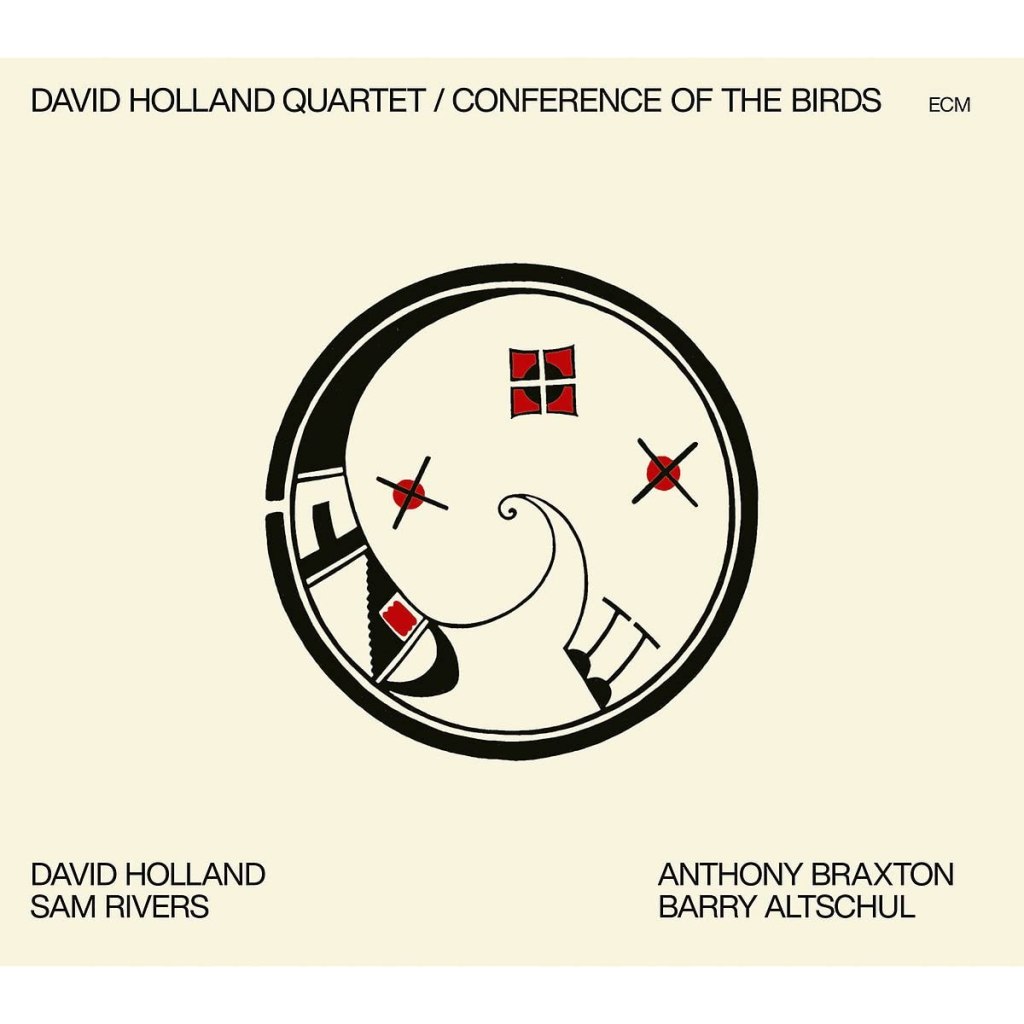
“In fact, jazz has such a great feeling and great emotional content that it really doesn’t require you to have technical understanding of it. I think you just have to allow your feelings to go with the music and you will find yourself carried along by it fairly quickly.”
-Dave Holland
I think if I had to pick a favorite jazz song, I might pick Four Winds from Dave Holland’s Conference Of The Birds. Its bouncy rhythms and hummable melody make me feel like I’m sailing on the open seas. (Of course in real life I wouldn’t be caught dead sailing the open seas.)
Dave Holland is one of jazz’s great bassists, and he can play pretty much any kind of jazz, from the most far-out avant-garde to more popular mainstream stuff, and he excels at all of it. For this album as leader, he managed to sign up two of the very best saxophonists on the planet in Anthony Braxton and Sam Rivers.
Sam Rivers was one of the greatest saxophonists recording with Blue Note in the 60s, and there were certainly many of those. His albums during that period are a clear bridge between the hard bop style of, say, Horace Silver and the “new stuff” that would eventually clarify into free jazz. His 4 Blue Note albums between 1964 and 1967 are great indicators of where the music was going. Especially check out Contours. He later was one of the founders of the “loft scene”, discussed for example in the film Fire Music. Free jazz musicians were trying to build a community of like-minded musicians to help them survive in a world where their music wasn’t catching on with the general public. Sam will show up again on this list.
For a band like this with such great soloists, the drummer is basically what keeps things on track, and there is no better drummer than Barry Altschul. He’s one of the all-time great free jazz and hard bop drummers, having been constantly at the centre of exciting music since the 60s, where he was making great music with Paul Bley and Chick Corea. He then went on to play with Braxton in several of his great groups. He’s been going strong ever since. This year (2025), he led multiple bands at the Big Ears Music Festival.
Rivers and Braxton are clearly having a blast here. It would have been fun to be in the studio for the recording of this one. Sam and Anthony sound great together, complementing each other’s styles beautifully. Even if you find free jazz to be a bit much sometimes, I highly recommend giving Four Winds a listen, it’s on youtube.
Holland has a great solo bass album called Emerald Tears, and for a fine bit of mainstream jazz, check out his quintet album, Prime Directive.
I also highly recommend tracking down the film Fire Music, with lots of footage of a bunch of musicians on this list and a discussion of the loft scene.
27-Derek Bailey, Evan Parker & Han Bennink-Topography Of The Lungs
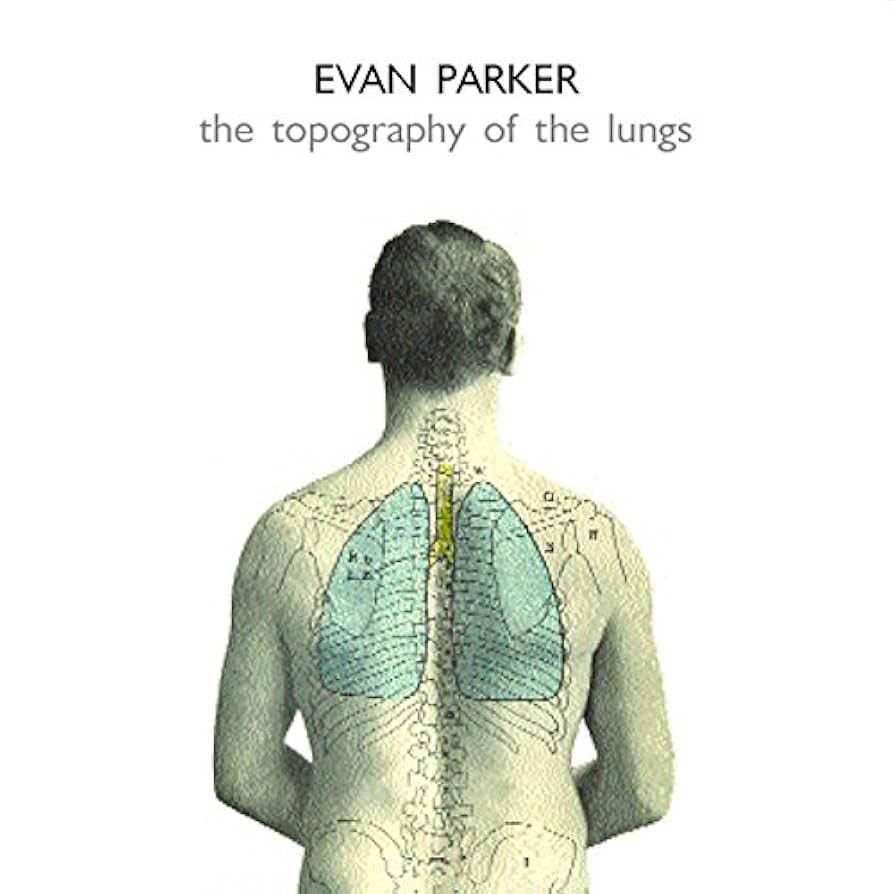
“The guitar is a divining rod. Use it to find spirits in the other world and bring them over.”
-Captain Beefheart
Derek Bailey is one of the most important musicians in the history of free jazz. He was especially instrumental in the European scene, where he played on many of the great early albums, including recording multiple albums with Brotzmann. He was a cofounder of Spontaneous Music Ensemble and Company. He was great at inventing extended techniques to make noise and atonal music that sounded nothing like any jazz guitar playing before him.
Evan Parker, who is showing up for the third time already on this list, provides his usual extraordinary sax playing here, and Han Bennink, the Dutch percussionist, is up to his usual antics.
It’s a bit of a mistake to call Han Bennink a drummer since he will whack anything within reach with his drumsticks, a folding chair, a cardboard box, the floor, his own head. He also likes to make various howling noises and birdcalls at random moments. (I’m proud to say he actually threw a drumstick at me once (as a joke), which I still have.) But for all the fun he has onstage, he is also a great free jazz percussionist and his propulsive style of drumming is always designed to push his fellow musicians to their limits. He played drums on Brotzmann’s Machine Gun, he recorded a duo album with Cecil Taylor, and played on any number of the most important free jazz albums.
I find the idea of collective improvisation fascinating live as you hear a group of musicians who are simultaneously making their own musical statements and reacting to the statements of their colleagues. This album is one of the finest examples.
Recorded just 2 years after Brotzmann’s Machine Gun, Topography Of The Lungs is one of the most important early documents of free jazz, and everything that came afterwards is indebted to this album for so many of the basic ideas of improvised music. And it’s just a damn intense but fun piece of music to listen to for the appropriately open-minded listener.
For more Derek Bailey, check out Yankees, with John Zorn and George Lewis or Dart Drug, his duo album with Jamie Muir of King Crimson fame, his solo album Ballads or his duets with Anthony Braxton, especially First Duo Concert. For Han Bennink, definitely check out his work with Clusone Trio, Soft Lights and Sweet Music: Clusone Trio Plays the Music of Irving Berlin. Han and Derek play together in a duo album simply titled Derek Bailey & Han Bennink, which is available on bandcamp. There is a live 4CD box set of this trio called Topographie Parisienne, which is amazing.
28-Wayne Shorter-Juju

“Jazz shouldn’t have any mandates. Jazz is not supposed to be something that’s required to sound like jazz. For me, the word ‘jazz’ means, ‘I dare you.'”
-Wayne Shorter
“Go out on the stage as a human being and do not be afraid to show struggle in your music. It’s a struggle in life and then struggle and then victory.”
-Wayne Shorter
Art Blakey And The Jazz Messengers was one of the most venerable institutions in jazz, in business for more than 35 years. They produced a number of fantastic albums, including several songs that have since become jazz standards. The other thing the band is famous for is being a starting point for many future great jazz musicians. Wikipedia lists 70 musicians who were part of the band at one point or another. None were more important to the future of jazz than Wayne Shorter. He was one of the Messengers, from 1959 to 1963, eventually serving as their musical director and primary songwriter. His illustrious career continued when he joined the Miles Davis Quintet in 1964. This band became known as the second great quintet, which also included Herbie Hancock, Ron Carter and Tony Williams. One of Miles’s many skills was spotting talent. Shorter stayed with Miles through the recording of Bitches Brew. He eventually went on to form Weather Report, the greatest jazz fusion band.
Beginning in 1964, he recorded a brilliant series of albums for the Blue Note label under his own name. These albums are remarkable for their uniform excellence. The best of the bunch is JuJu from 1965. He was backed by Elvin Jones, Reggie Workman and McCoy Tyner. All three worked with Coltrane extensively, with Jones and Tyner being part of the classic Trane quartet. They are the perfect accompanists for Shorter here. This album is distinguished both in terms of Shorter’s playing, he has an incredibly rich sound to his tenor sax, and his compositions. He always seems to find the right balance between thorny and melodic.
For more Shorter, all of his 60s Blue Note albums are excellent. I think most people prefer Speak No Evil to JuJu, but I prefer this one. As fine a trumpeter as Freddie Hubbard is, I think Speak No Evil is cluttered by his presence. JuJu is just Shorter and a rhythm section, and that is as it should be. I’m not a big fan of Weather Report, but Heavy Weather is pretty much universally regarded as their masterpiece.
I had the great privilege of seeing Wayne Shorter perform live in 2013. Even at the age of 79, he was an extraordinary musician.
29-Charles Mingus-The Black Saint And The Sinner Lady
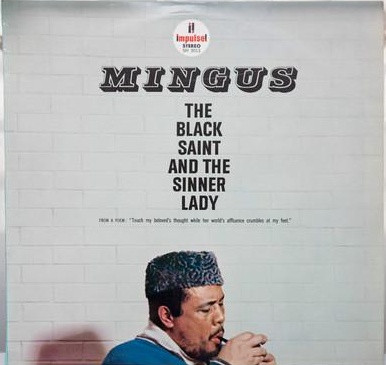
“Creativity is more than just being different. Anybody can play weird– that’s easy. What’s hard is to be as simple as Bach. Making the simple complicated is commonplace–making the complicated simple, awesomely simple–that’s creativity.”
-Charles Mingus
“Yeah, I pledge allegiance, to the United States of America… I pledge an allegiance to see that someday they will live up to their promises, to the victims that they call citizens…”
-Charles Mingus
Bassist, pianist, composer, bandleader, hellraiser, Charles Mingus was many things, some of which were contradictory. But he was unquestionably one of the greatest creators of music in the history of the genre. He could also play all kinds of jazz, from bop to free jazz, he played with Duke Ellington, Charlie Parker, Miles Davis and Eric Dolphy. He did it all, and nowhere better than on this album. I like the term “progressive big band music” for what Mingus is doing here.
The jazz big bands were originally swing bands. Think Glenn Miller or Count Basie. But the modernists, like Mingus or Gil Evans, wanted to keep the big band instrumentation but bring more modern ideas of jazz into play. This is by far the finest example of such music. I’m listening to it now and I have to occasionally remind myself what I’m listening to as I sometimes feel I’m listening to some old-fashioned swing music and others some of the most “out” jazz of the 60s. I absolutely love the trombone here, played by Quentin Jackson. The album is a masterpiece of big band composition as it flows smoothly from one musical idea to another, one style to another, always leaving plenty of space for his great musicians to show their skills.
It seems to me an extraordinarily difficult endeavour, what Mingus is doing here. I can’t imagine anyone else creating this remarkable synthesis of so many different types of music and making it so beautiful.
For more Mingus, check out Pithecanthropus Erectus or Let My Children Hear Music or Mingus Ah Um (hooray, a Latin reference!). Another masterpiece is the live album Town Hall Concert, featuring Eric Dolphy.
30-The Amazing Bud Powell, Volumes 1 & 2
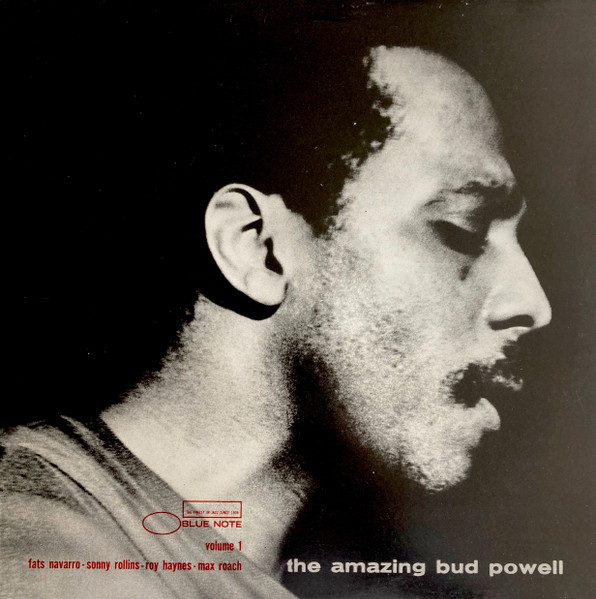
“If I had to choose a single musician according to his artistic merit and the originality of his creation, but also for the greatness of his work, it would be Bud Powell. Nobody could measure up to him.”
-Bill Evans
“He was the foundation out of which stemmed the whole edifice of modern jazz piano; every jazz pianist since Bud either came through him or is deliberately attempting to get away from playing like him.”
-Herbie Hancock
Note before I start: If you are going to buy either of these albums, be sure to get the Rudy Van Gelder remastered versions. The sound is much better and there are a bunch of alternate takes as well. This is true for Blue Note albums in general. If there is an RVG remaster, get it.
“Amazing” is right. One of the founding fathers of bebop and a genuine virtuoso on the piano, these 2 albums give a superb overview of his great skill. Covering 3 sessions between 1949 and 1953, all of his most famous compositions are here, Un Poco Loco, Bouncing With Bud, Glass Enclosure, Dance Of The Infidels, and Parisian Thoroughfare. They also feature some terrific covers of other great bebop songs. There’s 52nd Street Theme by Monk, A Night in Tunisia by Dizzy Gillespie and Ornithology by Charlie Parker and Benny Harris. And completely out of the blue, there’s a beautiful solo cover of Somewhere Over The Rainbow, a song I had not been expecting.
His sidemen are also the very best. On the first session, he has Fats Navarro on trumpet and Sonny Rollins on sax with Tommy Potter and Roy Haynes as the rhythm section. It goes without saying that Navarro and Rollins are superb, they were made for material like this. The other two sessions are piano trios (piano, drums, bass) with Max Roach and Curly Russell on the first and Art Taylor and George Duvivier on the second.
But the star is Powell and he deserves all the attention on these recordings. He uses some of the stop and start timekeeping of Monk, but I also hear a lot of classical music in his playing, especially on Glass Enclosure, but also on Parisian Thoroughfare and elsewhere. His playing would go on to be incredibly influential on how piano was used in bebop and beyond. He has remained that influential with jazz pianists to this day.
While his life was negatively influenced by mental health and substance use issues due at least in part to being severely beaten by railroad police in NYC, his music is infectiously joyful. Powell’s influence was so important that he was invited to be part of “The Quintet”, the 5 founders of bebop playing together one time only at Massey Hall. He joined Max Roach on drums, Charles Mingus on bass, Bird on sax and Diz on trumpet. The album is called Jazz At Massey Hall. His album Bud!, later renamed The Amazing Bud Powell Volume 3, is also well worth tracking down.
31-Barry Guy’s Orchestral Music:
New Orchestra-Inscape Tableaux
London Jazz Composers’ Orchestra-Ode
“Barry Guy’s piece has many different musical styles colliding into each other—scratchy dissonance bumping into gorgeous early music sound world. There’s no time to think about what’s going to happen next, it just happens. And because of this, it’s very challenging. You have to fall right into it.”
-John Sherba, Kronos Quartet, who commissioned Guy to write for them
Barry Guy is a wonderful bassist, composer and conductor, who has produced an enormous amount of great music in a number of different formats, from solo bass albums all the way up to orchestral work where he created and composed for The London Jazz Composers’ Orchestra. In particular, for LJCO, he wrote and recorded Ode, an orchestral piece written for 21 musicians, recorded in 1972. One sign of the respect that Guy receives is the staggering number of the very finest of Europe’s free jazz musicians that appeared on that recording. You’ll find Paul Rutherford, Trevor Watts, Evan Parker, Howard Riley, Derek Bailey, Paul Lytton and Tony Oxley among many others. Thom Jurek wrote of this music:
“…the result is a stunning array of questions, colors, shapes, timbres, textures, and moods. For Guy to score such an intricate tome, opening up the orchestra is an artistic feat; for it to sound so approachable and welcoming to non-musicians, or those approaching the music tentatively or enthusiastically, Ode is a kind of miracle.”
It’s a genuinely overwhelming piece of music, it feels like the jazz version of some of the monumental orchestral classical pieces. It also covers a great many types of music, at times the full orchestra is blaring away, but then it will switch to a much smaller group of musicians making quiet, serene sounds. Parts seem to have much room for improvisation and parts seem tightly composed.
More recently, Guy produced Inscape-Tableaux from his New Orchestra, in 2001. Again, he is surrounded by the very finest free jazz musicians, albeit a smaller group this time. There’s Marilyn Crispell, Evan Parker, Mats Gustafsson, Hans Koch, Johannes Bauer, Herb Robertson, Per Ake Holmlander, Paul Lytton and Raymond Strid. Much of the praise that critics issued to Ode applies here just as well. There are dense areas of intense sound and quieter more quiet introspective sections as well. There’s space for improvisation and heavily composed sections, and the entire piece is a delight to listen to, especially Crispell’s piano playing which is superb.
For more, check out Amphi-Radio Rondo, also by the New Orchestra, although the line-up is somewhat different. Still more orchestral work is found in The Blue Shroud, Guy’s homage to Picasso’s Guernica.
For still more Barry Guy, check out the Parker-Guy-Lytton Trio. They were crucial in the development of European free jazz, have been playing together for decades, and have many fantastic albums. Go for Atlanta or Imaginary Values first. He also has a number of solo albums, try Fizzles as a starting point.
32-Eve Risser, Benjamin Duboc & Edward Perraud-En Corps
“I have rarely listened to an album that manages to restrict its use of notes to a minimum, while at the same time creating a huge boiling mass of acoustic sound that engulfs you from the very beginning, carries you along and drops you off exhausted at the end.”
-Stef Gijssels, The Free Jazz Collective
Probably the most enduring configuration in jazz is the piano trio, with piano, upright bass and drums. Early examples of piano trios were bands led by Bud Powell, Teddy Wilson and Duke Ellington. (Ellington would record a piano trio album with Max Roach and Charles Mingus called Money Jungle, which is well worth checking out.) A bit later there were albums by Oscar Peterson, Ahmad Jamal and many others. Bill Evans’s Village Vanguard albums might be the most famous piano trio albums of all. More recently, EST, led by Esbjörn Svensson, and The Bad Plus have produced popular piano trio albums. (The Bad Plus are a lot of fun, they do covers of Blondie and Nirvana on their album These Are The Vistas).
To give you an idea of how wide a variety of music the piano trio can create, listen to a few of the above and then listen to En Corps, made by Eve Risser on piano, Benjamin Duboc on bass and Edward Perraud on drums. En Corps is one of the finest albums of this century from an artist, Risser, whom I had never heard of prior to the release of this album. The music is on one hand very intense with Risser playing with a Cecil Taylorish, percussionistic (I realize those probably aren’t words) style, but the effect is almost drone-like, inducing the reader into a trance state.
My favorite jazz website, The Free Jazz Collective, hosted an extended discussion on why this album was so great (an opinion that was not unanimous) and Stef Gijssels, the site’s creator, used the phrase “incredible exuberance of pulse and hypnotic repetition” which captures the brilliance of this music beautifully. Duboc and Perraud are terrific on this album and move past the standard roles of bass and drums in a piano trio. Duboc in particular keeps up with the theme of a monolithic drone which still manages to propel the music forward.
For more by these artists, Risser has a solo album called Des Pas Sur La Neige as well as several large group efforts. One excellent example is Les Deux Versants Se Regardent. Duboc and Perraud can be heard on many albums, an especially good one is Abdelhaï Bennani Trio: There Starts The Future.
Eve performed at the 2025 Ottawa Jazz Festival in a duo with John Hollenbeck, and it was the best show of the festival.
I suspect even some free jazz buffs might not know about this one, and I would urge you to check it out.
This seems like a good moment to thank The Free Jazz Collective and especially its creator Stef Gijssels, they’ve been a huge influence on my musical tastes. I discovered Eve Risser, Angles and a bunch more albums further down this list because of that website. They’ve been a force for good in bringing this wonderful music to the attention of so many listeners.
33-Archie Shepp-Fire Music
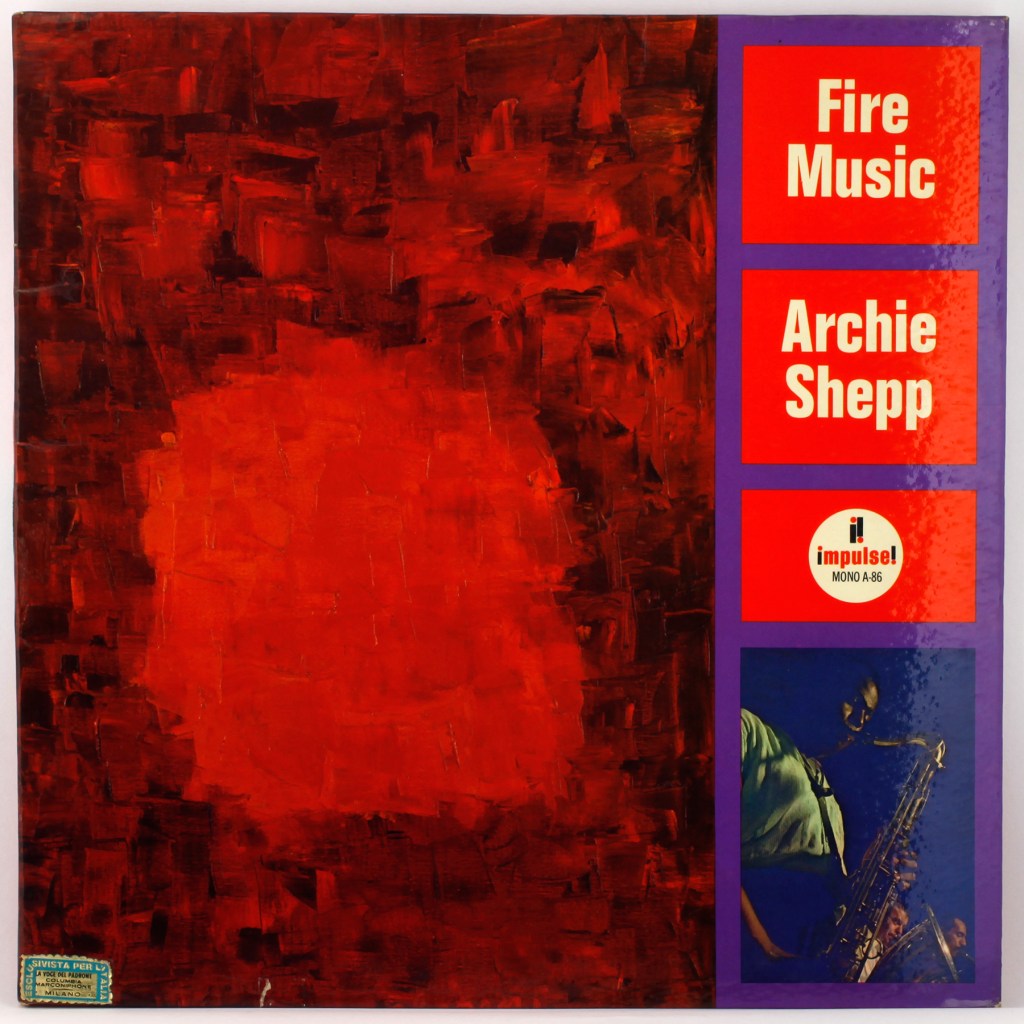
“So, I was just a young guy, maybe with an idea, and Cecil Taylor, himself a rebel, would take a chance on a guy like me. It turned out to be a very symbiotic partnership. I learned a lot from him…it was a complete transformation of musical identities. All the tenets that I had grown up with were thrown out the window.”
-Archie Shepp
Fire Music might be the most aptly titled album ever. Archie Shepp’s intent here was to bring the fire, playing the most intense sort of free jazz, surrounded by like-minded musicians, especially Ted Curson and the badly under-appreciated Marion Brown. But he was also making a fiery political statement. He saw his music as a chance to speak out loudly against the gross injustices of 1960s America, with titles like Malcolm, Malcolm – Semper Malcolm, and Los Olvidados, named after a Luis Bunuel movie about disenfranchised youth in Mexico City and the poverty and despair they face. On his equally brilliant album Four For Trane, he has a song called Rufus (Swung His Face At Last To The Wind, Then His Neck Snapped).
It’s instructive to compare Shepp’s work with Trane’s. Shepp is very clearly indebted to Trane both on a personal level, Trane helped him get a contract with the Impulse! label and Shepp played on Trane’s masterpiece Ascension, but also musically. At the same time, he was determined to create his own style. Shepp’s playing and compositions are more bluesy and the lack of piano also gives him a distinctive sound. He’s also clearly taken a cue from Albert Ayler in using ideas from gospel.
Archie Shepp made many fantastic albums on the Impulse! label. Check out Four For Trane (where he covers 4 Coltrane tunes and has the previously mentioned song Rufus…), Live In San Francisco, Mama Too Tight or The Magic Of Juju for some more great music. I spent a long time debating whether to put Fire Music or Four For Trane on this list. Also be sure to check out Marion Brown’s Three For Shepp, a clear tribute both to the Shepp album and to Shepp himself.
34-Gerry Mulligan-Mulligan Meets Monk

“People talk about innovations and evolutions and that kind of thing; I don’t understand about that nonsense. It’s like, all instruments are there to use all the time.”
-Gerry Mulligan
The album Birth Of The Cool was one of the most important landmarks in the history of jazz. It pointed out a way forward for the music other than bebop. Cool jazz was laid back and slower in tempo than bebop. It was an attitude as well as a musical style, and was no doubt in response to the extreme speeds at which bebop would be played. Birth Of The Cool is considered a Miles Davis album. But Gerry Mulligan deserves at least as much credit, and said in an interview after Miles’s death that he should have been listed at least as a cowriter on most of the songs on the album. Certainly in the subsequent development of cool jazz, Mulligan was at the forefront. And just because the music was more moderately tempoed than bebop doesn’t mean it was easier to play, especially on a cumbersome instrument like the baritone saxophone. Mulligan was its great master.
It’s interesting how many of Mulligan’s albums have titles like Mulligan meets ___ or Gerry Mulligan and ___. He’s played with all of the great artists of the cool jazz world, Chet Baker, Lee Konitz, Paul Desmond, Stan Getz. But he could play with anyone. One of his classic albums was with old school superstar Ben Webster. And then there was Monk. What genre of jazz would you put Monk in? He’s in a genre called Monk, and his meeting with Mulligan is a classic. Mulligan manages to play Monk’s compositions on his huge horn with the greatest of ease. Even better is Monk’s playing on the Mulligan tune Decidedly. These are two brilliant musicians who realized they had lots to say to each other and the result of this dialogue is this great album.
I knew I wanted to put Gerry Mulligan in this slot, but which album? I was originally planning on putting The Best Of The Gerry Mulligan, Chet Baker Quartet on the list. There are 2 distinct albums that were originally called The Gerry Mulligan & Paul Desmond Quartet. One was renamed Blues In Time, the other was renamed Two Of A Mind. All of these are great albums but there is really nothing like Mulligan playing Monk or Monk playing Mulligan.
35-The Evan Parker Sax Duos:
Anthony Braxton & Evan Parker: Duo (London) 1993
Steve Lacy & Evan Parker: Chirps
“I wanted to be a pianist but it just wasn’t my thing. I guess I wanted to stand up rather than sit down.”
-Steve Lacy
Imagine you had the opportunity to listen to a conversation between two of the people you most admire, and they were just talking about whatever. Maybe they’d get a bit heated about some topic and then laugh at another. I feel like these saxophone duets are like listening in on some great conversations, involving 3 of my favorite musicians.
I’ve written already about Parker and Braxton. Steve Lacy single-handedly revived interest in the soprano saxophone, after it had been mostly ignored by bebop musicians. Lacy first became interested in free jazz after playing on Cecil Taylor’s great first album, Jazz Advance. He quickly became one of its most ardent ambassadors. Probably Lacy’s most famous work is in interpreting Monk tunes. There’s nothing quite like listening to Lacy playing Monk solo on his soprano sax. He’s recorded album after album of Monk tunes, and they’re all fantastic. He is brilliant at finding the best balance between composition and free improvisation on virtually every album he’s recorded. Every solo album of his I’ve heard is brilliant, and as beautiful as his Monk albums are, my favorite is Clinkers, consisting entirely of his own compositions. I had the privilege of watching Evan Parker perform one of these songs on soprano sax as a tribute to his friend Steve Lacy. And it should never be forgotten that it was Lacy’s playing that convinced Coltrane to pick up a soprano sax. My Favorite Things was the result of that decision.
Chirps begins with a fairly standard sounding call and response structure, but the two quickly diverge to explore different ideas, occasionally returning to check in with each other. All the while, the two musicians are demonstrating supreme command of their soprano saxes. It’s easy to imagine this sort of duet setting turning into a contest, but that doesn’t happen at all on either record.
The album with Braxton begins quite differently with each granting the other space to develop a beautiful new idea and then the other will respond to it. I find the playing on this one more fiery, with each feeding off the other’s extraordinary playing. Much as I love Braxton’s compositions, I think it’s best to hear him when he’s improvising freely, and he couldn’t possibly have a better companion than he has here.
I find both of these albums fascinating and endlessly listenable. For more music along the same lines, check out Anthony Braxton, Evan Parker and Paul Rutherford Trio (London) 1993. where Paul Rutherford’s trombone is added to the conversation. Steve Lacy will be along again soon.
36-Peter Brotzmann-Die Like A Dog: Fragments of Music, Life and Death of Albert Ayler
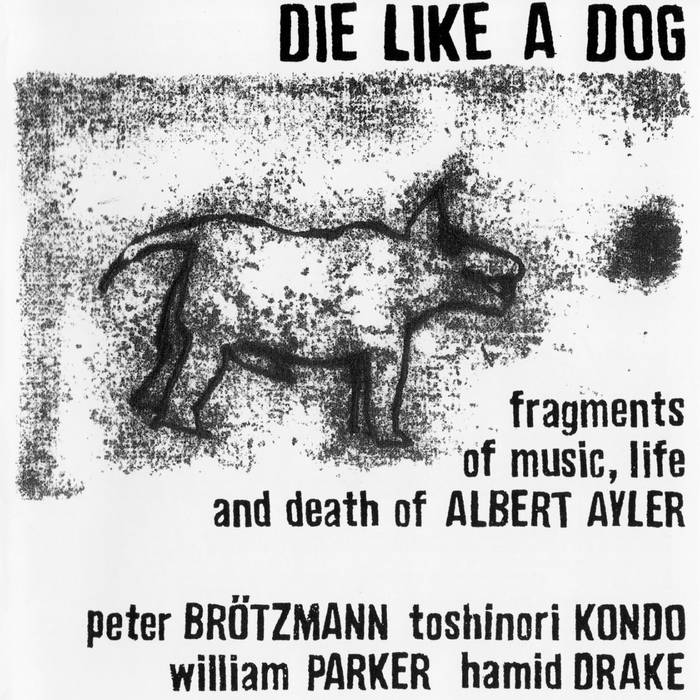
“You only have to listen to Ayler’s first ESP-Disk records, with what kind of love and desperation this man played his own stories-and also what honesty. These are three things which are important to me, which touch me.”
-Peter Brotzmann
While many tribute albums in any genre of music feel like shallow cash-ins, this certainly cannot be said about Peter Brotzmann’s achingly painful tribute to someone he clearly saw as a kindred spirit, Albert Ayler. This album feels like a straining reach across eras, and a leap across the Atlantic Ocean from one great artist to the ghost of another. Both Ayler and Brotzmann were making the most intense free jazz imaginable in the early 60’s, each unaware of the other’s existence. They both strived for a similarly raw and emotional style. And of course Brotzmann knew of Ayler’s terrible end, dying alone in the East River in New York City, feeling as if his music would never be appreciated.
Brotzmann assembled a quartet which he continued to call the Die Like A Dog quartet and would ultimately record 6 albums. It consisted of Brotzmann, William Parker on Bass, Hamid Drake on drums and Toshinori Kondo on electric trumpet. I’ve already written extensively about Parker.
I’ve seen Hamid Drake perform live quite a few times, the first time with the DKV Trio (see below) and they blew the doors off the building. I immediately wanted every recording with Drake I could get my hands on. Hamid somehow simultaneously reminds me of both of Trane’s most famous drummers, Elvin Jones and Rashied Ali. He can effortlessly mix the polyphony of the former with the cacophony of the latter, and he is just so exciting to watch live. His duo show with Colin Stetson, who will appear on this list soon, was an absolute masterpiece. With Parker and Drake, there is no better rhythm section on the planet, especially when it comes to making intense music such as this.
Toshinori Kondo was unknown to me when I picked this album up. Indeed, I had never heard of the electric trumpet. Kondo moved from Japan to New York in the 70s, and played with some of the most intense free jazz musicians of that scene, such as Bill Laswell, John Zorn and Fred Frith. He brought a unique style to his trumpet playing, using electronic means to extend and alter what one could do on the trumpet. I’ll be honest, I find some of his electronic effects distracting, but there are many moments on this album when his interactions with Brotzmann are sublime and remind me of Ayler’s interactions with his trumpeter brother Donald on the Greenwich Village album.
Ayler experts will listen to this album looking for all the Ayler musical phrases that are embedded into the music, and I catch some of them. But mostly I feel a great sadness listening to this beautiful album and thinking about what it represents.
All of the Die Like A Dog Quartet albums are worthwhile, and I also highly recommend Brotzmann’s duo album with Drake, The Dried Rat-Dog. (I’ve never been sure what to make of that title.)
37-David Murray-Ming
“I just saw that everyone’s sound was going towards Coltrane’s sound and I really didn’t want my sound to go in that direction. I wanted to study the people that Coltrane studied so I could maybe come up with my own sound. So I went back to deal with people like Coleman Hawkins and people like Ben Webster and Lester Young and Paul Gonsalves and all the way on up to Sonny Rollins, Lucky Thompson, people like Clifford Jordan, people who I knew and respected and then when I finally got to New York and met all these people, Dexter Gordon, when I met these people, it was a great thing for me because they took me in, Johnny Griffin, people like that. They took me in and I became part of their peer group.”
-David Murray
I love listening to David Murray play the saxophone. He has such a deep, rich sound to his sax, and his ability to play complex lines is unparalleled. I’ve seen him in concert 4 or 5 times, and it’s even more amazing to hear him live. Add to that an extraordinary ability to compose and arrange music for large ensembles. His octet has changed lineups over the years, but the quality of Murray’s playing and writing remains.
The octet’s lineup on this album is like a murderer’s row of great 80s jazz musicians. (For non baseball fans, this was the name given to the batting order of the 1927 Yankees, frequently considered the greatest line-up of all time.) Along with Murray, there’s Henry Threadgill, Olu Dara, Butch Morris, George Lewis, Anthony Davis, Wilber Morris and Steve McCall, every single one being a major contributor to the free jazz scene, especially Threadgill and Lewis. The compositions are fantastic, with twisty melodies but with lots of space for his great musicians to improvise as well.
Murray is also well known for being a member of the World Saxophone Quartet, and seeing them live with a group of African drummers remains one of my very favorite concert experiences. Check out Plays Ellington or Dances and Ballads or Metamorphosis for some great music. For more Murray, his octet album Home or the slightly later trio album The Hill are both great.
38-Satoko Fujii’s This Is It! Trio-1538
“I cannot imagine what my musical life would be now without meeting Paul Bley. Before meeting him, I didn’t like my music, and I didn’t even like myself. We spent so much time talking, and that made me change. I started to accept myself as an individual, and that led to me accepting myself as a composer and as a musician.”
-Satoko Fujii
The wonderful pianist Satoko Fujii simply had to appear in a prominent place on this list. The problem, and I realize this isn’t really a problem, is that her music is almost uniformly excellent. I have more than 30 albums of hers (She has many more than that. In fact in 2023, she released her 100th album), and I spent hours listening to them deciding which album would go on this list. (Putting this list together has been a lot of fun, if nothing else.) She has done everything from solo albums to any number of small group efforts to orchestral pieces, and they’re all marvelous. So I finally threw up my hands and picked this one simply because I saw this trio in concert under very special circumstances I’ll describe in a moment. Also of course, because it is an amazing piece of music.
The This Is It! Trio consists of Satoko Fujii on piano, Natsuki Tamura on trumpet and Takashi Itani on drums. Tamura, in addition to being a fantastic musician, is the spouse of Fujii. They have a number of wonderful duo albums together, and they each play in a number of the other’s bands. I was quite familiar with Fujii and Tamura, but Takashi Itani was new to me. He’s spectacularly well-suited to the music here, and I have no doubt, Fujii’s compositions take into account the strengths of the performers in the given band she’s writing for. The first song is wonderfully intense. Tamura uses breath techniques in overblowing his trumpet and Fujii focuses mostly on low notes and Itani propels the music forward, sometimes urgently, sometimes just with gentle hints. One of the hallmarks of Fujii’s compositions is the extent to which she trusts her bandmates and gives them lots of space. Every song on the album is rich with new ideas and exciting to hear.
What’s special about this music for me? Satoko bought this trio with her to Ottawa in 2019, and I had the privilege of seeing them in concert. I had seen her with her band Kaze a few years previously. But on this occasion, Ottawa greeted Satoko with a complete, citywide blackout. I’ve never seen the city so dark. The first night of their stay, Natsuki gave a solo trumpet performance lit only by a single fluorescent lightbulb attached to a car battery. It was one of the most amazing concert experiences of my life.
For more from Satoko Fujii, try any of her albums with the band Kaze or any of her solo albums. For her orchestral work, check out South Wind.
39-Roscoe Mitchell-Sound

“To be a good improviser, you have to study composition as a parallel. Because what improvisation is, on a high level, is spontaneous composition.”
-Roscoe Mitchell
“What I try to impart to a musician is to really try to practice the instrument in a really sincere way. Learn as much about music as you possibly can. Learn composition. Study to try to create compositions of your own and put your own personal touch on your music.”
-Roscoe Mitchell
The Association for the Advancement of Creative Musicians (AACM) was formed in Chicago in 1965 with the intent of “nurturing, performing, and recording serious, original music.” The first work in this direction was done by Muhal Richard Abrams, who formed a predecessor of AACM which he called The Experimental Band. AACM was trying to push the boundaries of what music could do, especially jazz, using improvisation and experimental music. They taught music education courses, gave access to instruments and teaching to poor Chicago kids and encouraged them to explore any type of musical ideas they wished. The list of great musicians who were/are members of AACM is a who’s who of American free jazz. In addition to Abrams, there’s Lester Bowie, Anthony Braxton, Kahil El’Zabar, Malachi Favors, Chico Freeman, Fred Hopkins, George Lewis, Steve McCall, Roscoe Mitchell, Wadada Leo Smith, Henry Threadgill and on and on. The great band Art Ensemble Of Chicago, came out of AACM.
While the music the members of AACM produced was too diverse to suggest there was a signature sound, many of the key ideas one would hear in their records can be found first in Roscoe Mitchell’s masterpiece Sound, made primarily between AACM members, in particular future members of Art Ensemble Of Chicago. For free jazz buffs who are familiar with the pummelling approach of something like Machine Gun or numerous David S. Ware albums, Sound is surprising to say the least. Mitchell takes advantage of silence in a way that hadn’t been heard before in this kind of music. Mitchell wasn’t afraid to use something like the quiet textures one can play on the trumpet, here played by Lester Bowie, or using cymbals, played here by Alvin Fielder. The ideas here would have repercussions in free jazz well outside the Chicago scene.
For more along these lines, do check out Art Ensemble Of Chicago, especially Urban Bushmen.
40-Julius Hemphill-Dogon A.D.
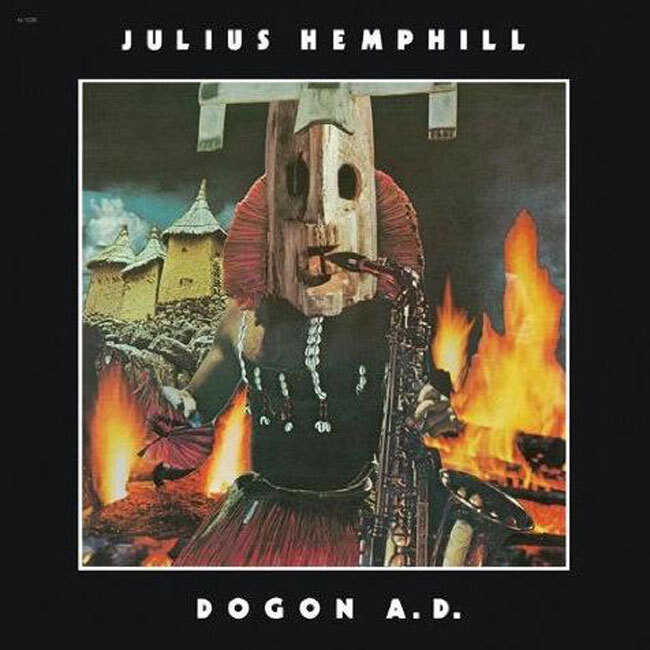
“Quite frankly, I didn’t like going to school. It had too many rules. The last person I really obeyed was my mama, and I was about 10. Once I got out from under that jurisdiction, I was a free-floating organic plankton. I hardly ever tried to emulate anybody. I’m stubborn enough to say that if I can’t come up with an idea I have no business being up here.
If I have anything to contribute to this art form (and I think it is an art form), it’s that this is a voice of our culture. This ain’t out of the conservatory. This is a voice right out of them cotton fields, out of the neighborhood. That’s where my impetus comes from. No matter what I study, music means to me a summation of my experiences.”
-Julius Hemphill
Stef Gijssels, founder of the great website The Free Jazz Collective, in a completely unprecedented move, gave this album 6 stars out of 5, the only time on that website this was done. Listening to the album it’s tough to argue with him.
Julius Hemphill was one of the founding members of World Saxophone Quartet, an incredibly influential band within the avant-garde jazz community, and he was a tremendously important composer both for WSQ and his own projects. He later formed The Julius Hemphill Sextet, another all saxophone group. His influential compositions had an enormous impact on other musicians, several of whom he personally taught, most notably Tim Berne.
Dogon A.D. features Hemphill on alto saxophone and flute, Baikida Carroll on trumpet, Abdul Wadud on cello, and Philip Wilson on drums. Whether or not you purchase the album, if you’re a fan of adventurous but beautiful music, you owe it to yourself to give the title track a listen. Wadud and Wilson lay down a very simple foundation that quickly becomes almost trance inducing in its repetition. This provides the basis for Hemphill to launch into his extraordinary solos. The track is long enough to allow him to explore any number of ideas, all the while that repeated riff from drums and cello keep the song propelling forward. I’ll leave the final word to Stef:
“Dogon A.D. is phenomenal in the simplicity of its form and the power and creativity of its performance.”
For more Hemphill, be sure to check out Fat Man and the Hard Blues from his saxophone sextet. Also check out the WSQ albums Plays Ellington and Dances And Ballads.
41-Anna Hogberg Attack-Lena
“The album’s opener “pappa kom hem”…begins with an unaccompanied, abrasive solo from Högberg…The minutes which follow find order in their chaos. The rhythm section play as though they are rioting in the street, while the wind players’ short blasts and exclamations at once sound like ambulance sirens and the yells of an angry crowd. Not until the last forty seconds of the song does the glorious, Albert Ayler-esque melody emerge from the din, navigating the turbulent tune to a close.”
-Samuel Stroup, All About Jazz
The album Anna Högberg Attack was a revelation. I’m bombarded on Bandcamp by suggestions of the form “You might like…” which only occasionally turns out to be the case. I’ll usually click on it for a few seconds and then go on to the next one. I almost fell out of my chair within seconds of clicking on this album. By the end of my first listen, I wanted albums from every musician on the album, none of whom I had heard of.
This is what free jazz should be. I heard the shadows of all that had come before it. “Hey, that’s Ornette.” “That solo sounded like Mats.” But it was also very much its own music, and was forging a way forward. Attack consists of Högberg on alto sax, Malin Wättring and Elin Larsson Forkelid on saxes, Lisa Ullén on piano, Elsa Bergman on bass and Anna Lund on drums.
As great as the whole band is, the stars are Högberg and Ullén. Högberg, who’s worked extensively with Mats Gustafsson, has his fiery playing style, but brings her own individual voice to her playing as well. Her compositions are knotty but beautiful, and it’s clear she trusts her bandmates to perform this music to its fullest extent. Ullén is a phenomenon here. Every free jazz pianist is going to sound like Cecil Taylor to some extent, but Ullén’s sound is quite unique here and on her own albums. I’ve been buying her music ever since hearing this. She provides a perfect counterpart to the attack of the saxes.
And the followup album, Lena, is even better. It’s a slightly different lineup with Niklas Barnö on trumpet replacing Malin Wättring. Adding a trumpet was probably a good idea, rather than having 3 saxes again. But the basic principles are the same as on the first album. Mats Gustafsson is a big supporter of the band, and wrote the liner notes, describes the music as “a primal force of something… real” which “hit me like a split axe in a split second”.
Fans of free jazz will occasionally worry that the genre has nothing left to say. Anna Högberg Attack would vigorously dispute that.
What else to get? If you like one of these albums, get the other for sure. For more Högberg, check out the band Se Och Hör (which means See And Hear in Swedish) and their album Se Mig, Hör Mig, Känn Mig (which means See Me, Hear Me, Feel Me. Were they channeling The Who?)
For more Lisa Ullén, check out Lisa Ullén, Nina de Heney & Charlotte Hug – Quarrtsiluni, which will appear on this list soon. Also check out Lisa Ullén, Elsa Bergman, Anna Lund-Space, featuring 3 members of Attack.
42-Art Blakey And The Jazz Messengers-Free For All
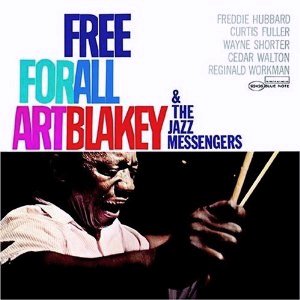
“Blakey is like a man on fire. When he drums, every inch of his body is involved in it. He can get a greater variety of counter rhythms going at any one time than any drummer I have ever heard.”
-Ralph Gleason
“What makes this set distinctive, however, is that on the night of the session, Blakey was in a more galvanic state than he has been on any of his previous Blue Note dates, as memorable as many of them are. It was, in sum, one of those times when everything was fused for unbridled action and emotion. Spurred by Blakey’s firebolts, the other musicians rose to a collective—as well as individual‚ intensity which makes this a remarkable series of performances.”
-Nat Hentoff, in the liner notes to Free For All
Art Blakey & The Jazz Messengers was one of the most enduring and greatest of all institutions in the history of jazz, in terms of the music it created, the music it inspired and the musicians it introduced to the jazz world. Over the course of its 35 year history, the list of former Messengers includes Chick Corea, Kenny Dorham, Curtis Fuller, Kenny Garrett, John Gilmore, Johnny Griffin, Freddie Hubbard, Keith Jarrett, Wynton and Branford Marsalis, Hank Mobley, Lee Morgan, Wallace Roney, Woody Shaw, Wayne Shorter, Horace Silver, Bobby Timmons, McCoy Tyner, Cedar Walton and Reggie Workman. In fact, Wikipedia lists more than 70 musicians who were Jazz Messengers at some point.
Hard bop as a form of jazz originated in the mid 50s, indeed it’s the name of one of the first Jazz Messengers albums. It’s seen as the next logical step after bebop. The speed of bebop is slowed up a bit, with the songs lengthened and given more space for soloing. Art Blakey and Horace Silver were the key figures in the movement, they had a vision of what they wanted to do and the skill to bring it about. Both were also great recruiters of the very best musicians, who were attracted to the freedom that hard bop offered.
I had the fun task of listening to a lot of Blakey albums to determine the best. I think the greatest era of the Jazz Messengers was when Wayne Shorter was in the band and acted as musical director. All of the albums of that period are terrific and you can’t go wrong on any of them. But this one is special as Nat Hentoff’s quote above makes clear. All of the musicians here are bringing the flame, spurred on by Blakey’s intensity. There’s a political overtone here which wasn’t common on a Blakey album. The song The Core is dedicated to The Congress Of Racial Equality, and this being 1964, you can imagine the feelings that drew from the musicians.
As on every album, Blakey had surrounded himself with the very best musicians. In addition to Shorter, there’s Freddie Hubbard on trumpet, Curtis Fuller on trombone, Cedar Walton on piano and Reggie Workman on bass. The three horn front line on this album sounds like they know they’re making some classic music here. Shorter’s soloing is extraordinary as usual.
Where to go for more Blakey? Every Blakey album on Blue Note is very good, especially Moanin’, A Night In Tunisia, Buhaina’s Delight, Mosaic, and Indestructible.
43-David S. Ware-The Wisdom Of Uncertainty

“I’ve always been very aware of form. People sometimes say that this type of music is just random notes, that anything goes. That’s just not the case at all. There’s so much information being passed through this music -musical, philosophical and metaphysical -and the motifs and melodies have their own direction about them.”
-David S. Ware
I’m pretty sure the first free jazz band I ever saw live was The David S. Ware Quartet. I had never seen anything like it. I alternated between being mesmerized by the talent of the 4 band members and blown away by the power and energy, especially coming from David S. Ware’s tenor sax. It was like hearing a musical volcano, but underlying all that energy was a great talent and what I think Monk would call ugly beauty. And I’ll confess I was also amused by everyone in the audience that had no idea what they were in for. Dave Brubeck, this aint. (For the record, I think Dave Brubeck is great.)
While Ware’s playing is captivating, what raises the music to greatness is the rest of the band. I’ve already written about William Parker extensively, and he plays wonderfully here. I’ll talk more about Matthew Shipp below, but suffice to say his instantly recognizable playing is evident here, and the gospellish style complements Ware’s ferocity beautifully. Take for example, the tune Sunbows Rainsets Blue. Shipp opens the piece with beautiful, pensive piano, backed by Parker’s bowing. Ware eventually comes in and takes the music in a completely different direction, but there’s always a trace of the original theme that Shipp led out. The song Acclimation which kicks off the album begins with a wild outburst from Ware, which lets the listener know what they’re in for. I knew that I would love this album from just those notes.
That brings us to the drummer for this album, Susie Ibarra. This quartet went through several drummers, with Susie Ibarra being present on three studio albums. She’s a remarkable drummer, who is more than able to have her own voice in the storm of this quartet. What sets her apart from most other free jazz drummers is her interest in indigenous music. Her parents immigrated to the states from the Philippines and Susie has researched indigenous and folkloric music in the Philippines, specifically kulintang gong music. This influence is much more evident on her recordings as bandleader. Be sure to check out her album Folklorico.
For more, you could check out any David S. Ware album. Aside from this one, my favorites are probably DAO and Godspelized. But really any of them are great.
44-Andrew Hill-Black Fire

“These magic moments when rhythms and harmonies extend themselves and jell together and the people become another instrument. These things are priceless and they can’t be learned; they can only be felt.”
-Andrew Hill
Black Fire was the first in a string of a dozen phenomenal albums Andrew Hill recorded on the Blue Note label. What I like about Hill is that he can’t be pigeonholed into one genre of jazz. Much as I love Horace Silver, he was squarely a hard bop pianist. Hill certainly has a lot of hard bop in his compositions, but he also has a more experimental side which gives his albums an extra level of appeal. Two months after Black Fire, he would record Judgement!, which features Bobby Hutcherson’s vibraphone playing prominently instead of the more typical saxophone. It was the beginning of a great career for Hutcherson.
Two months after Judgement!, Hill would record Point Of Departure, his most famous album and in the eyes of many, his best. There is no arguing, it is a great album, with a killer line-up, with Eric Dolphy, Joe Henderson, Kenny Dorham, Richard Davis and Tony Williams. It also features exciting compositions, which showcase Hill’s ability to compose for both straight-ahead jazz and the avant-garde.
But my favorite is Black Fire. All of the great things about Andrew Hill’s music apply just as well here, but I love the smaller line-up and the additional space it gives to Joe Henderson’s fantastic soloing. You can’t go wrong with any of the three albums discussed above.
45-John Zorn’s Masada-Alef
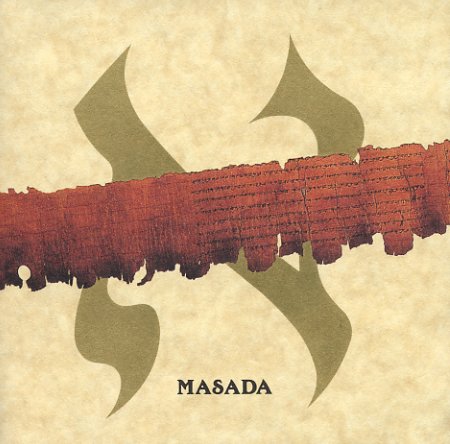
“I started the label Tzadik to support an entire community of musicians, not just Jewish musicians. But the radical Jewish culture movement was begun in a lot of ways because I wanted to take the idea that Jewish music equals ‘klezmer’ and expand it to, ‘Well, Jewish music could be a lot more than that.'”
-John Zorn
I know I promised to keep the number of artists who appear repeatedly to a minimum, but John Zorn’s work isn’t just voluminous, it’s incredibly varied. It’s also pretty much uniformly superb.
This album is the first album from the Masada Quartet, consisting of Zorn on alto sax, Dave Douglas on trumpet, Joey Baron on drums and Greg Cohen on bass. It’s also the start of a very large program inspired by Radical Jewish Culture, a music scene initiated by a group of Jewish musicians from New York. Aside from this band, there’s Masada String Trio, Bar Kokbha (which has several formations), Electric Masada and New Masada Quartet. The RJC output consists of close to 100 albums by my count.
The current album is dedicated to Asher Ginzberg (1856-1927), “founding father of cultural Zionism, who in the late 1880s, under the pen name of Ahad Ha’am (“one of the people”), passionately called out for a New Jewish Cultural Renaissance – one in which Jews everywhere could find pride and meaning.”
The wonderful thing about this album is that it’s Zorn playing sax in a relatively straight-ahead context. I generally hate it when music is described as X meets Y. But seriously, this is Ornette meets klezmer, and Zorn’s playing is superb. Indeed the whole band seems completely in tune to what Zorn is doing here. This is a classic and endlessly listenable.
For more Masada, do check out one of this quartet’s live albums. Live In Middelheim would be my suggestion. The double album Bar Kokhba is basically Masada with string arrangements. Also give Brian Marsella’s Buer: Book of Angels, Vol. 31 and Mary Halvorson’s Paimon: Book of Angels Volume 32 a listen, Book of Angels being Zorn’s Masada Book 2. New Masada Quartet has two great albums out and they are well worth seeing live.
46-Ivo Perelman & The Matthew Shipp String Trio-Armageddon Flower
“I called it Armageddon Flower as an attempt to instill some hope amidst the hysteria of the times and contemplating our own extinction as a human species. This music has drama but also has the light of being saved, of the savior, whoever and whatever that is.”
-Ivo Perelman
Sometimes works of art just seem to capture a moment of history far better and more profoundly than any history book ever could. I think about Picasso’s Guernica or Allen Ginsberg’s Howl. Ivo Perelman & The Matthew Shipp String Trio’s album Armageddon Flower seems to define this depraved time we’re living in, and at the same time, offer up some hope that things need not always be this way. It’s almost more than one can hope for, even given the calibre of musicians on this recording.
Ivo Perelman is a Brazilian saxophonist who can play the most pummelling, roaring music, but then drop out of that Ayler/Brotzmann style and play beautiful, touching melodies at the drop of a hat. The Penguin Guide To Jazz Recordings describes one of his albums as a “blissful uproar”. I like that. His album Sad Life with Rashied Ali and William Parker is one of the all-time great free jazz albums and if not for the existence of this album would be on this list. Another classic is Seeds, Vision and Counterpoint, with Dominic Duval and Jay Rosen.
There may be no better long-term pairing of musicians than Ivo Perelman and Matthew Shipp. (Shipp will be discussed in more detail later in this list.) They have released more than 40 albums together, some as duos and some as part of larger groups. I certainly haven’t heard all of them, but every time I hear them together, I hear two musicians who connect on an almost telepathic level.
Here Shipp brings along his String Trio, which first appeared in 1996 on the album By The Law Of Music. It features William Parker on bass and Mat Maneri on violin. It may be the perfect small combo for Shipp to show off his simultaneous devotion to free jazz and to chamber music.
I haven’t written about Mat Maneri yet, but he is a tremendous improvisor, playing violin and viola in a number of contexts, always superbly. In particular, he’s played with Cecil Taylor in a wonderful duo album, Algonquin. He’s recorded on Shipp’s Thirsty Ears Blue Series with the albums Blue Decco and Sustain. He’s recorded a wonderful viola duo album with Tanya Kalmanovitch called Magic Mountain. He’s played with Evan Parker, Ingrid Laubrock, Pandelis Karayorgis, Marilyn Crispell, Joelle Leandre and of course his father Joe Maneri. More on him later.
The Perelman quote above captures so well what I feel when I listen to this album. There are moments when the music, especially Shipp’s piano, thunders, Maneri plays clipped single notes in rapid succession which become increasingly urgent and of course Perelman roars. This is the end, beautiful friend. But then the song Restoration which closes the album begins with a beautiful piano melody and a hint of peace. The menace is still there even in this final song, but it feels like it’s being matched here and just maybe compassion will hold sway.
I highly recommend you read Sammy Stein’s beautiful review of this album on The Free Jazz Collective. I’ll just pick out one quote from it:
“All four musicians are fearless in pursuit of perfect communication. On Armageddon Flower, the impossible is possible; what is out of reach is close at hand, and what was lost is found.”
47-Lee Konitz With Warne Marsh

“What is ‘cool,’ anyway? Maybe it’s Warne Marsh, almost totally obscure and penniless, coming in late to a fourth-rate Hollywood nightclub, playing like an angel with a couple of sidemen, but never speaking to or even acknowledging another human being.”
-Carolyn See
Lee Konitz just seems like he must have been a great guy, and I love listening to him play his alto sax. He studied with Lennie Tristano who had a very academic approach to jazz. Konitz combined these academic ideas with bebop, which was going strong as he started his career, to come up with a sound that was truly original. He was in at the conception of cool jazz, appearing on Birth Of The Cool, and doing subsequent albums with everyone from that movement, especially quite a bit of work with Gerry Mulligan.
I find listening to Konitz blissful, and I’ll happily tap my feet with a big smile to anything he’s playing. This album has perfect accompanists for him in Sal Mosca, another Tristano student, on piano, Oscar Pettiford on bass, Kenny Clarke, one of the founders of The Modern Jazz Quartet on drums, Billy Bauer on guitar.
And of course Warne Marsh on tenor sax. I first heard of Marsh when I read that Anthony Braxton was a huge fan. Marsh was another student of Tristano, who didn’t have the great career of Konitz as the sad quote above suggests, but appeared on a number of fine albums, his work with Konitz on a number of albums being uniformly excellent.
On this album, they take on Bird, covering his famous piece Donna Lee. It’s close to perfect, successfully bringing the cool style to Parker’s great composition and still being faithful to the original. They cover a Tristano piece, Two Not One, equally beautifully. The sound of the two saxes playing the lines of these compositions together is one of my favorite sounds of jazz.
For more Konitz, absolutely track down his album Motion, with the great Elvin Jones on drums and Sonny Dallas on bass. It’s a flat out masterpiece. Also check out his work with Gerry Mulligan, especially Lee Konitz Plays with the Gerry Mulligan Quartet. For Warne Marsh, check out Ne Plus Ultra, on the Hat Art label. It features Gary Foster on alto sax.
48-Alexander von Schlippenbach-Globe Unity Orchestra 67 & 70

“Oh my god, what’s happening?”
-yelled by a woman sitting a few rows behind me at a Globe Unity Orchestra concert.
One of my most exciting concert experiences was seeing Alexander von Schlippenbach’s Globe Unity Orchestra at The Ottawa Jazz Festival in 2010. It was a relatively small version of the orchestra, with 9 or 10 members. But they made a glorious noise. I was the only soul brave/crazy enough to sit in the front row, and even though my ears rang for days afterwards, it was worth it. At the time, it was a glorious, apocalyptic cacophony, which I just let wash over me. (I also enjoyed the shocked reactions that were happening all around me. There were many there expecting something Ellingtonian, which this emphatically was not. The above quote really happened. “yelled” is not an exaggeration.)
But an advantage to listening to a recording of GUO is that it is possible to pick up the subtleties, and there are subtleties to be found here. There are two pieces here, one (recorded in ’67) is 34 minutes long and the other (recorded in ’70) is 17 minutes long. Each piece was played by an orchestra of 18 members, although a slightly different lineup in each. AvS used a graphical system which set up the groupings under which several musicians would play while others laid out. They may or may not have been given specific music to play. Using the system, AvS makes sure that no one’s voice is lost. There’s plenty of space for soloing. At one point in ’67, there’s a a moment of quiet with flute played by Gunter Hampel. It’s somehow funny and beautiful within this sea of chaos. There are trombones (one played by the great Albert Mangelsdorff) and basses (including playing by the greatest of all European bassists Peter Kowald) weaving in and out. Yet AvS’s piano always comes through. Several times I found myself thinking how difficult this must have been to record.
For the ’70 piece, AvS added the Brits Evan Parker, Derek Bailey and Paul Rutherford. While it’s basically impossible to single out Parker in the recording, Derek Bailey’s intense guitar playing comes through loud and clear.
It’s inevitable to want to compare these two pieces to the American versions of large-scale free improvisation groups led by Ornette and Trane. I’m going to leave it to Charlie Wilmouth of Allmusic to describe the difference:
“Compared to Ascension and Free Jazz, the organization of Von Schlippenbach’s music is not as similar to traditional American jazz and neither is the playing: the members of Von Schlippenbach’s orchestra would rather shriek through their horns or bellow huge, roaring glissandi than play anything resembling the blues.”
Personally I’m very much in favor of horns shrieking and bellowing. There’s lots to be found here.
There aren’t a lot of GUO recordings. In addition to this one, I like the 40th and 50th anniversary albums.
49-Pat Thomas-The Locals Play The Music Of Anthony Braxton
“The piano is a great sound source. There’s no instrument like it in the Western world because it’s so self-contained. And the fact that it’s still being used, the fact that you can’t replicate it. I’ve yet to come across any sample that sounds like a real piano. You think of other instruments that are now regarded as outdated and it’s incredible. It’s still got a mileage of another hundred years at least. It’s way ahead of its time.”
-Pat Thomas
I type this after having just seen Pat Thomas’s band [Ahmed] (The brackets are part of the band name) blow away the 2025 Big Ears Music Festival with one of the most intense free jazz performances I’ve ever seen. I half expected the strings of Joel Grip’s bass to be bloody, his playing was that intense. All 4 musicians looked thoroughly exhausted by the end, and I was thrilled to see the extended standing ovation they received. Pat Thomas has built up a wonderful discography, despite being under the radar of a lot of free jazz listeners. (That unfortunately included me for quite a while. I’m making up for lost time now.)
The sheer variety of music on his resume is impressive, with a penchant for electronic music and a desire to explore many different avenues of music and thought. He has a solo album called The Solar Model of Ibn Al-Shatir, dedicated to a 14th century Arab astronomer, and another called The Elephant Clock Of Al Jazari, inspired by a 12th century water clock. He currently has projects with many of the best improvising musicians. I especially like his work with saxophonist Rachel Musson and percussionist Mark Sanders for the band Shifa.
That brings us to the present recording. I’ve heard many adjectives used to describe Anthony Braxton, not all of them positive. But “funky”? After listening to this album, I can say “oh, yes”. This band, with Thomas on piano, Alex Ward on clarinet, Evan Thomas on electric guitar, Dominic Lash on electric bass and Darren Hasson-Davis on percussion, decides to bring the funk to a collection of Braxton tunes.
As Gary Chapin points out in his review on The Free Jazz Collective:
“[Braxton] is more than the sound of his recordings. Braxton has developed the idea of “trans-idiomatic” music, i.e., music that exists across boundaries.”
So any skilled musician could pull Braxton’s compositions into their own framework. (I seriously would like to hear “Braxton Polka”. There already is an album of Braxton compositions played on the bagpipe by Matthew Welch and Braxton has also written a great deal of marching band music, so it’s not that crazy an idea. How about Braxton Death Metal?)
What raises this album above gimmick level to greatness is the calibre of the musicians. All 5 musicians are superb and clearly understand Braxton’s complex compositions to the extent they can interpret them in this new setting.
For more Pat Thomas, check out his bands, ism, Shifa and [Ahmed], or the solo albums listed above. For another interpretation of Braxton’s music, check out The Steve Lehman Trio plus Mark Turner-The Music of Anthony Braxton.
50-Horace Silver-Song For My Father
“I may be prejudiced, but I believe that jazz music has the strongest healing potential, and it’s not just because I play it and love it so much. I feel that it’s the improvisation in jazz that makes it so strong as a healing tool, what each individual gives to a tune from their heart and their soul when they take a solo. It’s all spontaneous, and it’s all love, and from the heart.”
-Horace Silver
Before getting into Horace Silver, this seems like a good moment to note how great the Blue Note label was in the 50s and 60s. When I first started buying jazz, I bought pretty much anything from that label from those 2 decades and very rarely regretted it. Then there are the amazing album covers. The history of jazz has to take Blue Note into account and give them a huge amount of credit.
Which brings us to Horace Silver. I wonder how many jazz fans realize that before the band was called Art Blakey And The Jazz Messengers, it was called Horace Silver And The Jazz Messengers. It was a quintet of Silver, Blakey, Hank Mobley, Kenny Dorham and Doug Watkins. Their self-titled 1956 album is largely seen as the starting point of hard bop. Hard bop took bebop, slowed it down a bit and extended the lengths of songs to give the opportunity for more soloing. It was also seen as a reaction against cool jazz which a lot of jazz musicians thought had drifted away from the music’s blues roots.
Silver would continue on from this starting point to make great album after great album after great album for the Blue Note label right up until 1980. His compositions are among the most beautiful and complex in the entire hard bop genre. The title track from this album, with Joe Henderson (another Blue Note regular, who appears on this list repeatedly), is possibly my favorite Blue Note song. Do yourself a favor and find the opportunity to give it a listen. His piano playing is also fantastic, he can keep up with Henderson and they spur each other on, especially on the title track.
For more Horace Silver, check out The Jazz Messengers album, Finger Poppin’, Blowing The Blues Away, The Tokyo Blues, The Cape Verdean Blues. But honestly, any Blue Note album with his name on it is well worth your time.
Here’s a trivia question. Even if you’ve never heard or even heard of Horace Silver, the title track of this album should sound very familiar. Why?
51-AMM-Newfoundland
“AMM exists where words fail.”
-Ed Baxter, in the liner notes for the AMM album The Nameless Uncarved Block
In the documentary film American Hardcore about the L.A. hardcore punk rock scene, one of the punks says “The less it sounds like a song, the more we like it.” While AMM will never be confused with hardcore punk, they very much share this sentiment.
AMM was one of the first and most important British improvised music groups. It was founded in 1965 and their dedication to improvised music was complete. They had no interest in making something that sounded like anything else. While they would invite musicians to join them, they would kick them off the stage if they felt they were playing something too familiar sounding. (According to AllMusic, they did this to Steve Lacy once.) They had no hesitation to use extended techniques and modified instruments, or just random objects. They even would turn on a radio at random moments, as they do on this album. Unlike some of their European free jazz contemporaries, they were also happy to incorporate silence into their performances.
The band was founded by Eddie Prevost on percussion, Lou Gare on sax and Keith Rowe on guitar. Cornelius Cardew was also a frequent member of AMM, but did not appear on this album. This version has Prevost, Rowe and John Tilbury on piano. This is a monolithic, monumental piece of music, a single 77 minute track. It has a great stillness about it, reminding me of a musical Rothko painting.
For more AMM, check out The Nameless, Uncarved Block (a great title for an AMM album), The Crypt or Live In Allentown. A fantastic John Tilbury album is John Tilbury Plays Samuel Beckett. I wouldn’t be surprised if Ed Baxter was thinking of Beckett when he wrote the words above.
52-Lotte Anker-Floating Islands
“Humans are like isolated islands, floating in the sea of fate.”
-Gu Zhen Re
A great, great album from saxophonist Lotte Anker, ably aided and abetted by Craig Taborn on piano and Gerald Cleaver on drums.
Craig Taborn is a prolific pianist who has worked with a staggering number of the best musicians in jazz, including Tim Berne, Rob Brown, Steve Coleman, Kris Davis, Michael Formanek, Ingrid Laubrock and on and on. He has also been leader on a number of fine recordings. Especially check out his albums on Thirsty Ear and Tzadik.
Gerald Cleaver has worked with many of the very best avant-garde jazz musicians, including Joe Morris, Matthew Shipp, Ivo Perelman, Roscoe Mitchell, Ellery Eskelin, Weasel Walter and on and on. His work is always of the highest skill.
Lotte Anker has shown a willingness to work with the most adventurous musicians in the free/avant-garde scene such as Ikue Mori, Satoko Fujii, Fred Frith, Tim Berne and Sylvie Courvoisier. I saw her perform a wonderful duet show with Okkyung Lee.
Anker’s playing on this album is superb. The accompaniment of Taborn and Cleaver quite surprised me at first. On the tune Floating, they’re both laying down minimal, repetitive riffs, which nonetheless build up momentum in much the same way as Eve Risser did with her trio on En Corps (see above). Each piece on the album leads beautifully into the next, and the whole album just left me feeling overwhelmed with how good this music was.
I suspect even some free jazz buffs might not know about this one, and I would urge you to check it out.
This trio has two other releases, Live At The Loft and Triptych. Also be sure to check out the trio Farmers By Nature, which is Taborn, Cleaver and the great bassist William Parker.
53-DKV Trio-Live In Wels And Chicago

“Like the New Orleans tradition that preceded it, and the Swing Era offerings that followed it, Chicago jazz was not just the music of a time and place, but also a timeless style of performance – and for its exponents, very much a way of life – one that continues to reverberate to this day in the works of countless Dixieland and traditional jazz bands around the world. For many listeners, the Chicago style remains nothing less than the quintessential sound of jazz.”
-Ted Giola, The History Of Jazz
As the above quote makes clear, Chicago has always been an epicentre for great jazz. That remains true today, as Chicago is one of the most exciting free jazz destinations in the world with an amazing lineup of fantastic musicians. Ken Vandermark is at the forefront of the scene. He’s recorded so many great albums with so many different configurations. I’ll list some below.
This album is a great introduction to Vandermark’s work. And we get to celebrate the legacy of the great Don Cherry (trumpeter for the Ornette Coleman Quartet, not the annoying hockey announcer) at the same time.
I’ve already written about Drake. Kent Kessler is a much in demand free jazz bassist. Aside from DKV, he’s played extensively with Peter Brotzmann, Vandermark and the trio Boneshaker, with Mars Williams and Paal Nilsson-Love.
DKV is best heard live, and the sound quality on this live album is top-notch. It’s a 2-CD set, with the first being the Complete Communion Suite, a tribute to the great Don Cherry’s album of the same name. The album begins with Vandermark stating the main theme of the Cherry album and then Drake spurs the trio forward as they explore every aspect of the theme and then go off on whatever tangent they see fit to explore. The communication between the three is always of the highest order. The second CD consists of 3 lengthy improvisations, and this group sounds great with that much time to explore their ideas.
For more DKV Trio, check out Baraka or their pairing with another great Chicago saxophonist, Fred Anderson. For more Vandermark, anything by Vandermark 5 or Lean Left. But there’s lots more from him as well. I suggest going to bandcamp and clicking on pretty much anything of his. For more Drake, Brotzmann’s Die Like A Dog quartet’s first album is a masterpiece as is his duo with Brotzmann, Dried Rat Dog. His many albums with Vandermark are well worth a listen, as is his work in William Parker’s O’Neal’s Porch. Kent Kessler is great in the band Boneshaker, especially on their first album.
54-Max Roach Duos:
Birth And Rebirth Featuring Anthony Braxton
Historic Concerts with Cecil Taylor

“I will never again play anything that does not have social significance. We American jazz musicians of African descent have proved beyond all doubt that we’re master musicians of our instruments. Now what we have to do is employ our skill to tell the dramatic story of our people and what we’ve been through.”
-Max Roach
“…in my search for growth as a drummer, to play with Anthony Braxton or with Cecil Taylor is just as exciting and challenging for me as it was to play with Charlie Parker or Bud Powell-they make me think of other things to do on the instrument.”
-Max Roach
It’s difficult to come up with enough superlatives to describe Max Roach, both as a musician and as a human being. He, more than anyone, defined how drums should be played for the new bebop scene in the 1940s. His contribution was so important that he was chosen to be the drummer in the famous Massey Hall concert by “The Quintet”, presenting the 5 most important bebop musicians. He was such a skilled drummer that he also contributed to cool jazz, appearing on Birth Of The Cool. He was also a great bandleader, most famously with his band with Clifford Brown, which played hard bop, the successor to bebop. That band met a tragic end when Clifford Brown died in a car accident at the age of 25. One of the many tragic “what if?’s” of jazz is to wonder what this great band could have done if they had had more time.
He was also an important civil rights activist, most importantly producing the album We Insist!: Max Roach’s Freedom Now Suite with an absolutely great band featuring Booker Little, Coleman Hawkins and others. It was written after being invited to contribute to commemorations of the hundredth anniversary of Abraham Lincoln’s Emancipation Proclamation. It features lyrics by Oscar Brown, Jr. and vocals by Abbey Lincoln. It was a fierce statement in support of civill rights as well as a fantastic piece of music.
He was also quite open-minded when it came to music. He created an all percussion ensemble, M’Boom, which was quite rare in jazz at the time. Most remarkably of all, he recorded duos with two of the very greatest of avant-garde jazz musicians. At this point, I don’t need to say more about Cecil Taylor or Anthony Braxton. They’ve left an oversized imprint on avant-garde jazz. Both of these albums are superb, but I have a special place in my heart for the duo with Taylor. Taylor’s playing is so percussionistic that one is essentially listening to a drum duo. They inspire each other at every turn. Sometimes, it sounds like Roach is the more “out” of the two musicians. Another great advantage is the length of the two main pieces. At 40 minutes and 38 minutes, the musicians have lots of space to communicate and explore each others ideas.
The album with Braxton is also fantastic. I love hearing Braxton in a fully improvised setting, and much as in the album with Taylor, the two musicians inspire each other to great heights. It was such a success they recorded a second album a year later, called One in Two – Two in One.
It was incredibly important to the future of avant-garde jazz that one of jazz’s godfathers gave the music his seal of approval with these two albums.
For more Max Roach, there’s a lot to listen to, aside from We Insist!. For early work, there’s The Max Roach Quartet Featuring Hank Mobley, then try Max Roach and Clifford Brown At Basin Street, Max Roach Plus Four On the Chicago Scene which featured trumpeter Booker Little, Percussion Bitter Sweet, the intriguing album The Max Roach Trio Featuring the Legendary Hasaan (Hasaan being quite the enigma), and M’Boom.
55-Count Basie-The Complete Atomic Basie

“All I wanted was to be big, to be in show business and to travel… and that’s what I’ve been doing all my life.”
-Count Basie
“Well, if you find a note tonight that sounds good, play the same damn note every night!”
-Count Basie
“I’m saying: to be continued, until we meet again. Meanwhile, keep on listening and tapping your feet.”
-Count Basie
One of the most pleasant surprises from putting this list together has been discovering new music to love. My desire to make sure that the earlier forms of jazz are well-represented led me to discover that I seriously enjoy swing era big band music. Yes, it can be occasionally cheesy. But at its best, it combines the work of incredibly skilled musicians, fantastically elaborate compositions and arrangements, packaged in songs that are at once fun and exhilarating. I find the best of this music endlessly listenable and find myself tapping my foot almost against my will on occasion.
Gunther Schuller, himself a fine musician and composer, defined this era to be from 1933 to 1945, in his book The Swing Era. While Duke Ellington is the most prominent name in the genre, there is so much great music from other bands to listen to as well. There’s Jimmie Lunceford, Bennie Moten, Fletcher Henderson, Woody Herman, Jay McShann, Glenn Miller, Benny Goodman, Lionel Hampton and on and on. Later in this list, we’ll encounter a wonderful label called Complete Jazz Series which has done a remarkable job of documenting this music.
And of course, Count Basie. If you know this music, you’re probably objecting. The album was recorded in 1957, long after the swing era’s heyday. This seems especially wrong since Basie has any number of excellent albums from that period.
But I’m sticking with this one, because it illustrates all of the best qualities of the music. It has an absolutely crack rhythm section, the arrangements by Neal Hefti are a delight and the soloists are fantastic, especially Eddie “Lockjaw” Davis on tenor sax. (Part of me wishes we still gave great nicknames like this to musicians.) There’s also Thad Jones on trumpet, Al Grey on trombone and many more fantastic musicians. The album is also wonderfully recorded and that makes a big difference on music this complex.
This album feels like Basie saying, maybe even yelling, “Hey we’re still here and we still kick ass”. I totally agree.
For more Basie, check out The Complete Decca Recordings. For some vocal jazz, there’s his work with Ella Fitzgerald or Frank Sinatra. Basie at Newport is also a classic.
56-Lisa Ullen, Nina de Heney & Charlotte Hug-Quarrtsiluni
”Quarrtsiluni is an Inuit term refering to a state of deep silence in which one sits together and waits until something is ready to burst. It’s about the ancestor belief that all songs came from that deep silence. Their songs would come to the human consciousness as bubbles from oceanic depths.”
-Lisa Ullen
I first discovered Lisa Ullen because of her work as part of Anna Hogberg Attack, she was an absolute star on those two recordings. I’ve been buying her albums ever since. While they’re all exciting, this one is a whole other level of excellent. Born in Korea, she’s lived most of her life in Sweden and is at the forefront of the improvised music scene in that country. On Quarrtsiluni, she’s joined by Nina de Heney. Nina de Heney is a bassist who grew up in Switzerland but studied extensively in Sweden, where she met Ullen. She specializes in solo albums, having made 3 to date. But she’s also made a number of duo albums with Ullen, any of which would be worthy of this list. I picked the album where they’re also joined by Swiss violist Charlotte Hug. She is also a visual artist, composer and much more. She’s developed a notion of visual music which she calls Son-Icons and has made a number of site-specific performances based on these ideas, including a performance on the Rhone Glacier. See her website for details and videos.
I don’t usually just quote an artist describing their album, but the way Lisa describes this album, beginning with the above quote, is better than anything I could write. It continues:
“This awaiting was done in the dark, and this was how their songs were born, admonishing in a common creative state maybe the spirit of the Great Whale; rituals unknown by us. Yet known; beyond the remembered.
The six tracks on this digital album are about the collective human experience of listening and then expressing what has to be expressed. Therefore: songs, not pieces; songs from the core of silence, born in the same space of the unsung. The unsung that has to become a song in it’s own thriving necessity, burst-born.”
I find this album of completely improvised pieces absolutely stunning. There are times the artists will settle into something like a traditional jazz groove, but they quickly move away from it, always looking for something new to say. They are in a constant quest to communicate with the listener and each other.
I can only urge you to give this one a listen. This is improvised music unlike any I’ve ever heard.
For more, check out any album in which de Heney and Ullen play together, for example the duo album Hydrozoa. Two other great albums featuring Ullen are Festen and Space. Charlotte Hug’s most recent album, In Resonance With Elsewhere is well worth a listen, as is her duo with Lucas Niggli, Fulguratio.
57-Joe, McCoy and Elvin
Joe Henderson-Inner Urge
McCoy Tyner-The Real McCoy
“Joe Henderson is the essence of jazz ….He embodies musically all the different elements that came together in his generation: hard-bop masterfulness plus the avant-garde. He’s a great bopper like Hank Mobley or Sonny Stitt, but he also plays out. He can take it far harmonically, but still with roots. He’s a great blues player, a great ballads player. He has one of the most beautiful tones and can set as pretty as Pres or Stan Getz. He’s got unbelievable time. He can float, but he can also dig in. He can put the music wherever he wants it. He’s got his own vocabulary, his own phrases he plays all different ways, like all the great jazz players. He plays songs in his improvisations. He’ll play a blues shout like something that would come from Joe Turner, next to some of the fastest, outest, most angular, atonal music you’ve ever heard.”
-John Scofield
A Love Supreme is the greatest jazz album ever recorded, and it also marked a culmination of what The John Coltrane Quartet could do. While they would record together after that date, it was clear that Trane was moving on to something else, and that personnel changes were imminent. All four quartet members were present on Ascension, but Elvin admitted he didn’t really get what they were doing and he would soon be replaced by Rashied Ali. McCoy would soon be replaced by Alice Coltrane. But Elvin and especially McCoy would go on to have great careers after ALS.
The question became where to go if one didn’t want to follow Trane into free, avant-garde jazz, but rather continue to explore the sort of music the quartet had been making. It certainly felt like there was still a lot to be said.
Along came Joe Henderson, and the law firm of Henderson, Tyner and Jones. Inner Urge feels like the mantle is being taken up, and by a great tenor sax player at that. His playing is consistently superb. The title track is probably the most well-known song on the album, but El Barrio is the killer track for me. In parts, it seems dark and almost terrifying. You Know I Care is Joe showing he can play beautiful ballads as well. This album was very much the way forward. It’s one of the first albums I ever bought, and it led me to my mad scramble to buy as much Blue Note material from the 60s as possible.
The Real McCoy sees Joe, McCoy and Elvin together again, the only difference being the bassist. But this feels like a very different album than Inner Urge. It starts off with Passion Dance, a bright and happy piece that shows where McCoy’s heart is. Joe’s playing is as brilliant as on Inner Urge, and on this one McCoy spends more time showing off his soloing chops. They are formidable.
For more Joe Henderson, check out Mode For Joe. For McCoy Tyner, try Extensions, featuring Alice Coltrane, Wayne Shorter and Elvin again.
58-Ingrid Laubrock, Kris Davis, Tyshawn Sorey-Paradoxical Frog
“Most animals in the world start small and grow bigger as they become adults. Not the paradoxical frog. Tadpoles of this species actually shrink as they mature into frogs, and the changes don’t stop there. Young paradoxical frogs eat plants, but adults learn to hunt and prey on insects on the bottom of lakes and rivers.”
-Weird n’ Wild Creatures Wiki
Paradoxical Frog is a trio consisting of Kris Davis on piano, Ingrid Laubrock on sax and Tyshawn Sorey on drums. They’re three musicians who I absolutely love, have seen in concert many times and who regularly show up on my year-end list. So the possibility of hearing the three together was incredibly exciting. But would the chemistry between them be there to produce great music? Oh yes.
Kris Davis is a fantastic pianist whose compositional skills match her playing. She writes songs with beautiful melodies that leave plenty of space for improvisation with the opportunity for her bandmates to shine. Her recent trio album, Run The Gauntlet, provides a great example of her unique approach to jazz. She’s played with so many terrific musicians because she brings those skills to every album she appears on. She’s played with Tony Malaby, Jon Irabagon, Tom Rainey, Mat Maneri, Nels Cline, Marc Ribot and on and on.
Ingrid Laubrock is one of the most important free jazz saxophonists and has also now established herself as an equally important composer. She’s played with a similarly extensive list of the very best free jazz musicians. Her 2018 album Contemporary Chaos Practices shows both sides of her abilities, and her compositions for orchestra and soloists are quite complex but inviting. She also picks up her own sax to add fantastic soloing to the album. Her just released album Purposing The Air is entirely devoted to her compositions and is a beautiful piece of writing performed by great musicians.
Tyshawn Sorey has all the accolades, including a Pulitzer Prize and a MacArthur Fellowship and he deserves all of them. He is a percussionist and composer, and the amount of material, the number of distinct styles of music and the invariably high quality of all he does is staggering. He was featured prominently at the 2025 Big Ears Festival, performing 6 times in 3 and a half days. He played gorgeous piano trio music, a drum duet, performed in another trio with Vijay Iyer and Steve Lehman, saw one of his compositions performed by the Knoxville Symphony Orchestra, saw another composition performed by The St. John’s Episcopal Choir and took part in an unclassifiable celebration of jazz and hip-hop.
It’s no surprise that 3 such distinguished musicians produced such a great album as Paradoxical Frog. It’s an album I’ve listened to many times, but always find something new to appreciate. On the first track, Iron Spider, drums and piano lay down a very simple line while the sax improvises wildly around it. Eventually the piano strays to something more complex, and soon the three are engaging in the most intense musical conversation. The whole album is suffused with moments of great intensity but then moments of quiet beauty.
There’s a second Paradoxical Frog album, called Union, worth checking out.
For more Kris Davis, check out her recent trio album Run The Gauntlet or any of her solo albums. For Ingrid Laubrock, try Contemporary Chaos Practices or Combobulated with Mary Halvorson and Tom Rainey. For Tyshawn Sorey, I highly recommend The Inner Spectrum of Variables for both his compositions and his drumming. His piano trio will show up on the list soon.
59-Agusti Fernandez, Peter Evans & Mats Gustafsson-A Quietness Of Water

“Water does not resist. Water flows. When you plunge your hand into it, all you feel is a caress. Water is not a solid wall, it will not stop you. But water always goes where it wants to go, and nothing in the end can stand against it. Water is patient. Dripping water wears away a stone.”
-Margaret Atwood
Pianist, composer and teacher, Agustí Fernández is one of the great masters of improvised music. He’s performed with pretty much everyone such as Peter Kowald, Derek Bailey, Butch Morris, Evan Parker, Barry Guy and is a member of The Blue Shroud Orchestra and the London Jazz Composers Orchestra.
While his music is squarely in the free improvisational genre, he has a sound quite distinct from most other pianists there. I think he’s less influenced by Cecil Taylor than most. But he can bring the fire with the best of them and play delicate melodies perhaps influenced by his Spanish music tradition. He’s appeared on more than 150 albums, and all of the ones I’ve heard have been superb. I especially like his collaborations with Barry Guy in his various orchestras as well as a duo album called Some Other Place. But perhaps his best work is with Peter Evans and Mats Gustafsson on this album and Kopros Lithos.
Peter Evans is a great trumpeter and a wonderful experimentalist. He’s worked with lots of different electronic effects. I very highly recommend his album with Evan Parker and Okkyung Lee, The Bleeding Edge or his quintet album Ghosts. I saw him perform a wonderful solo set. It takes extraordinary ability to perform alone with just a trumpet and keep the whole room fascinated. Perhaps his most well-known work is with the group Mostly Other People Do The Killing. Check out their hilarious album covers if nothing else.
This fully improvised album sees the musicians striving to perfect a language to communicate in, and if that means playing their instruments in ways they were perhaps never intended to be played, so be it. They can bring a raging fire of monumental sound, especially Gustafsson, but can make a quiet lull in the torrent just as meaningful and bring beauty into that quiet. I find this album endlessly fascinating, and somehow it sounds different every time I listen. I think that shows how profound the music is here. It has layers upon layers.
60-Ballister-Smash And Grab
“…possibly the best band in the world”
-Martin Schray, Free Jazz Collective
Who am I to argue with Martin Schray’s opinion of Ballister, especially after listening to this one? This is jazz as punk rock. Punk jazz is maybe my favorite flavor of free jazz, and there’s a lot of good stuff with that label. But no one matches Ballister. It’s punk in terms of intensity. Ballister positively roars at times, but it’s punk made by three of the finest jazz musicians on the planet.
We’ve got the great Norwegian drummer Paal Nilssen-Love. He’s played intensively with pretty much everyone who wants to play raging hardcore free jazz. There’s Brotzmann, Vandermark, Gustafsson, Mars Williams, Frode Gjerstad, Steve Swell, Ab Baars and on and on. He’s also a band leader for the bands Paal Nilssen-Love Circus and Paal Nilssen-Love Large Unit. He and Hamid Drake are the two drummers for whom I’ll buy anything with their name on it. For PNL, it’s because I know he will bring high intensity and his playing is such that he draws that intensity out of those he’s playing with.
On cello, it’s Fred Lonberg-Holm. I saw Fred Lonberg-Holm perform live once and I feared for the well-being of the cello. Classical string quartet music is not what he has in mind. The sounds he gets out of his cello are not at all what the creator of that instrument had in mind. In fact, he refers to himself as an anti-cellist. His intensity is the perfect foil to his bandmates.
And then there’s Dave Rempis on saxophones. A great musician and bandleader, he first came to prominence as part of the group Vandermark 5, but has been leader of a number of projects, The Rempis Percussion Quartet, The Engines, The Rempis/Daisy Duo and of course Ballister. his playing and composing are always of the highest order and he can more than keep up with his two intense friends.
While this album is punk in terms of raging intensity, it has one enormous difference in terms of song length. There are two very long pieces, at more than 20 minutes and more than 14 minutes and then a somewhat shorter piece at more than 7 minutes. The long pieces are crucial as these guys want to explore lots of ideas. Amazingly there isn’t a dull moment to be found.
What else to get? Every Ballister album is terrific. For more by Fred Lonberg-Holm, his band Stirrup is great. I especially like their album Picks Up The Thread. For PNL, be sure to listen to an album or two by The Thing and check out his big band Large Unit. For Rempis, his work with Vandermark 5 is uniformly great and I especially like The Rempis Percussion Quartet.
61-Tyshawn Sorey Piano Trio-Continuing & The Susceptible Now
“I see every moment that I sit behind a drum set or behind a piano as a moment of practicing “Zen” but in a different kind of sense. Every moment, before I even go to the instrument, before a concert even, I’m already in the music. I’m already inside of what is about to happen.”
-Tyshawn Sorey, talking about his Zen practice
Further evidence that the piano trio is alive and well as a mode of expression in modern jazz. These are 2 incredibly beautiful albums from the supremely talented Tyshawn Sorey, who we already met in the trio Paradoxical Frog. He is a composer and multi-instrumentalist, here playing drums.
He has already won pretty much all the prizes, a Pulitzer Prize, a MacArthur Fellowship, a Pew Fellowship, a Fromm Fellowship, an American Academy of Arts and Letters’ Goddard Lieberson Fellowship, and the Koussevitzsky Prize. And he’s played with everybody, including John Zorn, Bill Frisell, Joe Lovano, Vijay Iyer, Kris Davis, Jason Moran, King Britt, Ingrid Laubrock, Roscoe Mitchell, Steve Lehman, Butch Morris and Sylvie Courvoisier. At the 2025 Big Ears Music Festival, he performed 6 times, one of his compositions was performed by the Knoxville Symphony Orchestra, and another composition was performed by The St. John’s Episcopal Choir. He also engaged in a spirited celebration of the crossover between jazz and hip-hop with King Britt. His music has been performed at the Library of Congress, the John F. Kennedy Center for the Performing Arts and Lincoln Center. He is now Professor of Music at Wesleyan University, having replaced the retired Anthony Braxton.
Following Sorey’s career makes it clear that one of his primary objectives is to demolish the artificial boundaries between genres. Jazz, classical and hip-hop are all just music in his mind, and the ease with which he hops from one of these genres to another makes that clear. I came very close to choosing Sorey’s amazing The Inner Spectrum Of Variables for this slot. It’s a remarkable achievement, effortlessly combining the music of his piano trio with strings. The work moves back and forth between very traditional romantic classical music to jazz to modern classical in a seamless fashion that makes this combination seem utterly natural. He has extended Lawrence “Butch” Morris’s ideas of “conduction” as a method of combining improvisation and written music for large groups as a fundamental part of his strategy.
But ultimately the beautiful simplicity of his two most recent piano trio albums won me over. No doubt this decision was influenced by having seen the trio at Big Ears this year (2025). It was a stunning show. (It also created a dilemma for the festival organizers. The trio’s set ran way long, which is a real problem at a tightly scheduled festival like Big Ears. Sitting in the front row, I could see the stage manager sending increasingly desperate signals to the musicians. But the audience didn’t want them to stop.)
Continuing features Aaron Diehl on piano and Matt Brewer on bass. It is simultaneously respectful of the tradition of the piano trio and forward looking. At times, I feel like I’m listening to Bill Evans but then the music morphs quite simply into something more challenging. The trio performs all jazz standards and Sorey shows great taste in his selections. I especially like their interpretation of Wayne Shorter’s Reincarnation Blues. It’s extremely interesting to play the two versions side by side. There’s Ahmad Jamal’s Seleritus, Harold Mabern’s In What Direction Are You Headed and the 1940’s standard Angel Eyes. This is a beautiful album which I find myself revisiting frequently. I love the fact that he gives all 4 tunes time (each tune is over 10 minutes) for the musicians to fully explore any ideas which the composition raises.
The Susceptible Now is more of the same, and I mean that in the best possible sense. Here we have a new bassist Harish Raghavan. Again the trio starts with a standard, Peresina by McCoy Tyner. Again, the tracks are quite long, this time each tune is at least 15 minutes. Also each tune flows into the other seamlessly. He also demonstrated this technique at the Big Ears show, one of the most remarkable aspects of the performance.
For more Sorey, the earlier piano trio albums are also worth checking out, there’s Koan, Alloy, Verisimilitude, Mesmerism and The Off-Off Broadway Guide to Synergism. (The lineups vary on these albums.) And do check out The Inner Spectrum Of Variables and the 2 Paradoxical Frog albums.
62-Miles Davis-Sketches Of Spain, arranged and conducted by Gil Evans
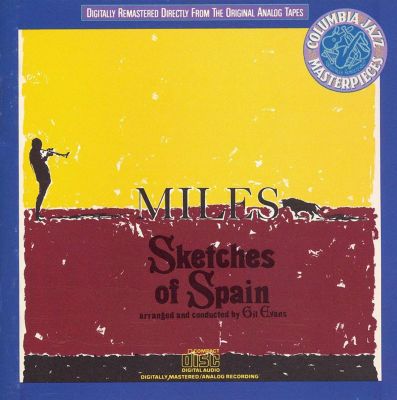
“That’s all I did. That’s all I ever did was try to do what Billy Strayhorn did.”
-Gil Evans
The collaboration between Miles Davis and Gil Evans began with their joint work on Birth Of The Cool. It eventually blossomed into one of the most fruitful collaborations in jazz history. Evans would go on to arrange for 4 Davis albums, 3 of which are considered among the best in Davis’s incredible discography.
Miles Ahead was first. Columbia was willing to shell out serious bucks for Evans to put together a big band designed specifically to showcase Miles’s trumpet. Big bands were’t selling much those days, so it says a lot about Columbia’s faith in Davis. And it paid off. The album was a great success, critically and commercially. It really is a beautiful piece of music and Miles’s playing on it was exceptional. (It also led to an ugly, but amusing, dispute about the cover. To quote Wikipedia, “Davis was reportedly unhappy about the album’s original cover, which featured a photograph of a young white woman and child aboard a sailboat. He made his displeasure known to Columbia executive George Avakian, asking, ‘Why’d you put that white bitch on there?'”)
The follow-up was Porgy And Bess. Originally an opera, written by George Gershwin with lyrics by Dubose Heyward and Ira Gershwin, Porgy And Bess was a perfect vehicle for Miles’s sad trumpet (and flugelhorn). It’s another great example of orchestral jazz, and again Evans arranged it to showcase Davis’s playing. It was a huge commercial success and highly praised. Both Allmusic and Down Beat gave it 5 stars, and they are much deserved.
That brings us to my favorite of the collaborations, Sketches Of Spain. The first piece is the centerpiece of the album, Concierto de Aranjuez, a piece of classical music written for guitar by Spanish composer Joaquín Rodrigo. The Davis/Evans interpretation of it is beautiful, with soft percussion touches immediately setting the feel of the whole album. It has an unmistakable Spanish air to it, and the whole piece has a dreamy, melancholy feel. While that track is the most impoant, the rest of the album carries on the feel of the Concierto. And there’s just enough jazz on the album to make the purists happy, Indeed, in addition to the classical musicians, you’ll find Elvin Jones, Paul Chambers, Jimmy Cobb and Johnny Coles.
Critical reception of this album has always been mixed. When it came out, the classical music critics didn’t like it, especially when comparing it to the traditional versions of the Concierto. Some jazz critics, both present day and at the time it came out, found that it lacked fire. The Penguin Jazz Guide referred to it as “inflated light music”. But I love it. I love the mood it sets, and Davis’s playing throughout.
For more of the same, check out the first two Davis/Evans collaborations. The fourth and final collaboration between the two, Quiet Nights, is not of the same calibre.
63-The Thing with Jim O’Rourke-Shinjuku Growl
“Everyone should have his or her own definition… In my world, the word ‘jazz’ represents resistance, improvisation and swing….”
-Mats Gustafsson
Not for the faint of heart, as in Abandon Hope, All Ye Who Enter Here.
Mats Gustafsson hooks up his other trio, The Thing, (Paal Nilssen-Love on drums and Ingebrigt Haker-Flaten on bass), with guitarist Jim O’Rourke to create an unholy ruckus. I’ve seen The Thing in concert several times, and always left exhilarated, overwhelmed and with ringing ears. While a recording can’t match the live experience, this album comes close.
Jim O’Rourke is an American experimental guitarist, composer and producer, who clearly has a musical imagination that knows no bounds. He can play noise rock or ambient or, I imagine, anything else. He’s collaborated with Sonic Youth, Wilco, Derek Bailey, Nurse With Wound, Merzbow and Henry Kaiser. He’s a perfect counterpart for what The Thing wants to get up to.
While the first tune starts off quietly enough, it slowly but surely builds to extremes, with O’Malley and Gustafsson at times seeming to compete and at times teaming up to make a ruckus. It’s great stuff. The title, by the way? “If Not Ecstatic, We Replay”. No replay needed here.
The title of the second song deserves some discussion. It’s “Half A Dog Can’t Even Take A Shit”. While this bit of wisdom is certainly true, it turns out there’s an explanation for the title. (Thanks to Massimo Ricci at Squidco for explaining this.) I mentioned the previous time I wrote about Gustafsson that I saw him as the heir to Peter Brotzmann. One of the most infamous pairings in all of free jazz was Brotzmann and Han Bennink. They had a glorious and occasionally troubled partnership for many years. See Peter Brotzmann: Free-Jazz, Revolution and the Politics of Improvisation by Daniel Spicer for details. They had an album called Ein Halber Hund Kann Nicht Pinkeln, namely “Half A Dog Can’t Piss.” So this was a tribute to that album, I guess? Anyway, it’s another great track with PNL drumming like a bat out of hell.
But the whole album is terrific, intense, loud and unruly. It’s always incredibly skilled musicians at the top of their game. Also if you have a room full of people with the standard dull taste in music, it can be used to clear the room quickly.
This album is one of a pair, the other being Shinjuku Crawl, with Japanese guitarist Otomo Yoshihide. It’s just as good.
64-Matthew Shipp-Pastoral Composure
“The iconoclastic mode, that specific mode of language, there is an element of it that is punk – that is confrontational. That’s just a part of the language of jazz.”
-Matthew Shipp
I first discovered pianist Matthew Shipp because of his work with the David S. Ware Quartet, one of the most volcanic long-running free jazz groups ever. It consisted of Ware on tenor sax, Shipp, bassist William Parker and a rotation of several different drummers, my favorite being Susie Ibarra. Their music was terrifying and completely absorbing. I saw them live several times and enjoyed seeing the shock of audience members who hadn’t known what to expect. But one of the keys to all of that group’s great music was its beauty. Shipp was a crucial component of that beauty. His style is instantly recognizable, it’s very forceful free jazz with a hint of gospel and, on his Ware albums, frequently recalls more traditional jazz ideas amidst the thunderous tenor sax of Ware. His style might be best understood on his solo albums, the first of which, Symbol Systems, is a classic and the many solo albums he recorded subsequently are all worth checking out.
One of Shipp’s greatest contributions to jazz was to serve as curator to the Thirsty Ear record label’s Blue Series. As described by The L.A. Times, it’s “reclaiming the youthful, intellectual challenge of jazz, finding new forms and audiences”. I see it as providing a bridge between more straight-ahead jazz and the more far-reaching avant-garde forms of jazz. Shipp’s selection of albums for the series is phenomenal. I was insta-buying every single one of these albums I came across in music stores, and I was never disappointed. You’ll find Tim Berne, William Parker, Mat Maneri, Craig Taborn, Kidd Jordan, Fred Anderson, Billy Bang, Roy Campbell and on and on. The label was also the first to take seriously the relationship between jazz and hip-hop. You’ll find DJ Spooky, Springheel Jack and The Antipop Consortium here as well.
Matthew Shipp contributed a number of albums to the Blue Series as well, the best of which is Pastoral Composure, with Shipp, Parker, Campbell on trumpet and drummer Gerald Cleaver. It’s a fantastic album and I would recommend it to anyone looking to broaden their jazz horizons beyond the straight-ahead. The first piece, Gesture, is as good as anything Shipp has done. Initially, his commanding piano style interacts with Cleaver’s military drumming and Campbell steps in with a beautiful, but simple trumpet line which repeats and builds up tension that lasts the rest of the album. The second track, Visions, is straight-ahead jazz of the highest quality. On music like this, the musicians get to show off their skills, and all four of these musicians are among the most skilled at their instruments. But even in this context, Shipp allows a bit of darkness and dissonance to seep into the music. His solo take on Ellington’s Prelude To A Kiss is unabashedly beautiful.
For more Shipp, go to his Thirsty Ear albums, any of his solo albums or his many albums with Ivo Perelman.
65-Mary Halvorson, Weasel Walter & Peter Evans-Electric Fruit

“Electric Fruit alludes to the vexing encounter between nature and technology, one of the most complex issues that we face as a global society…[It] is a stirring and potent recording of the dangerous confrontation between the innate and the artificial, the organic and the robotic.”
-publicity from Thirsty Ear record label.
“I’ve always been attracted to extremity in music. I started listening to free jazz at the same time I was listening to punk and no wave in the ’80s. I put them on a somewhat even keel, and although they were different idioms, I felt they were saying similar things. That’s really the core of my aesthetic—I want music to be wet with bodily fluids, a certain bloody-mindedness that’s part of my music and attitude. I want to see sweat and blood, a little pain and struggle in music. This is not a style—it’s an abstract idea applied to music, and I’m more interested in those essences.”
-Weasel Walter
I feel badly that it took this long into this list for Mary Halvorson to make an appearance. The problem is that there are about 35 albums that deserve to be in the top 20, and the problem gets worse from there.
Mary Halvorson is a guitarist, I hesitate to say in avant-garde jazz because while she has produced some wonderful music in that genre she has no hesitation stepping outside of that narrow box, including several albums of pop music with her band Code Girl. She can rock out or even bring the noise depending on the occasion. Her style is instantly recognizable, as she makes unique use of delay loops, which bring a disorienting aura to some of her playing which I find really appealing. The list of musicians she’s played with is a who’s who of avant-garde jazz. She justifiably won a MacArthur Genius Grant in 2019. I’ve seen her in concert many times, and she is always exciting to watch.
I love the fact that she was originally a biology major at Wesleyan University, but took a course from Anthony Braxton, and not only changed majors but became a professional musician. She’s since played in a number of ensembles with Braxton, and some of their collaborations can be found on the New Braxton House bandcamp page. With her band Thumbscrew, she produced an album of covers of Braxton songs, called The Anthony Braxton Project. It’s well worth checking out as are all the Thumbscrew albums. Also check out her trio albums, Ghost Loop and Dragon’s Head.
Weasel Walter, drummer, guitarist and composer, might not seem like an obvious partner until you realize that he shares Mary’s wildly diverse musical tastes. His most well-known band is probably The Flying Luttenbachers, which he describes as brutal prog. He’s formed a band called Vomitatrix, whose music he describes as acid grind. He has a band called Cellular Chaos, a noise-punk band. (They’re probably my favorite of his projects.) He tours regularly with Lydia Lunch, legendary singer of the no-wave scene. But he’s also at home with free jazz. He recorded an album with free jazz veteran John Butcher and Damon Smith called The Catastrophe Of Minimalism. I saw him perform with Vinny Golia in a fantastic set. I also saw him with Lydia Lunch and they blew the room away.
I’ve already written about Peter Evans. The three of them produce an album that’s fully improvised with none of them using their instruments in anything like a conventional way. At times it feels like there are lots of insects participating on this album. Walter can play loud and fast or just lay down textures and he’s always very responsive to his partners. There’s a wonderful sense of communication between the 3 of them, it feels like they genuinely enjoy each other’s company which gives the album a sense of fun which can be missing from some free jazz albums. And do be sure to check out their song titles. I won’t spoil the surprise.
Mary and Walter have a duo album Opulence, worth checking out, as are all the albums discussed above.
66-Paul Bley, Evan Parker & Barre Phillips-Time Will Tell & Sankt Gerold
“I anticipated all the changes in jazz because they were all problematical things that I was dealing with myself. In New York in the late ’50s, there were a lot of experiments being made on how to avoid playing popular standards and how to get improvising out of those constricting formats.”
-Paul Bley
When Time Will Tell came out in 1995, I initially avoided it in spite of my interest in all three musicians because I had the mistaken belief that good jazz required drums. I didn’t understand how beautiful such music could be. It goes largely under the name of chamber jazz. This album is a fine example and the label ECM is one of the most consistent producers of superb chamber jazz. By the time Sankt Gerold came out in 2001, I was a firm believer.
Paul Bley earned a crucial place in jazz history when he performed in 1958 in The Hillcrest Club in Los Angeles with Ornette Coleman and the other 3 members of what would become the Ornette Coleman Quartet. This is considered in many jazz histories as the beginning of the new thing that would become free jazz. The Penguin Jazz Guide called that concert “the palace coup that overthrew bebop”.
But Bley would go on to be defined by much more than that one moment. He was a superb pianist who could play all sorts of genres of music. He also was a great experimenter with electronic music. But for me he primarily is the greatest practitioner of freely improvised ballads. Maybe someone did this before him, but I can’t think who. Certainly no one has done it better. Bley’s early album Closer may be his most famous, including the great composition Ida Lupino. (Sidenote: The actor Ida Lupino is pretty great too.) But also check out his work with Jimmy Giuffre with the album 1961, the album Flight Bremen 1961, the most famous of Giuffre’s collaborations with Bley and Swallow Free Fall, or the solo album Open, To Love.
By my count, these are the 9th and 10th albums on this list featuring Evan Parker, in spite of my promise to try to keep the number of artists who show up on this list repeatedly to a minimum. You can conclude I kind of like the guy.
Barre Phillips was a free jazz bassist who worked with so many of the most important musicians, and was leader on a number of the very best free jazz albums, including multiple solo albums and bass duets. For some examples of his greatness, check out Joe Maneri, Mat Maneri & Barre Phillips – Angles of Repose (2004) (another great example of ECM chamber jazz), Dave Holland, Barre Phillips – Music from Two Basses (1971) and The Space Between with Barre Phillips. He was also wonderful to see live, as I was lucky to do on several occasions.
Both of these albums are beautiful, both modulate between free balladry and sharper, more aggressive playing. One of the wonderful things about both of these albums is that there is lots of space for Bley to show off his skill and his two partners provide the perfect counterpoint throughout. These three experienced improvisors are happy to take their time and listen to their partners. I would say the first is the more conventionally beautiful of the two. That’s not to say it is in any way soft. The second reminds me of Schoenberg’s 5 piano pieces, and has a similarly disorienting effect. Which one I’m going to listen to depends entirely on my mood. I know I’ll be listening to a master class provided by three legends of free jazz either way.
67-Herbie Nichols-The Complete Blue Note Recordings
“There is a kind of culpability in the discovery of dead artists, and in Herbie Nichols there is an almost perfect example of an artist who was largely ignored during his lifetime, only to be canonized as soon as he was gone.”
-The Penguin Guide To Jazz Recordings
I’m simultaneously listening to the fantastic recordings of Herbie Nichols on Blue Note and reading about his sad life, failing repeatedly to get the recognition he clearly deserved, but which only came after his death at age 44 of leukemia. It’s difficult to square the two. The music is fun with catchy tunes but challenging, and one can almost feel the joy the musicians have in playing it. Fortunately, Nichols had a crack rhythm section to really make his compositions sing out. There’s Al McKibbon on bass, and you may have heard of the 2 drummers he played with over the course of his Blue Note recordings, Art Blakey and Max Roach. That he was given such skilled musicians to work with shows the faith that Alfred Lion at Blue Note had in him. Unfortunately, this never translated into album sales. Nichols apparently expressed his frustration at this in several interviews.
But today, we can just enjoy the music, and I urge you to do so. Check out Amoeba’s Dance or The Third World or House Party Starting or pretty much any tune on this comprehensive collection. Blue Note also did Nichols a huge service in giving this music a great remaster.
Nichols did have one hit during his lifetime when Billie Holiday wrote lyrics for his tune Lady Sings The Blues. While Holiday’s version is a torch song, Herbie’s version is another jaunty piano trio romp.
Further evidence of Herbie’s greatness can be found in the number of free jazz stalwarts that have paid him musical tribute. The great trombonist Roswell Rudd made 3 albums of Nichols covers, and Steve Lacy put together an all-star band including George Lewis, Misha Mengelberg and Han Bennink to record an album called Change of Season (Music of Herbie Nichols).
68-Steve Lacy Solo-More Monk & Clinkers
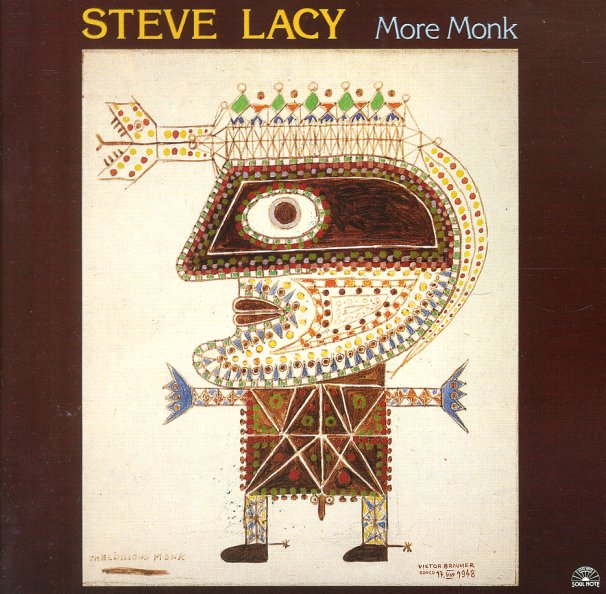
“Play difficult and interesting things. If you play boring things, you risk losing your appetite. Saxophone can be tedious with too much of the same.”
-Steve Lacy
Imagine performing a solo saxophone concert. Imagine the audacity that requires. At least in a solo piano concert, you have a big piece of furniture between you and the audience. I would think the solo sax performer pretty much has to bare their soul. I find solo sax albums incredibly interesting, live or not, and am always give them a listen out of respect for anyone willing to make such a difficult artistic statement.
I’ve already written quite a bit about Steve Lacy, so I’ll just say that his solo saxophone work is unrivalled, and it forms an absolutely crucial part of his discography. Lacy’s playing on these albums and his many other solo albums is so assured, with such pure sound. Every note feels like the only logical note it could be. On Clinkers, we get his compositions, they’re wonderfully knotty but there’s a beautiful melody hidden underneath peeking out. The sound quality on this one is great too. I didn’t realize that it was a live album until the applause kicked in after the first song. On More Monk, we get some of his many majestic interpretations of Monk tunes. I’m sure Monk would be thrilled to hear his tunes being played with such skill and love. And let’s take a moment to appreciate the Victor Brauner painting on the cover.
I’m thinking of this entry at least in part as a tribute to solo saxophone albums. So here is a list of some great ones in no particular order. Several of these musicians have many, especially Braxton, Parker and Stetson. But I’m sticking to one per artist. Am I missing any?
Solo Saxophone Albums
********************
Anthony Braxton-For Alto
Evan Parker-The Snake Decides
Mats Gustafsson-The Education Of Lars Jarry
Signe Emmeluth-Hi, Hello I’m Signe
John Butcher-Nigemizu
Rachel Musson-Dreamsing
Ken Vandermark-Furniture Music
Colin Stetson-The Love It Took To Leave You
Steve Lacy-5XMonk, 5XLacy
Lee Konitz-Lone-Lee
Peter Brötzmann-Münster Bern
Chris Pitsiokos-Irrational Rhythms And Shifting Poles
Rodrigo Amado-Refraction Solo
Sam Rivers-Portrait (Also includes some solo piano, but hey, it’s Sam Rivers.)
Akira Sakata-The Tale Of The Heike
Joe McPhee-As Serious As Your Life
Lao Dan-To Hit A Pressure Point
David S. Ware-Saturnian
Camila Nebbia-rastro o vacío
Erin Rogers-2000 Miles
John Zorn-The Classic Guide To Strategy
69-Dominic Duval, John Heward & Joe McPhee-Undersound
“Keep going.
If you’re tired, keep going.
If you’re scared, keep going.
If you’re hungry, keep going.
If you wanna taste freedom, keep going.”
-Harriet Tubman, quoted by Joe McPhee at the beginning of his album with Hamid Drake, Keep Going.
I’ve seen Joe McPhee in concert many times, and I always find him to be an exciting, impassioned player. He always surrounds himself with wonderful musicians and never insists on the limelight, but he can bring the fire when needed. Listen to him fire up a crowd of students in 1970 on Nation Time. These days, he’s something of an elder statesmen of free jazz, and I can’t think of anyone more deserving of that title.
He plays in many different combinations of instruments. I’ve seen him in a sax duo with Ken Vandermark where they put on a wonderful show full of the very best interplay. He seems especially at home in trios with bass and drums. His Trio X, with Jay Rosen on drums and Dominic Duval on bass, has a number of tremendous albums. I’ve seen him in concert with Nicolas Caloia on bass and Jesse Stewart on drums, another great show.
For this list, I went with a slightly different trio, this time with Dominic Duval and John Heward on drums. I love Dominic Duval on bass. I first heard of him because of the Ivo Perelman album Seeds, Vision and Counterpoint, another trio with Jay Rosen on drums. That album just flat out burns and Duval’s bass, to which he adds electronics, was a huge part of it. I saw this version of the Ivo Perelman Trio and they blew the room away. (They were so loud that after the show my wife vowed to never go to another one of these shows. It was all worth it.)
According to the liner notes here, Undersound is something like the musical equivalent of understatement. But that’s not to say the musicians hold anything back. The playing is superb as is the communication between the 3. Duval gets to take a number of solos, including two tracks which are entirely him solo. This is free jazz that manages to cover a wide spectrum of styles and plays them all well.
For more Duval, check out the Perelman album mentioned above. McPhee is great on any of the Trio X albums, but also try any of his Hat Art albums, like Linear B or Legend Street One. He has a great solo album on Hat Art called As Serious As Your Life.
70-Akira Sakata-Arashi
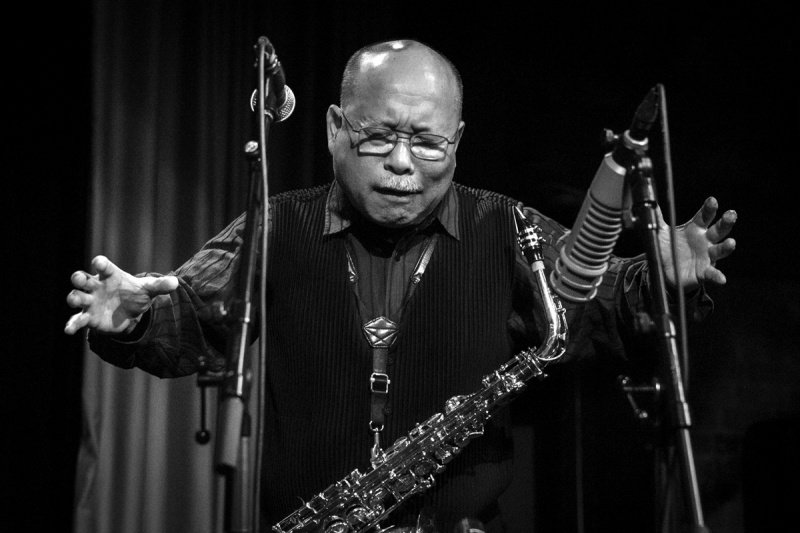
-Photo of Akira Sakata vocalizing.
I gave this album a first listen despite having no idea who Akira Sakata was. But I knew his partners on this album well. There’s drummer Paal Nilssen-Love, frequent collaborator of Mats Gustafsson and one of the world’s greatest drummers. Then there’s another frequent Mats partner, Johan Berthling on bass. That was more than enough to convince me to give this a try. I immediately fall for Sakata’s sax playing. He’s fast, propulsive with a sharp edge but he seems very much in control, and knows the statement he’s trying to make. He’s more than able to hold his own with his distinguished partners. And PNL is being PNL. I’m hooked. I’m thinking album of the year candidate.
Then all of a sudden, the vocals kick in. It’s the track Ondo No Huna-Uta, which means Rower’s Song Of Ondo, Ondo being a type of Japanese folk music. I immediately think of Toshiro Mifune running raging and howling into battle, samurai sword held high. But somehow Sakata’s vocalizing is also profoundly musical. I don’t really know how to explain it, except to urge you to give it a listen. The song is on youtube. From that moment, I was a Sakata obsessive. (I love samurai movies almost as much as free jazz, and Mifune is the greatest Japanese actor IMO.)
Born in Japan in 1945, Sakata grew up listening to jazz on Voice Of America and took up playing while also studying marine biology. He played in a well-known Japanese jazz trio led by Yosuke Yamashita. But the defining moment in his career may have been in 1986 when he sat in with the infamous free jazz/death metal/hardcore punk/raging bonfire of a band Last Exit. It featured Bill Laswell, Peter Brotzmann, Ronald Shannon Jackson and Sonny Sharrock. If you know these four gentlemen, you might be able to guess how ferocious and uncompromising this band was. The concert actually produced an album, The Noise Of Trouble: Live In Tokyo. One can’t help thinking this had a large impact on Sakata’s style and philosophy of music. It certainly shows in Arashi.
For more, Sakata has a great solo album called The Tale of the Heike with lots of his vocals. The Arashi band now has several albums, check out Jikan. For a really wild ride, try Flying Basket which also features experimental guitarist Jim O’Rourke (discussed above), Japanese noise artist Merzbow, Chris Corsano on drums and Darin Gray on bass. My ears are ringing just typing that line-up.
71-Grachan Moncur III-Evolution
“In my opinion, the trombone is the true head of the family of wind instruments, which I have named the ‘epic’ one. It possesses nobility and grandeur to the highest degree; it has all the serious and powerful tones of sublime musical poetry, from religious, calm and imposing accents to savage, orgiastic outburst. Directed by the will of the master, the trombones can chant like a choir of priests, threaten, utter gloomy sighs, a mournful lament, or a bright hymn of glory; they can break forth into awe-inspiring cries and awaken the dead or doom the living with their fearful voices.”
-Hector Berlioz
Grachan Moncur was one of the first trombonists to work towards introducing their instrument into the developing “new thing” that would eventually be free jazz. He did so with this, his debut album (1963), with a combination of wonderful knotty compositions which extend beyond the hard-bop formula and virtuoso playing. In addition to this album, he worked extensively with alto sax player Jackie McLean on several of McLean’s albums, and contributed several compositions. McLean made the landmark album Let Freedom Ring and was one of the first great musicians to try on a major label record to push beyond the hard-bop formula. That album led to this album and a whole lot more, indeed it helped mark a new direction for much of the Blue Note lineup.
On Evolution, Moncur also had a crack band. In addition to McLean, he’s joined by Lee Morgan on trumpet. Morgan may have the most catchy tune in the history of the Blue Note label with The Sidewinder. Go ahead and give it a listen, it will be in your head for days (in a good way). (Morgan is also yet another of the horrible jazz tragedies. See the documentary I Called Him Morgan for the awful details.) Then the young drummer Tony Williams who would go on to be an integral part of Miles’s second great quintet. Bob Cranshaw is on bass. While he has no albums as leader that I can find, he was basically the house bassist for Blue Note and the other big labels of the 60s, and played on a huge number of the most important albums in jazz history. In particular, he played on at least 25 albums by Sonny Rollins. And then the most surprising move of all, Moncur replaces what would typically be a piano with Bobby Hutcherson on vibes. I think Hutcherson is seriously under-appreciated and his contribution here is one of the key factors in making the album work so well.
Moncur’s playing is top-notch. But the memorable thing here is the compositions. There are 4, all quite long, leaving lots of space for soloing. The first track, Air Raid, does feel like a fairly standard hard bop piece, but with a memorable melody and great soloing by Morgan. It’s the title track that starts to set this album apart. Hutcherson lays down a single note struck repeatedly which gives the tune a hypnotic feel. Moncur takes a beautiful solo followed by one from Hutcherson as he veers away from the earlier drone he had established. Listening to this, I wish vibes were much more prominent in jazz. (I’ll pause for a minute to mention that Jason Adasiewicz’s work with Peter Brotzmann on the album Mental Shake is exactly the sort of thing I’m talking about.) While The Coaster is another well done post bop tune, it’s the final track Monk In Wonderland that lands Evolution on this list. Greg Simmons at All About Jazz describes it as “…with an opening that could have been composed for Pee-Wee’s Playhouse: an abstract children’s theme…” I like that. It captures how much joy went into the playing and writing here. Hutcherson’s soloing is again great on this track.
For more along the same lines, try Moncur’s Some Other Stuff, which is a much better album than that title would indicate. Try Jackie McLean’s Let Freedom Ring or One Step Beyond or Destination… Out!. Also there’s Bobby Hutcherson’s Dialogue or Components or Stick-Up!.
72-Sam Rivers-Reunion: Live In New York
“Traditionally in jazz you play a theme and then you improvise on that or on the harmonic material. I decided to take it a little further. You take a theme and then depart from it without regard to the underlying harmonics. The next step is to start with nothing and just create everything right then and there. A lot of musicians were going in that direction: Cecil Taylor, Ornette Coleman and Anthony Braxton. The high point was in the late ’70s.”
-Sam Rivers
Sam Rivers recorded a series of classic albums for Blue Note in the 1960s, the best of which, Contours, almost went into this slot. It featured a pretty much perfect line-up for a 60s Blue Note album, with Freddie Hubbard, Herbie Hancock, Ron Carter and Joe Chambers. He had played briefly with a version of The Miles Davis Quintet, so had familiarity with these musicians, and it shows. The album is one of the very best examples of how hard bop was growing into a freer more improvisatory style. Rivers would be one of the leaders of that movement.
One of his most important achievements wasn’t an album, it was the founding of the Rivbea jazz loft. (The “bea” is after his wife Beatrice.) The jazz lofts were a cultural phenomenon of the 70s, where the most avant-garde musicians who weren’t able to find steady work would move into abandoned downtown spaces in NYC and turn them into living and performing spaces. See Michael Heller’s book Loft Jazz: Improvising New York in the 1970s or the film Fire Music: The Story Of Free Jazz for more details. Heller writes:
“loft practices came to be defined by a number of key characteristics, including (1) low admission charges or suggested donations, (2) casual atmospheres that blurred the distinction between performer and audience, (3) ownership / administration by musicians, and (4) mixed-use spaces that combined both private living areas and public presentation space…this was community music. Part of the point was that, free of the strictures of clubs, the music could be anything, go anywhere, go on for as long as it wanted.”
While these lofts eventually came to an end, they established that there was a whole community of free jazz musicians who were willing to stick together and Rivers was seen as one of their leaders. During that time, Rivers formed a trio with Dave Holland and Barry Altschul, which was one of the great bands of the decade, but wasn’t well documented. They had two albums, The Quest and Paragon, which were out of print for decades, but can now be found on iTunes, at least.
The release of Reunion: Live In New York was met with huge excitement, and it was a delight to discover that the trio was as good as they were rumored to be. Keep in mind, Rivers was 84 years old at the time. Of course this is three quarters of the Dave Holland Quartet that recorded Conference Of The Birds. But Rivers was squarely the focus here. As always with Rivers, he’s able to mix the avant-garde with hard bop with bebop with achingly beautiful melodic sections. He plays tenor and soprano saxophones, flute and piano, each with a unique imprint of his personal style.
I’ll leave this with a quote from Mark Corroto of All About Jazz:
“If this recording had been made in 1977 instead of 2007 it would have been a watershed event. Here, it is a masterpiece of a reunion.”
For more Rivers, another late period masterpiece is his album Portrait, a solo album on FMP, where he again plays all the above instruments.
73-Colin Stetson-New History Warfare, Volume 2
“Lord, I just can’t keep from crying sometimes.
When my heart’s full of sorrow and my eyes are filled with tears.”
-Blind Willie Johnson
There is no experience in the world quite like a solo Colin Stetson show, and if ever given the chance to see him, I highly recommend it. I’ve seen him many times, and the first note, though I always know it’s coming, is always astonishing. I’m reminded of the scene in Close Encounters Of The Third Kind when the first note the alien spaceship plays blows out all the windows in the nearby building. But after the shock of the first note, you’ll quickly be mesmerized by the musicality that underlies his forceful playing. You’ll also doubt that the one guy in front of you is making all the noise you’re hearing. It sounds more like the advance of a musical army. But one of Stetson’s key techniques is to place microphones throughout the inside of the sax. That combined with his circular breathing skills are the basis of his extraordinary performance.
This is especially stunning to hear when he plays the enormous bass saxophone. I’m sometimes amazed that he can even lift the damn thing, let alone make the compelling music that he makes on it.
His solo albums (I believe he has seven.) are recorded in the same way he performs live, in a single take with no overdubbing. Honestly I wouldn’t have believed that if I hadn’t seen him perform. This is my favorite of his solo albums because it’s so emotional, there’s a profound sadness that the deep sounds of his sax playing bring out. The sadness can be found in the titles. There’s Awake On Foreign Shores, All The Days I’ve Missed You, From No Part Of Me Could I Summon a Voice, Lord I Just Can’t Keep From Crying Sometimes, All The Colors Bleached To White and The Righteous Wrath Of An Honorable Man. One of these, Lord I just… is a cover of a Blind Willie Johnson song, and it features vocals from Shara Worden from the band My Brightest Diamond.
This is the other thing I love about this album, in addition to Shara Worden, the album features vocals of one of my musical heroes, Laurie Anderson. Here her soft, spoken word style contrasts the pulsating saxophone of Stetson on the tracks A Dream Of Water and Fear Of The Unknown And The Blazing Sun perfectly.
For more Stetson, check out his solo albums The Love It Took To Leave You, All This I Do For Glory or his duo with Sarah Neufeld Never Were The Way She Was. For something completely different, try Sorrow: A Reimagining Of Gorecki’s 3rd Symphony.
74-Herbie Hancock-Empyrean Isles
“There’s a thread, now, that connects us, and that thread is Miles Davis. It’s… I don’t even know how to put it into words, but it’s like, once you’ve been touched by Miles you’re changed forever. But what you change to is more of who you really are…”
-Herbie Hancock
Herbie Hancock’s Empyrean Isles is probably the album that set in cement forever the Blue Note 1960’s style. It has arguably the catchiest Blue Note tune ever in Cantaloupe Island (give or take Lee Morgan’s Sidewinder). You know the tune, you’re probably humming it already. If you don’t recognize it by its title, check out the original or try Us3’s Cantaloop (Flip Fantasia) to remind yourself. That’s one of the few hip-hop songs where the sampling doesn’t bother me, they give it such a respectful treatment.
The album’s performed by 4 musicians of the “needs no introduction” variety. There’s Hancock, Ron Carter on bass, Freddie Hubbard on trumpet and Tony Williams on drums. Carter, Hancock and Williams were in the second great Miles quintet. Hubbard will be along on his own album soon, but he appeared on Ornette’s Free Jazz, Trane’s Ascension, worked with The Jazz Messangers, was on multiple Wayne Shorter albums and many, many more of the most important albums in jazz history.
It shouldn’t be forgotten that the album is much more than Cantaloupe Island. All 4 compositions are brilliant in a unique way. The final piece, The Egg, is just 14 minutes of brilliance.
There isn’t much more to be said about this one, except give it a listen.
For more, check out any of Herbie’s Blue Notes. There’s not a dud in the bunch. If you want to hear his electric side, check out Headhunters.
75-Sun Ra-We Travel The Spaceways/Bad And Beautiful
“The outer space beings are my brothers. They sent me here. They already know my music.”
-Sun Ra
“In some far off place, many light years in space, I’ll wait for you. Where human feet have never trod, where human eyes have never seen. I’ll build a world of abstract dreams and wait for you.”
-Sun Ra
“I am strange,
my mind is tinted with the colors of madness,
they fight in silent furor in their effort to possess each other,
I am strange.
I have approached a degree of love that is so unwise,
In one world that it is wisdom in another,
I am strange,
I no longer have respect for hate,
I’m stronger than hate.”
-Sun Ra
“I’m actually painting pictures of infinity with my music, and that’s why a lot of people can’t understand it.”
-Sun Ra
I feel like it’s somehow wrong to only talk about Sun Ra’s music, let alone just talk about a single album. I was sorely tempted to just leave the quotes above as the discussion for this entry. But that wouldn’t be fair to the band that put this great music together.
Sun Ra was is a cosmic being whose essence could not be contained in human form. While he did grace the earth with his presence, he put together a wonderful band which he called the Myth Science Arkestra or just the Arkestra. Some of the brilliant members of the band were Ra on keyboards, and Marshall Allen and John Gilmore on saxes. Allen and Gilmore could easily have had great careers on their own, but their devotion to Ra and the Arkestra was absolute. They were more than a band, they were a commune, absolutely devoted to Ra and each other. According to Val Wilmer in her wonderful book As Serious As Your Life: Black Music and the Free Jazz Revolution, 1957–1977:
“For a reunion in Central Park, New York, Sun Ra was able to assemble a hundred-strong Arkestra of ex-alumni.”
They produced stunning music which somehow was both far ahead of its time and very much of its time. It’s in essence big band music. (Sun Ra was actually an arranger for the Fletcher Henderson Big Band earlier in his career.) But he also left lots of space for free jazz elements.
This entry is actually 2 albums which were paired for CD release. We Travel The Spaceways is done by a 15 piece band. It has all the hallmarks of a big band, a lot of this music has the old-fashioned feel of Count Basie or Duke Ellington, but then there’s a twist, and you know you’re listening to Ra. One of the twists is what the band called “space chants”. When I saw them in concert, I was chanting “interplanetary music” along with everyone else. To give you some idea of what the Arkestra was about and how they differed a bit from the usual big band, here’s a quote from Robert Campbell’s book From Sonny Blount to Sun Ra: The Chicago Years:
“The bizarre whirring and quacking heard at the end of “We Travel the Spaceways” comes from a toy robot with flashing lights; John Gilmore told John Corbett that around this time the Arkestra would release the “robots” into the audience during their performances. The band also used mechanical “flying saucers” as props.”
Bad And Beautiful is recorded by a sextet and less essential, but still beautiful and fun.
One of the reasons talking about the albums is slightly unsatisfying is that they can’t match a live performance. I’ve been lucky enough to see the Arkestra twice (unfortunately after Sun Ra left this galaxy) and it was an unforgettable experience.
It should also be said that the ranking of this album doesn’t reflect the enormous impact that Sun Ra had. I highly recommend Val Wilmer’s As Serious As Your Life: Black Music and the Free Jazz Revolution, 1957–1977, which has an extensive chapter on Sun Ra.
For more, check out Jazz In Silhouette or The Heliocentric Worlds Of Sun Ra. As of this writing, Marshall Allen is still alive at the age of 101 and released his first album as leader at the age of 100.
A great article about Sun Ra is How Sun Ra Taught Us To Believe In The Impossible, by Hua Hsu, which appeared in The New Yorker in 2021. Also see the movie Fire Music: The Story Of Free Jazz in which Ra and The Arkestra figure prominently, and there’s lots of concert footage.
76-Sylvie Courvoisier & Mark Feldman-Hotel Du Nord
“Dance me to your beauty with a burning violin.”
-Leonard Cohen
The second album from a quartet of superb musicians. There’s Sylvie Courvoisier, an award-winning Swiss pianist and composer who has produced some of the most stunning jazz albums of the last several years. Her most recent project Chimaera was on many album of the year lists and was universally well-reviewed. That band put on a sensational show at the 2025 Big Ears Festival. Mark Feldman is a jazz violinist who brings a distinct contemporary chamber music feel to every project. He’s played with John Zorn and the Masada String Trio, Marilyn Crispell and Dave Douglas to just name a few of his collaborations. Thomas Morgan is a much in demand bassist, and a regular on ECM albums. He’s played with Tyshawn Sorey, Craig Taborn, Tomasz Stanko, Henry Threadgill, Bill Frisell and on and on. We’ve talked about drummer Gerry Hemingway already, and he’ll also appear again soon.
The first piece here is the title track where, after a bass solo, Sylvie at first plays a simple repetitive riff which sets the mood and pace, Feldman starts to play over the riff, alternating between bowing an picking the strings to get an increasingly insistent feel to the tune. Then Sylvie takes a great, forceful solo. Morgan and Feldman pair up beautifully. All the while, Hemingway is setting a subtle rhythm which keeps the musicians on pace. The music would very much feel like contemporary classical music, something like Messiaen perhaps, but for Hemingway’s drumming, and I think that’s what the goal of this music is. It’s not like third stream music, where jazz and classical music seemed to be just jammed together. Here the piano and violin especially are incorporating chamber music motifs into their compositions and improvisations. It has a much more natural feel to it. I think this describes in particular a great deal of Feldman’s career.
For more, check out the quartet’s first album To Fly To Steal. There’s a slightly different lineup on Birdies For Lulu, and as already mentioned, Chimera is a great listen. Feldman is part of the Masada String Trio which have several albums on the Tzadik Label. He also appeared on Marilyn Crispell’s great album Santuerio.
77-Wadada Leo Smith-Tabligh
“When I’m performing, my focus is deeply inside me, and when I’m making art, if I’m successful on focusing deep inside, I can create a higher quality. I’m aware of the ensemble making this journey with me, but I’m not responsible for them, I‘m responsible for myself. And that’s true if I’m playing their music or I’m playing my music.”
-Wadada Leo Smith
“Creation serves as the opposite of composition, and therefore it refers to a work of art in the same respect as composition. It is not unlike composition in this sense, it has signs and symbols which could also be found in composition. Also, unlike composition the performers use those signs and symbols to generate a work of art, whose dimensions are realized in the present moment.”
-Wadada Leo Smith
Wadada Leo Smith is one of the most respected and, I think it’s fair to say, revered members of the free jazz scene. I’ve had the extreme pleasure of seeing him 5 or 6 times over the last couple of years. At the 2025 Big Ears Music Festival, at the age of 83, he programmed a series of shows both for him to perform and others to perform his compositions. In the first show alone, he performed two solo pieces and then a string quartet, the RedKoral Quartet, performed multiple of his compositions, and then he joined them to perform a new piece of music he had composed. The next day he performed with his band Revolutionary Fire-Love, which mixed his trumpet with strings, percussion and electronics. He performed in a duet with Vijay Iyer, then in Sylvie Courvoisier’s band Chimaera. He then finished up performing with Radio Light & Orange Wave Electric for still more of his music. I said that he was revered earlier. To show you that’s not an exaggeration, the Festival also featured The Knoxville Symphony Orchestra performing Tyshawn Sorey’s piece Adagio For Wadada Leo Smith.
He’s also won pretty much every award. He’s collaborated with everybody including (this is taken from his website):
“Anthony Braxton, Leroy Jenkins, Roscoe Mitchell, Henry Threadgill, Lester Bowie, Joseph Jarman, Cecil Taylor, Steve McCall, Anthony Davis, Carla Bley, Don Cherry, Jeanne Lee, Tadao Sawai, Muhal Richard Abrams, Ed Blackwell, Kazuko Shiraishi, Han Bennink, Marion Brown, Charlie Haden, Malachi Favors Magoustous, Jack DeJohnette, Vijay Iyer, Ikue Mori, Min Xiao Fen, Bill Laswell, John Zorn, Ronald Shannon Jackson, Frank Lowe, among many others.”
More importantly is the message he brings with him every time he speaks or performs. It’s a message of compassion for everyone. It shows in his words and music.
Having said all that, I had the difficult task of choosing one of his albums. He has produced so much great work of so many different styles that I was almost despairing. Eventually I settled on Tabligh, made with his quartet with Vijay Iyer playing piano and keyboards, John Lindberg on bass and Ronald Shannon Jackson on drums.
This album is very much his tribute to the electric era of Miles Davis. I was initially surprised to like this album as much as I did, since I’m not a big fan of those Miles albums. But the musicianship is superb here, from all 4 musicians. And I think the fact that it was a small group rather than the much larger groups Miles worked with made a huge difference. I found those albums to be too busy. But here there’s sufficient space for every musician to show their skills. I realize I’ve talked about Wadada a lot, but this is the first time I’m mentioning what a brilliant trumpeter he is, and the setting of this album give him the perfect arena to demonstrate this. There’s a dark and ominous feel to the music, especially generated by Lindberg’s bowing and Iyer’s keyboards, which makes Wadada’s bright trumpet sound stand out even more.
It’s almost difficult to know where to begin for more. But one great choice is his duo with Anthony Braxton, Organic Resonance. You could get any of his albums on the Tzadik label. One of his most famous pieces is 10 Freedom Summers which was nominated for a Pulitzer. It’s the one I almost chose for this list. He has a great album with George Lewis and John Zorn, Sonic Rivers. I also enjoyed his duo with Ed Blackwell, The Blue Mountain’s Sun Drummer. For something completely different, there’s a box set of his String Quartets, Volume 1-12.
78-Milford Graves-Babi & Children Of The Forest

Look at the room downstairs
Look at the garden outside
Don’t try to analyze it
Just take it in
-Milford Graves, from the movie Full Mantis.
“And when they make a long blast with the ram’s horn, when you hear the sound of the trumpet, then all the people shall shout with a great shout, and the wall of the city will fall down flat…”
-The Book Of Joshua, Chapter 6, Verse 5
If ever there was music capable of bringing down the walls of Jericho, it’s the music of Milford Graves and his partners in holy noise, Arthur Doyle and Hugh Glover. I’ve listened to lots of free jazz, especially a lot of the energy music of people like Brotzmann and Gustafsson, and I’ve never heard anything quite like this trio. The first and most obvious point is Milford’s extraordinary drumming. I repeatedly found myself thinking this can’t be just one guy. I can’t help thinking this is what Elvin would have sounded like had he embraced free jazz. I can’t think of a higher compliment than that.
Glover and Doyle aren’t interested in melody. They are living entirely on the very edge of what their instruments can do, skronking, screeching, howling, maybe a made-up verb with -ing on the end should go here, and they’re always driving each other to even greater heights. You won’t come away from this album humming. If you can find yourself in the same headspace as these musicians, you will come away from listening to this stunning, frequently shocking music exhilarated. As Graves would say, “Don’t try to analyze it, just take it in.”.
Byron Coley at Forced Exposure writes (about Babi):
“… the way his mastery of all known pulses weaves its way through the blazing skronks of Doyle and Glover is quite astounding… they have a pretty incredible way of moving sheets of sound around and through each other’s auras. It is surely one of the most explosive and powerful albums of pure Fire Music extant, and is highly recommended to anyone who doesn’t know it.”
This comment applies equally to Children Of The Forest.
Babi was originally a single 30 minute LP recorded in 1976, which was incredibly hard to find. It was reissued on CD by the Corbett Vs. Dempsey label, who added a second CD of previously unreleased music from the same trio from 7 years earlier.
Children Of The Forest contains the results of 3 recording sessions in Graves’s basement studio. The first session is the full trio and is by far the most interesting, the second is a duo with Glover and the third is a very brief solo song from Graves.
For more, there is an extraordinary album by Peter Brotzmann, William Parker and Milford Graves called Historic Music Past Tense Future. Graves also has a duo with John Zorn on the occasion of Zorn’s 50th birthday. Also be sure to check out the documentary Full Mantis about Graves. It was made by a former student of his and features a great deal of concert footage as well as letting you into the mind of Milford Graves.
79-Freddie Hubbard-Ready For Freddie
“I used to try to play like [Miles Davis], and Miles caught me copying him one night at Birdland. He said, ‘Hey man, why don’t you play some of your own stuff.’ So, I finally did, because I had copied all his solos.”
-Freddie Hubbard
Freddie Hubbard has a unique claim to awesomeness. He’s the only musician to appear on both of the classic American large group free improvisation albums of the 60’s, Ornette’s Free Jazz and Trane’s Ascension. It was clear early on that he could play pretty much anything. This album fits squarely into the hard bop genre, and it’s an absolutely perfect example. Scott Yanow of Allmusic quite justifiably declared it one of the 17 essential hard bop recordings.
The first track Arietis, a Hubbard composition is a classic of the form. Hubbard’s tone and playing here are sensational. I’ll confess the trumpet isn’t my favorite instrument, but his playing here could change my mind. The second track, Weaver Of Dreams, a standard, is a beautiful ballad with Hubbard’s stunning playing. There’s a composition by Wayne Shorter, and two more by Hubbard, all among the best of the genre.
Oh, and Hubbard has a fantastic band here as well. There’s Wayne Shorter, Elvin Jones, McCoy Tyner and Art Davis, familiar names to anyone who follows Blue Note and Hard Bop. And one more. Bernard McKinney, who would later change his name to Kiane Zawadi, plays the euphonium. I’ll confess I had to look up both the musician and the instrument. It sounds like a deeper version of the trombone. He takes a couple of great solos, especially on the Shorter track, Marie Antoinette.
For more Freddie, most of his Blue Notes are great. Check out Open Sesame, Hub Cap or Hub-Tones.
80-Rodrigo Amado-The Bridge: Beyond The Margins
“I like to think about the music I do as real-time composition, so I relate a lot to melodies, to harmonic cycles and rhythmic cycles, and this is something that you find very strongly in avant-garde jazz.”
-Rodrigo Amado
Sometimes I’ll come across an album where the lineup of musicians is so amazing, I won’t even bother to give it a preview. I’ll just buy it on the spot. Beyond The Margins is one of those. I was not disappointed. It’s got Gerry Hemingway on drums and Alexander von Schlippenbach on piano, both of whom appear on top 10 albums on this list. Then there’s Ingebrigt Haker-Flaten, long-time colleague of Mats Gustafsson and member of The Thing, Gustafsson’s riotous free jazz band, which is also on this list.
That leaves Rodrigo Amado, the leader of this band. He’s a Portuguese saxophonist with a tremendous sound and an ability to improvise that rivals the very best. It’s not without justification that the third track on this album is a revisiting of a classic Albert Ayler piece. He has multiple long-term projects, all of which are producing superb music. There’s Motion Trio with Miguel Mira on cello and Gabriel Ferrandini on drums. They’ve collaborated with Jeb Bishop on The Flame Alphabet, which I almost put into this spot. There’s Wire Quartet with Ferrandini again Manuel Mota on guitar and Hernani Faustino on bass. Their album, called simply Wire Quartet, appeared justifiably on many year-end lists. The Portuguese free jazz community is producing some of the finest music today between Amado and The Red Trio which will be showing up on this list soon.
Back to this album, the central piece of the album is the title track which takes up 43 minutes, and it feels like not a minute is wasted. Pieces that long can degenerate into blowing contests or aimless noodling, there’s none of that here. It is also entirely freely improvised as far as I can tell, which makes it all the more remarkable. This is 4 masters of free jazz at the top of their powers creating something very special.
All of the Amado albums discussed above are worth a serious listen. The Flame Alphabet is probably my favorite. He also has a solo album called Refraction Solo.
81-Bobby Hutcherson-Dialogue
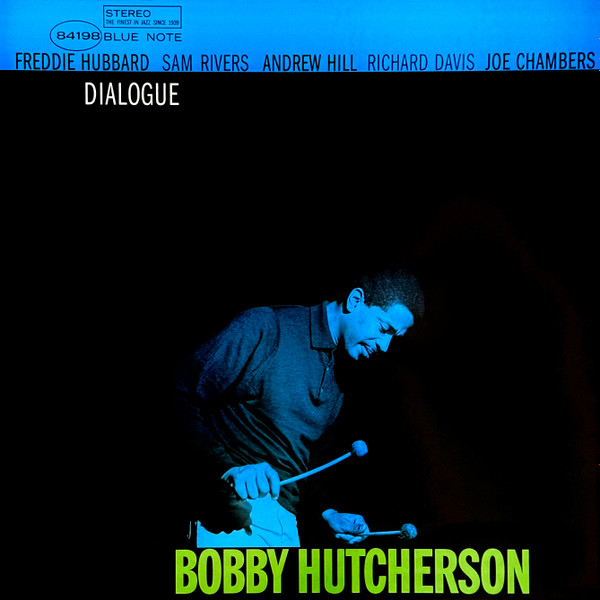
“If Bobby Hutcherson had been a horn player, or even a pianist, he would certainly be regarded as one of the major figures of the past 25 years…few have developed such a consistently challenging language for the instrument.”
-The Penguin Guide To Jazz Recordings
One of the unexpected benefits to me of working on this list is that I’ve discovered there are artists who I hadn’t appreciated sufficiently. Aside from all of the early jazz greats I’ve studied to put this list together, there’s Bobby Hutcherson and his great work on the vibraphone. When I was writing the entries for the Andrew Hill and Grachan Moncur entries above, I realized how much I appreciated Hutcherson’s playing. I came to realize he was more than a sideman. So I’ve been catching up on his albums as leader, especially the Blue Notes from the 60s. This one in particular is a classic.
Yes, it features the great Sam Rivers, the also great Freddie Hubbard and the equally great Andrew Hill (OK, I admit I’m running out of adjectives.) and, yes, Hill wrote 4 of the 6 tracks. But this is Hutcherson’s show and his bandmates give him the lead. It’s post-bop in the very best sense, but it pushes the boundaries much like the other two albums on which Hutcherson appears on this list. I’m listening to a beautiful Rivers solo on the song Ghetto Lights as I type this which leads into an exciting vibes solo. The closer, Jasper, cranks up the pace and Bobby is more than capable of keeping it. Hubbard and Hill are terrific on this track. I would have killed to be in the studio for the recording of this album.
For more Bobby Hutcherson, get Eric Dolphy’s Out To Lunch first. Then go for Hutcherson’s own Stick Up! and Components.
82-Tim Berne, Jim Black & Nels Cline-The Veil
“I was able to do all this stuff because of guys like Braxton, Roscoe, Ornette, Cecil. Anybody who basically stopped playing song forms laid it out: you can do whatever you want. You don’t have to necessarily play straight-ahead jazz to be a “jazz musician.” I wasn’t really sticking my neck out; it’d already been done. I had my moments of noisy shit but basically, I was into really melodic, rhythmic music….Even though I loved Joe Henderson, Sonny Rollins, and those guys, that wasn’t my language, it isn’t now, it may never be. But grooves are something that I like.”
-Tim Berne
The smoke filling our living room is coming from my headphones as I listen to The Veil, by Tim Berne, Jim Black and Nels Cline. And smoke this album certainly does, it’s an album by three of the very best improvisers. Berne is a major star of the improv scene who effortlessly mixes ideas from hard rock and funk into his sax playing. I think his approach to improvising is as exciting as anything going on today.
I’ve seen Berne in concert many times, and he always seems to work well opposite guitarists. In the band Son Of Goldfinger, he worked with David Torn and they put on a tremendous show at The Ottawa Jazz Festival. With his band Big Satan, he works with Marc Ducret to great effect. Here he’s opposite one of the very greatest of improv guitarists in Nels Cline, famous for The Nels Cline Singers, The Consentrik Quartet and lots of other projects. Jim Black is one of the most in demand free jazz drummers going, having worked with Dave Douglas, Peter Evans, Satoko Fujii and many others. He’s capable of rocking out or playing subtle accompaniment as the situation warrants.
The album is presented as 9 tracks, but it is really all one continuous piece presented to a live audience. It’s always intense, but varies between furious jazz riffing, gritty rock and some moments of calm. I especially love the title track for its interlude of peace. Even here the communication between Cline and Berne is amazing.
I was trying to come up with a description of the music on this album which wasn’t just a bunch of superlatives. But I’ve decided I can’t top Paul Acquaro from The Free Jazz Collective:
“…they are wrapping Waterford crystals in sheet-metal and playing catch. They are sprinkling machine nuts in the gears watching it sputter and spit out twisted scraps and unanticipated treasures.”
For more Berne, check out any of the Snakeoil, Big Satan or Bloodcount albums. His very recent album Yikes Too with Guitarist Gregg Belisle-Chi is one of the best albums of 2025.
The Nels Cline Consentrik Quartet album is also one of the best of 2025. Another album I like is Accidental Sky by White Out with Nels Cline. Any of the Nels Cline Singers albums are also worth a listen.
Jim Black has a great band in Jim Black and The Schrimps. (Yes, that’s how he spells it.) I loved their album Ain’t No Saint.
83-Django Reinhardt-In Chronology 1939-1940 (Complete Jazz Series)
“… by far the most astonishing guitar player ever has got to be Django Reinhardt … Django was quite superhuman, There’s nothing normal about him as a person or a player.”
-Jeff Beck
“Jazz attracted me because in it I found a formal perfection and instrumental precision that I admire in classical music, but which popular music doesn’t have.”
-Django Reinhardt
Before getting to Django, I want to give a very strong recommendation to the music label called The Complete Jazz Series, also called Chronological Classics. They have a remarkable string of almost 1000 albums documenting the early jazz pioneers. All the ones I’ve listened to have been great quality (considering they were recorded in the 1920s, 1930s and 1940s). I’ve discovered the music of some fantastic artists this way, like Henry “Red” Allen, Kid Ory, King Oliver, Miff Mole (how’s that for a name?), and of course Django Reinhardt. They’ll document all of the recordings by the named artist over a certain time frame. For Django, they have 1934-35, 1935, 1935-36…, 17 albums in total. All of the Complete Jazz Series album covers look like the above with different colors, and most of them are available on iTunes super cheap. I was a bit familiar with Django before, but I’ve had the opportunity to listen to so much of his music because of this label.
Django Reinhardt, born in Belgium to a Romani family, may well be the greatest of all jazz guitarists. Certainly in early jazz only Charlie Christian can compare, and listening to Django’s music is an absolute delight. It’s squarely within the framework of swing music and “swing” is the most accurate description I can imagine. I find myself unconsciously swaying back and forth and tapping my feet almost immediately.
His first claim to fame was when he partnered with French violinist Stephane Grappelli to form the Quintette du Hot Club de France. They form one of the most legendary partnerships in all jazz history and any recording featuring the two is pretty much guaranteed to be great. This album has several.
Reinhardt was seriously injured in a fire, losing several fingers, but was undeterred in his playing. He was in Paris for much of WWII. As a Romani and a jazz musician (the nazis considered jazz degenerate music), he was in constant danger of persecution. According to Wikipedia:
“Reinhardt’s first attempt at escape from Occupied France led to capture. Fortunately for him, a jazz-loving German, Luftwaffe officer Dietrich Schulz-Köhn, allowed him to return to Paris. Reinhardt made a second attempt a few days later, but was stopped in the middle of the night by Swiss border guards, who forced him to return to Paris again.”
After the war, he toured the U.S., played with Duke Ellington and played Carnegie Hall to great acclaim.
The album under consideration has a great mix of classic tunes given the Django treatment. There’s Tea For Two, The Man I Love, Blue Skies… There are also compositions by Django. Naguine is quite beautiful. There are solo tunes, tunes with Grappelli and every one of them is catchy as hell.
For more Django, I’m pretty sure any of the albums in this series will be great. A more wide retrospective would be The Best Of Django Reinhardt on Blue Note.
84-Mette Rasmussen, Tashi Dorji & Tyler Damon-To The Animal Kingdom
“I don’t want to be a preacher, or impose upon the identity of others! I think being able to alter perception of “the now” or contribute to how we perceive what we experience in the now, can happen at a concert. You know that one second where your mind is not capable of understanding any of the content, but you are so affected emotionally that you feel it all over your body. You know “that” physical reaction that your mind can´t comprehend. Being able to get to that point with an audience, I think can be the gateway for someone to branch out, into “other” truths than the ones we get from any set of laws or social code of conducts, something that can be extremely hard in a world that is cluttered in “fake news and fake reality”.”
-Mette Rasmussen
I saw this trio perform in a small used book store, and I half expected books to go flying off the shelves, there was so much intensity. But even in the live setting, I recognized the musicality of what they were doing and the high levels of communication that were taking place. All of that is confirmed in this album of at times blistering but always exciting music.
Mette Rasmussen is a Danish saxophonist living in Norway. She’s played with some serious firebreathers in her career, most notably Mats Gustafsson and Paul Flaherty. She can bring the flame as well, but tempers it with more introspective moments as well.
In a just universe, her partners, drummer Tyler Damon and guitarist Tashi Dorji, would be household names, at least in the jazz community. They work together frequently, and on every album they appear on that I’ve heard, they bring an intense sense of rhythm. Dorji’s guitar playing is extremely percussive, but he can also use the guitar to make some sounds you don’t expect guitars to make. In many cases, extended guitar techniques are different for the sake of being different. But they’re a fundamental tool for what Dorji is doing.
On To The Animal Kingdom, the three musicians are very much on the same channel with the same purpose of making some intense but beautiful energy music. But some of the most interesting sections occur when one of them drops out temporarily. The two remaining will have some great conversations, and then the third will return and grab some attention for themself. This is a fine example of free jazz as energy music as in Brotzmann, Parker et al but which brings a more modern sensibility to it.
There’s lots more music to be heard from these three. Damon and Dorji have a duo album Both Will Escape which is fantastic. With Dave Rempis of Ballister fame, they form a band called Kuzu which routinely shows up on year-end “Best Of” lists, including mine. Rasmussen is great on Crying In Space with Paul Flaherty, Zach Rowden and Chris Corsano. She has a great duo album with Corsano called A View Of The Moon. She has multiple collaborations with extreme noise band MoE.
85-Jimmy Giuffre-1961
“I’ve come to feel increasingly inhibited and frustrated by the insistent pounding of the rhythm section. With it, it’s impossible for the listener or the soloist to hear the horn’s true sound, I’ve come to believe, or fully concentrate on the solo line. An imbalance of advances has moved the rhythm from a supporting to a competitive role.”
-Jimmy Giuffre
It was 1961. The “new thing” which would come to be called free jazz was making an entrance in the music world. Ornette and Cecil had both released multiple albums at this point. Ornette had even recorded the album Free Jazz in December, 1960, to be released in September 1961. Hard bop, the successor to bebop, was still going strong on Blue Note, as was soul jazz.
But there was this other guy, Jimmy Giuffre, who wanted to go in an entirely different direction. He didn’t like the obsession with drums in jazz. He wanted to not be constantly getting urged on by the rhythm section to hurry up. He wanted to explore in detail any melodic ideas he had at whatever pace was necessary. This to some extent was also the philosophy behind cool jazz. But Giuffre took it one step further, he eliminated the drums entirely. The result was an astonishing and unprecedented trio, with Giuffre on clarinet, Paul Bley on piano and Steve Swallow on bass. This apparently led to the usual tedious arguments on whether this was really jazz. I’ll ignore the question because this is beautiful music.
I should pause for a moment to discuss Steve Swallow. He’s most famous as a bass guitarist, but here he’s still playing the upright bass. He has a remarkable discography, in addition to this famous trio, he’s played with Carla Bley, Art Farmer, George Russel, John Scofield, Paul Motion and Gary Burton. He’s frequently to be heard on ECM albums. He can play both straight-ahead jazz or more avant-garde. (Check out his album, The New Standard, with Jamie Saft and Bobby Previte, for some more “out” playing.)
The music inevitably has a classical music feel to it, frequently compared to Debussy’s Premier Rhapsodie. This isn’t to say there’s no urgency to the music. Check out the tracks Scootin’ About or Venture, for example. The whole album is suffused with the beautiful tone of Giuffre’s clarinet. He’s an extraordinary musician. The instrumentation here gives him the space to demonstrate that repeatedly.
1961 is actually 2 albums, Fusion and Thesis (recorded in 1961 obviously) which ECM combined into one double album which they also remastered. They even added a number of previously unreleased songs from the same session. This was ECM’s first ever rerelease which demonstrates the high regard they had for the music.
For more, try Free Fall from the same trio, recorded the next year. It’s pretty much universally regarded as a masterpiece, with The Penguin Guide To Jazz Recordings even giving it the ultimate rating of a crown.
86-Ganelin Trio-Catalogue: Live In East Germany
“Maybe not since the first Ornette Coleman records appeared has Western European jazz experienced quite such a shock of the totally unexpected as the Ganelin Trio produced”
-Roger Cotterrel, Wire Magazine
“We sense a moment when the music and the artist fuse. There is no Ganelin Trio, nor their music, there is only the One. A great moment of mutual fusion-the feeling of musicianship disappears, of art, the “madeness”, “expression”, only the reality remains.”
-Efim Barban, Chorus Magazine.
The story of how this album came to be released is almost as interesting as the music. Leo Feigin, founder of Leo Records and the man primarily responsible for bringing the music of the Ganelin Trio to the world, writes in the liner notes to this album:
“The tape, recorded live in East Berlin, was smuggled out of the former Soviet Union by a German tourist and released with a disclaimer “the musicians do not bear any responsibility for publishing this tape”.
Similarly the above quote from Efim Barban is from a review in an underground Soviet magazine. It was reproduced in this album’s liner notes with the statement that it was reprinted “without either his knowledge or permission”.
While this sounds like stuff from a spy novel, the tape didn’t contain nuclear secrets. It had something far better, some amazing and exciting jazz from a part of the world where it wasn’t allowed. I met a mathematician once who had lived there for many years, was a huge jazz buff and knew a bunch of musicians from this scene. He said it really was that oppressive and concerts had to be held in secret. But that made the music that much more exciting.
The trio consisted of Slava Ganelin on piano, percussionist Vladimir Tarasov and saxophonist Vladimir Chekasin. They play music that is recognizably jazz, but also very much distinct from what was going on in the rest of the world. Maybe that’s to be expected given what music was or wasn’t allowed into the Soviet Union. It gives the music an almost alien feeling. The music alternates between quiet pensive sections which sound more classical than jazz and then Chekasin will grab the spotlight and let loose a wild and twisting solo. Yeah, that’s jazz and Chekasin is a fine soloist. I think the fundamental difference between other free or free-ish jazz being released at the time is in the use of percussion. Tarasov and the bassline, produced by Ganelin on a bass keyboard, seem determined not to settle into anything like a blues groove.
At the end of the day, all that matters is whether the music is any good. Oh yes, this is some great stuff. For more, try their albums Poco-A-Poco and Ancora Da Capo.
87-Grant Green-Talkin’ About!
“The greatest contribution jazz has made in music has been to replace the role of the conductor with a member of the ensemble who, instead of waving his arms to keep time and convey mood, is an active member of the musical statement. That person is the drummer.”
-Elvin Jones
The list goes electric!
How’s this for a lineup? Grant Green on electric guitar, Larry Young on Hammond B3 organ and some guy you may have heard of named Elvin on drums.
The comment I quoted above from The Penguin Jazz Guide about how Bobby Hutcherson would have been a much bigger name had he played a different instrument applies in equal force to Larry Young. The organ didn’t really have a big place in the hard bop style moving towards free jazz that was so prevalent at Blue Note. (There was plenty of soul jazz which used the Hammond on Blue Note as well. Check out Jimmy Smith’s work or any Baby Face Willette, Freddie Roach or Shirley Scott album.) I’ll confess, I had mostly ignored Young’s work because the Hammond constantly reminds me of skating around a roller rink. In revisiting this album, I’ve managed to get past that.
Larry Young carved a place for himself, creating a style which took cues from soul jazz, but his playing could jump from soul jazz to free to simple and melodic at the drop of a hat. He brings more musicality to that instrument than I would have thought possible. His album Unity on Blue Note is an acknowledged classic, with The Penguin Guide giving it one of their rare crown ratings. Aside from Unity, also check out his album Into Somethin’ with the same lineup as this album plus Sam Rivers on saxes. He would later go on to make a number of fusion albums, which I confess I don’t know much about.
Grant Green is without doubt the greatest guitarist to have recorded with Blue Note. By my count, he has 29 albums on the Blue Note label, most of them are generally labelled classics. He was great because of his ability to play pretty much anything and he refused to be restricted to labels. Idle Moments is more or less universally considered the best of the best, but the compilation The Complete Grant Green-Sonny Clark quartets is gold, as are Feelin’ The Spirit, Sunday Mornin’ and Solid.
The classic track on this album, indeed one of the best Blue Note songs, period, is Talkin’ About J.C.. Even though this is officially a Green album, the piece feels like a Larry Young track. Indeed it was included on Young’s Best Of Blue Note album. The lines he plays seem like they couldn’t possibly work on that clunky instrument. But oh yes, they do. Elsewhere, there’s beautiful balladry on People and You Don’t Know What Love is. Luny Tune is pretty much straight soul jazz, and an excellent example. Elvin here doesn’t try to take the spotlight and keeps the pace going throughout this excellent album.
88-Joe Maneri-In Full Cry
“The first problem I had to solve was how to play jazz on a string instrument. I knew about Stéphane Grappelli, of course, but I wanted to be able to play like the major forces in jazz, like Miles Davis or John Coltrane.”
-Mat Maneri
“It’s scary to think about, but if Maneri hadn’t had a devoted son, violinist Mat, who’d pushed him back into playing in public, he’d be unknown today. How many great musicians, artists and writers are around that we know nothing about?”
-Harvey Pekar, JazzTimes
Joe Maneri’s place in jazz is one of its most fascinating stories. He was by all accounts an extraordinary saxophonist from a young age but was able to gain no recognition in part because of his style, which was a very different notion of free jazz than the sort of energy music that was beginning to gain some credibility. So he spent many years teaching at the New England Conservatory, quite well according to the testimonials I’ve seen quoted.
It was at the urging of his son, the violinist and violist Mat Maneri who we’ve already met, that he made a public appearance at the age of 65 at the 1992 Montreal Jazz Festival with Mat and pianist Paul Bley. By all accounts, they blew the room away. Recording contracts quickly followed, especially with Leo Records, the same label that “discovered” The Ganelin Trio.
The reason Joe’s style of jazz was considered so odd is that he specialized in “microtonality”. Microtonality refers to the use of intervals smaller than the standard semitones of most western music. Maneri studied the theory extensively, founded the Boston Microtonal Society and worked on a 588 note keyboard. But more importantly, while there’s a great deal of work in microtonality in classical music, he explored playing microtonally in a jazz setting.
His sound is undoubtedly alien, even to someone like me who has listened to a great deal of alternative jazz. But at the same time, I still recognize the desire to communicate and the desire to say something new.
His first two albums (not counting an old recording from the 60s that was released after his success) are on the Leo label, they’re Get Ready To Receive Yourself and Let The Horse Go. They both feature the Joe Maneri Quartet, with Joe, Mat, John Lockwood on bass and Randy Peterson on drums. This is the same quartet that appears on In Full Cry, and this is a fantastic album. It’s on the ECM label whose pristine recording style is perfect for this music.
Mat shares his father’s love of microtonality and by far the best thing about this album is their interaction. Another great thing about the album is that the band focuses its style on some covers. There’s a version of the old standard Nobody Knows. It begins with a solo from Joe that immediately identifies the song but interprets it in such a way that you’re never sure that’s what they’re really playing or where they’re going. Given the spiritual nature of the song, it’s inevitable to think of Ayler. But the Maneris have something very different in mind. As The Penguin Jazz Guide says about the Maneri style “Almost anything might resolve, almost nothing does.” But the resulting song somehow still has the same deep sadness as the original or an Ayler piece.
Their take on Motherless Child on the other hand is quite different, you have to wait quite a while for the song to resolve into something recognizable. When it does, it comes with a sigh of understanding from the listener.
Joe also plays a bit of piano, which I find a bit less effective, but his take on the Ellington tune Prelude To A Kiss is beautiful, in that alien way the Maneris seem to bring to all of their music.
The 2 Joe Maneri Quartet albums discussed above are both worthwhile. There are more albums on ECM and several on Hat Art with somewhat different lineups, all of which are excellent. For more from Mat, try Jam with Assif Tsahar and Jim Black or Ash with Lucien Ban, John Hebert and Randy Peterson, or, one of my favorites, Magic Mountain, with Tanya Kalmanovich.
89-Slobber Pup-Pole Axe & Black Aces
“Heaven to me is percussion and bass, a screaming guitar and a burbling Hammond B-3 organ. It’s a soup I love being immersed in.”
-Dan Aykroyd
In the Grant Green commentary above, I made a joke about the Hammond organ reminding me of skating around a roller rink. But that joke only works when talking about the organ being used in jazz. The Hammond has a long and glorious history in rock and roll, as well. Think about The Spencer Davis Group’s Gimme Some Lovin’, with Steve Winwood on organ. There’s ? And The Mysterians’ 96 Tears or Procul Harum’s A Whiter Shade Of Pale. Dylan used it to great effect on Like A Rolling Stone. But the relevant example for thinking about Slobber Pup is Winwood playing the Hammond on the 15 minute version Jimi Hendrix’s Voodoo Chile. (Hat tip to Daniel Spicer at Jazzwise for pointing this out.) In fact, I highly recommend listening to Voodoo Chile before tackling Slobber Pup’s Black Aces.
The album begins with the 27 minute track Accuser. The great free jazz electric guitarist Joe Morris starts it off with some dirty bluesy soloing, and he’s joined soon by the sludgy electric bass of Trevor Dunn, then Jamie Saft’s organ kicks in, then Balasz Pandi on drums, and Oh My God, it’s a full-on blow-out! And it doesn’t let up! And it’s 27 minutes long! Morris, who I’ve always loved, is sensational here. He sounds like Hendrix several times. He’s determined to keep the tune in a blues vein throughout. I can picture Jamie Saft leaning onto his Hammond, trying to squeeze out every last drop of sound. The remarkable thing about the track is that even though it’s most definitely a blow-out, the musicians aren’t trying to top each other. There’s real communication happening here.
I should say a bit about the musicians. Joe Morris is a guitarist and bassist, mostly electric and mostly free jazz. He’s played with some fantastic musicians on this list, like the Maneris, Evan Parker, William Parker, Matthew Shipp, Ivo Perelman, Ken Vandermark, Nate Wooley etc etc. Check out his albums Illuminate, Singularity, and Altitude. Jamie Saft plays piano and lots of other keyboard instruments. He’s worked a lot with John Zorn, Wadada Leo Smith, Joe McPhee, Dave Douglas etc, etc. Check out his albums Ticonderoga and Red Hill. Trevor Dunn is a bassist, composer and bandleader whose band Trio-Convulsant avec Folie à Quatre blew away the 2024 Big Ears Festival. There are 3 albums to be found under the Trio Convulsant heading. Also check out his work with Zorn and Erik Friedlander. Balasz Pandi is a Hungarian drummer who seems to enjoy creating crushing noise, and what’s more, he’s quite good at it. Check out his albums with Merzbow and Mats Gustafsson for further proof.
Back to the music. The next track Basalt shows that the band also wants to combine some ideas from free jazz with this sludgy rock sound they’ve created, and it’s completely successful. The whole album is superb, and all 4 musicians have ample space to shine. That Dan Aykroyd guy knows what he’s talking about.
Incredibly, after the release of Black Aces, the musicians decided that maybe they weren’t loud enough, weren’t crushing enough. Apparently there were survivors and that can’t be allowed to stand. So let’s add Mats Gustafsson, they thought. Pole Axe is the result. (Unfortunately Trevor Dunn isn’t on the second album.) Pole Axe, an apt name if ever there was one, is about what you’d expect it to be, and that is damned good and crushingly loud.
For more music along similar lines, check out the band Spanish Donkey, with Joe Morris, Jamie Saft and drummer Mike Pride.
90-Kate Gentile & International Contemporary Ensemble-b i o m e i.i
“With a commitment to cultivating a more curious and engaged society through music, the International Contemporary Ensemble – as a commissioner and performer at the highest level – amplifies creators whose work propels and challenges how music is made and experienced.
The Ensemble’s members are featured as soloists, chamber musicians, commissioners, and collaborators with the foremost musical artists of our time. Works by emerging composers have anchored the Ensemble’s programming since its founding in 2001, and the group’s recordings and digital platforms highlight the many voices that weave music’s present.”
-From the International Contemporary Ensemble website
“Hey, this isn’t jazz. Oh, Shut up.”
-Me, talking to myself.
Kate Gentile is probably best known in the jazz world as a drummer. I saw her put on a fine show with Caroline Davis at the Ottawa Jazz Festival. But she is also a highly skilled composer and she was commissioned by the International Contemporary Ensemble for a piece which turned into this amazing album.
I.C.E. (an unfortunate acronym these days) consists of many musicians, their website lists more than 40 members. On this album, in addition to Gentile, we hear Cory Smythe on piano, Jennifer Curtis on violin, Isabel Lepanto Gleicher on flutes, Joshua Rubin on clarinets, Rebekah Heller on bassoon and Ross Karre on percussion. Fans of avant-garde jazz should recognize Cory Smythe’s name as someone who worked extensively with Anthony Braxton, in particular recording his piano piece, Composition 30. Jennifer Curtis recorded a wonderful duo album with Tyshawn Sorey called Invisible Ritual. So these two musicians are well-qualified to play this music which combines ideas from improvised music and contemporary chamber music, as I’m sure is the rest of the ensemble.
My concern when I read a sentence like that previous one is the extent to which the two genres fit together. I imagine that would be the most difficult aspect of composing such music. But here the two pieces live together not just in peace but they form a whole greater than the sum of its parts.
Not surprisingly there is a percussive feel to the album, and not just from the percussion instruments. On the track xooox, Smythe is initially playing a simple note repetitively which gives the piece its momentum. On nionine, we begin with percussion, which is soon joined by bassoon and (I think) plucked violin and eventually becomes a turbulent piece of chamber music. Moons is percussion free, but still has the feel of percussive momentum, with the bassoon acting like a contrabass.
The whole album is remarkable, it feels like a new way forward, a way to combine these two music forms into a wonderful new whole.
I’ll leave the final word to S. Victor Aaron at Something Else!:
“In building such a sophisticated New Music oeuvre, Kate Gentile has thrust herself to the forefront of creative improvised music, alongside forbears of a prior generation like [Tim] Berne or the generation before that one, like Roscoe Mitchell or Carla Bley. If she’s capable of a major statement like b i o m e i.i, there’s nothing she’s incapable of.”
For more from Gentile, check out her band with Matt Mitchell, Snark Horse. They have a 6 CD Box Set and a live album, Live @ Korso.
91-The Gerry Mulligan And Paul Desmond Quartet-Blues In Time
“Paul Desmond would open the door of the saxophone world for me…I have never stopped loving this man’s music. The first thing that struck me about it was the sound. The sound grabbed me….he understood his craft so well his music has this air of easiness about it. But, oh, the man is very ahead, a profound thinker.”
-Anthony Braxton
You may have noticed I’m a fan of cool jazz, and I haven’t managed to get Paul Desmond on here yet. Paul Desmond is most famous as the saxophonist for the Dave Brubeck Quartet. The Quartet has one of the biggest selling jazz albums of all time in Time Out, with its big hit Take Five. It’s one of those songs you know even if you don’t know that you know it. It’s been in countless commercials, TV shows and movies, it’s pretty well seeped into the world consciousness. (My wife tells me it was in the movie Pleasantville.) I’ve always thought Desmond was the real star of that band (nothing against Brubeck), especially as he wrote Take Five.
I was going to put Time Out into this slot, but in listening to a bunch of Desmond, I realized I prefer him without piano (again nothing against Brubeck). I think piano-less is more consistent with the cool jazz vibe, and it leaves the saxophonist more space and freedom. Who better to pair Desmond’s alto sax with than the baritone sax of cool jazz cofounder Gerry Mulligan.
Note that there were two distinct albums which were initially called The Gerry Mulligan, Paul Desmond Quartet, one from 1957 and one from 1962. The first was eventually retitled to Blues In Time and the second to Two Of A Mind. I slightly prefer the first, but they’re both fine albums. Both are piano-less, as I would want. The blend of the sounds of those two saxes is utterly beautiful, and the ease with which they navigate the fun tunes on this album is a delight to hear.
For more, any Brubeck album with Desmond on it that I’ve ever heard has been well worth a listen. Maybe try Jazz At The College Of The Pacific after Time Out. For an album with Desmond as leader, try Easy Living with Jim Hall on guitar.
92-gabby fluke-mogul, Matteo Liberatore, Joanna Mattrey, Ava Mendoza-Death In The Gilded Age
“Life is like playing a violin solo in public and learning the instrument as one goes on.”
-Samuel Butler
“What I’ve found in improvisation is an immediate connection to expression, character, and connection, without the need of the over-thinking/critical mind’s input to understand, process, or interpret. In improvisation, I tap into a state where I’m listening, surrendering to the sound, and sending the energy of the sound through my body. It feels like a very direct and personal transmission that I haven’t found in other settings.
A big part of my improvisation practice has been preparing the viola. I love making new and surprising sounds come out of my instrument. I love how preparations are acoustic, living, and vibrating instruments of their own. Playing with pedals or through electronic processing can be really fun also, but preparations are resonating bodies themselves, and the way that they interact with acoustic instruments changes depending on the day, depending on the room, almost as if they have their own temperament.”
-Joanna Mattrey
I first discovered this music when I randomly clicked on a Youtube video of a solo performance by Joanna Mattrey. My initial reaction after 10 seconds was “My god, what is she doing to that poor viola?”. Another 10 seconds later and I was completely hooked. I realized I was watching something extraordinary and unlike anything I had encountered before. The viola in Mattrey’s hands had become an instrument that could combine traditional classical music, improvisation and harsh noise into a remarkable stew. While Antonio Stradivari would no doubt be spinning in his grave, I was thrilled. I had found something genuinely new and exciting.
I started buying up her music. I found multiple solo albums. I realized part of her technique was amplification and preparation. She also liked playing less well-known instruments like the Stroh violin or the tromba marina. Exploring Joanna Mattrey’s music led me to gabby fluke-mogul (They don’t capitalize their name.), who was making similar and similarly exciting music on the violin. More great music for me to explore. Then the two of them released a duo called Oracle, and I was completely happy.
Ava Mendoza is a guitarist, here playing electric, and like gabby and Joanna, she doesn’t see lines between genres of music and is happy to jump between them and combine them in any way she sees fit. Her highest profile work has been with the William Parker Guitar Trio, and I highly recommend tracking down their album Mayan Space Station. She’s also a member of the Bill Orcutt Guitar Quartet.
I’ll confess I don’t know the work of Matteo Liberatore nearly as well. He’s another NYC based guitarist, here playing acoustic, and judging by his music on bandcamp, he has a style and technical ability that would fit in well with the other musicians on this album. That turns out to be the case.
On this album, the musicians waste no time in getting into a spirited improvisation. This album was recorded in the midst of the pandemic which had had a huge impact on their mental states. This album feels like they’re breaking out of a cage. As the liner notes say:
“The sheer joy and excitement of playing again after months of isolation were palpable. But also keenly felt was the weight of last year’s pervasive loss, separation, and death…Death In the Gilded Age was born out of those disparate feelings.”
One of the reasons I think this album is so great is that there is no grandstanding. One musician will occasionally push the music forward, playing their instrument percussively, but no one wants to hog the limelight for themselves. When Joanna and gabby are both bowing their instruments, the music takes on a dark tone. When they’re both plucking, the music sounds like a guitar symphony, something Bill Orcutt would be proud of. This is profound communication and it’s a great pleasure to listen to.
For more, I suggest any of the solo albums of Joanna or gabby. gabby has a great duet with Nava Dunkelman on percussion called Likht. Ava has a new album with gabby and Carolina Perez called Mama Killa, which is a blast, and a solo album called New Spells. Check out Oracle or Mayan Space Station as well.
93-Alexandra Grimal-Shape
“Organ playing is the manifestation of a will filled with the vision of eternity.”
-Charles-Marie Widor, a French organist, composer and teacher of the late Romantic era.
In the last few entries, we’ve seen the Hammond organ appear twice. First, Larry Young makes some toe-tapping soul jazz and post bop. Then Jamie Saft uses it to make some sludgy hard rock. And here we are again with Antonin Rayon using it to make … what, exactly? The sound of an alien landscape? Some hallucinatory fever dream?
From the opening notes of the first song, Mouvances, I was hooked. The Alexandra Grimal Trio’s Shape is immediately captivating, in part because I’ve never heard anything quite like it. But even more than that, there’s Grimal’s fantastic saxophone playing. She winds around and wheels in and out of the off-kilter rhythms of her bandmates. (Emmanuel Scarpa plays drums here.)
The final track, Suite Du Temps Absorbe’, is extremely interesting. Grimal starts off playing a meditative soprano with Scarpa laying down a simple quiet beat. Rayon enters almost hesitantly but the three seem to find each other and quickly the song gains in intensity. Rayon seems absolutely determined to sound nothing like any jazz organ player ever. He succeeds. By the end of the track, Grimal has switched to tenor and the band is cranking. This is pure energy music, and the transition from the initial vibe of this tune is seamless. This is the mark of a great band.
I would urge everyone to at least give the first track a listen. The album’s on Bandcamp.
For more Grimal, check out her albums Andromeda or Owls Talk or one of her duos with Giovanni di Domenico. They’re a bit too straight-ahead for my taste, but feature some great playing from Grimal. On Owls Talk, she gets to play with Lee Konitz, which must have been a thrill.
94-More from The Complete Jazz Series, featuring Charlie Parker:
Jay McShann-In Chronology 1941-1943 (Complete Jazz Series)
Dizzy Gillespie-In Chronology 1945-1946 (Complete Jazz Series)
“To McShann, Parker seemed to have a crying soul, a spirit as troubled by the nature of life as it was capable of almost unlimited celebration. But the saxophone was all he really had: it provided him with the one constantly honest relationship in his life. What he gave the horn, it gave back. What it gave him, he never forgot.”
-Stanley Crouch, in Kansas City Lightning: The Rise and Times of Charlie Parker.
“As the McShann band walked the short distance from the Woodside to the Savoy, the tension began to hit them even if they didn’t show it. This was the big time: Harlem, the capital of black America, a world already immortalized by musicians like Fletcher Henderson, Duke Ellington, Jimmie Lunceford, and Count Basie. The Savoy was the Madison Square Garden of the battles of the bands, and the instrumentalists who played there—Negro paragons of glamour—fought with the verve and the swashbuckling charm of matinee idols on the silver screen.”
-Stanley Crouch, in Kansas City Lightning: The Rise and Times of Charlie Parker.
“It’s taken me all my life to learn what not to play.”
-Dizzy Gillespie
“They’re not particular about whether you’re playing a flatted fifth or a ruptured 129th as long as they can dance to it.”
-Dizzy Gillespie
“Some days you get up and put the horn to your chops and it sounds pretty good and you win. Some days you try and nothing works and the horn wins. This goes on and on and then you die and the horn wins.”
-Dizzy Gillespie
This entry serves three purposes. I wanted to have another entry of big band music, I wanted to present some early examples of Chalie Parker’s playing and I wanted to give another strong recommendation for the music label called The Complete Jazz Series, also called Chronological Classics.
The Jay McShann Big Band were one of the prime examples of a Kansas City big band. The Kansas City bands sported a style that was initiated by Count Basie and had a huge influence on the history of jazz both for their musical style and their swagger. The book by Stanley Crouch, quoted above, is a wonderful read for understanding that scene and the influence it would have on Parker. This version of The McShann Band has Parker sitting in on 6 of the songs. While he hadn’t fully developed his style to this point, he’s instantly recognizable. What a thrill it must have been to hear him that young and be able to predict the impact he would have on the musical world. But this entry isn’t just about Parker. All the songs are a blast. The Penguin Jazz Guide describes this music as “second generation Basie”. But it is no less exciting for that.
The second album features a slightly more mature Parker, with the great Dizzy Gillespie. Diz’s bands in the mid-40s were the very best in terms of arrangements, compositions and personnel. Aside from Bird who appears on 4 tracks, there’s Al Haig, Mingus, Milt Jackson, Lucky Thompson, Sarah Vaughan, Curly Russell and on and on. And so many of the foundational tracks of bebop are here. There’s Salt Peanuts, Lover Man, Diggin’ Diz, Round About Midnight, Night In Tunisia, Anthropology.
As I said, this entry is also an advertisement for the music label called The Complete Jazz Series, also called Chronological Classics. The label has produced almost 1000 albums of early jazz.They’re all available on iTunes and they’re quite inexpensive. They have done an enormous service for the music community.
Here are some more of my favorites:
-Teddy Wilson In Chronology 1938
-Muggsy Spanier In Chronology 1939-1942
-Lester Young In Chronology 1943-1946
-Miff Mole In Chronology 1928-1937
-Coleman Hawkins In Chronology 1945
-Eddie “Lockjaw” Davis In Chronology 1946-1947
-Bennie Moten In Chronology 1927-1929
-King Oliver In Chronology 1923-1926
-Willie “The Lion” Smith In Chronology 1925-1937
-Luis Russell In Chronology 1926-1929
-Meade Lux Lewis In Chronology 1927-1939
-Bill Coleman In Chronology 1936-1938
-Stuff Smith In Chronology 1936-1939
-Albert Ammons In Chronology 1936-1939
-Kid Ory In Chronology 1922-1945
95-Harris Eisenstadt-Canada Day I
“Elbows up, Canada!”
-Mike Myers
Harris Eisenstadt is a tremendous drummer & composer. He’s also wonderfully adventurous, as his wildly diverse discography demonstrates.
Perhaps his most adventurous album is Guewel, which translates as “musician” in the Wolof language, the primary language of Senegal. He had studied in Gambia and Senegal with griot musicians, and learned their techniques and rhythms and wanted to adapt what he learned to a jazz setting. The band’s lineup for that album consisted of 4 horns and his drums. In listening to Guewel, you can hear the musicians using the griot rhythms and making them their own. It’s highly recommended.
Another great album is Woodblock Prints. It features Eisenstadt’s compositions for a 9 piece band which works together in various combinations over the course of the album. Each piece is inspired by a Japanese woodblock print. Being Canadian, he approached the music in a very unassuming way, letting his musicians have lots of solo space.
One of the things you’ll notice about Eisenstadt is that he has lots of brilliant musician friends, who are happy to join him on his albums. On Canada Day I (which was just called Canada Day when it was released), he’s joined by the great Nate Wooley on trumpet, Matt Bauder on tenor saxophone, Chris Dingman on vibraphone and Eivind Opsvik on bass. Someone who wasn’t familiar with Eisenstadt doing a blindfold test of Canada Day I might think it was a 1960s Blue Note Album. Surely the vibes are Bobby Hutcherson, the sax is Joe Henderson and the trumpet is Freddie Hubbard. But as they listen a bit more, they’d realize that this very much was modern music that was extending the music of those great Blue Note albums, and doing a damn good job of it. Again, Eisenstadt’s bandmates have lots of space to play, which is good because they have lots to say.
For more Eisenstadt, there are now 7 Canada Day albums by my count, including a couple of live ones. Aside from the others mentioned above, try The September Trio with Angelica Sanchez on piano and Ellery Eskelin on tenor sax. I told you he has lots of great friends.
96-Rachel Musson-Shifa: Live At Cafe Oto

“Music is the healing force of the universe.”
-Albert Ayler
Rachel Musson is a British saxophonist with prodigious composing and playing skills. On Live At Café Oto, she’s given a chance to make an album with two of the greatest figures of British jazz, Pat Thomas who we’ve already met, and drummer Mark Sanders. While the band is a cooperative, she’s as close to a leader as such a band can have. She makes the most of this opportunity with a stunning album which has given her the spotlight she deserves.
Her style is unique, it’s clear listening to her that she doesn’t want to travel roads that have already been travelled by other free jazz saxophonists. On this, and on her solo album Dreamsing, she can blow all Brotzmanny, but then turn melodic on a button. She also uses lots of brief choppy notes with vocalization which I find fascinating to listen to.
Mark Sanders is one of those drummers who’s played with everybody, such as Evan Parker, Barry Guy, John Butcher, Paul Dunmall, Elliott Sharp, Ken Vandermark, Roscoe Mitchell, Joelle Leandre, Roswell Rudd, Myra Melford, Henry Grimes and Sylvie Courvoisier, etc, etc. He’s a great drummer, and an accompanist who doesn’t insist on the spotlight.
Shifa is the Arabic word for healing, perhaps referring to Albert Ayler’s album title quoted above. As an improvising trio exploring the idea of healing, they sound very different than a band trying to create a blowout session. Here, improvisation is all about communication. I like what A.J. Dehaney says in London Jazz News:
“Each player brings what they hear from the other two people into their own medium, each extending the range of their instrument and as a group forging a fascinating polyglot between the dialects of three very different voices.”
For more by Rachel Musson, check out her solo album Dreamsing. Shifa has another live album, Live At Oslo. For a great Mark Sanders album, check out Fox Fire with Ken Vandermark and Barry Guy.
Shifa just (July 25, 2025) released a new album Ecliptic which is fantastic.
97-Clifford Brown and Max Roach-At Basin Street
“l’m sorry I never got to know him better. Not that it necessarily follows that one who plays that beautifully is also a marvelous person, but I think one can discern in Clifford Brown’s case that the particular kind of extraordinary playing was linked to an equally special human being.”
-Ira Gitler, jazz historian
Yet another awful tragedy in the history of jazz. Destined to be one of the greatest trumpeters in the history of jazz whose skill and style would impact generations of future musicians, Clifford Brown instead died in a car crash at the age of 25. Also killed were Richie Powell, pianist in the Brown-Roach Quintet and brother of Bud Powell, and Richie’s wife Nancy. The Brown-Roach quintet was really just finding its footing, and At Basin Street was their last studio album and last release aside from some concert recordings that surfaced later.
The style of At Basin Street was squarely hard bop, and one of the key albums in the creation of that genre. Of course, Max Roach was the drummer who established the drumming style for bebop, so it was only right that he lead the jazz world in the next stage of development. The album also benefits from the presence of the great Sonny Rollins on sax. It was the only time he recorded with the group. The lineup was Brown, Roach, Powell and Rollins with George Morrow on bass.
My favorite track is their take on Love Is A Many-Splendored Thing. Every other time I’ve heard versions of this song it’s played as a romantic ballad. But not here. The version here is full steam ahead or as Michael West of JazzTimes describes it, it’s “about as dainty as a football game in a prison yard.” Brown’s soloing is so good here. I kept getting into it and then being filled with deep sadness knowing that this was recorded just before his end. The interplay between Brown and Rollins on I’ll Remember April is just as great.
As The Penguin Guide To Jazz Recordings put it:
“Relative to the length of his career, he had a greater impact on the music than any comparable instrumentalist. A whole generation was affected by his combination of fast attack and broad, lyrical tone…”
For more Clifford Brown, check out Memorial Album, Clifford Brown Quartet In Paris and Clifford Brown Sextet In Paris.
98-Red Trio & Mattias Stahl-North And The Red Stream
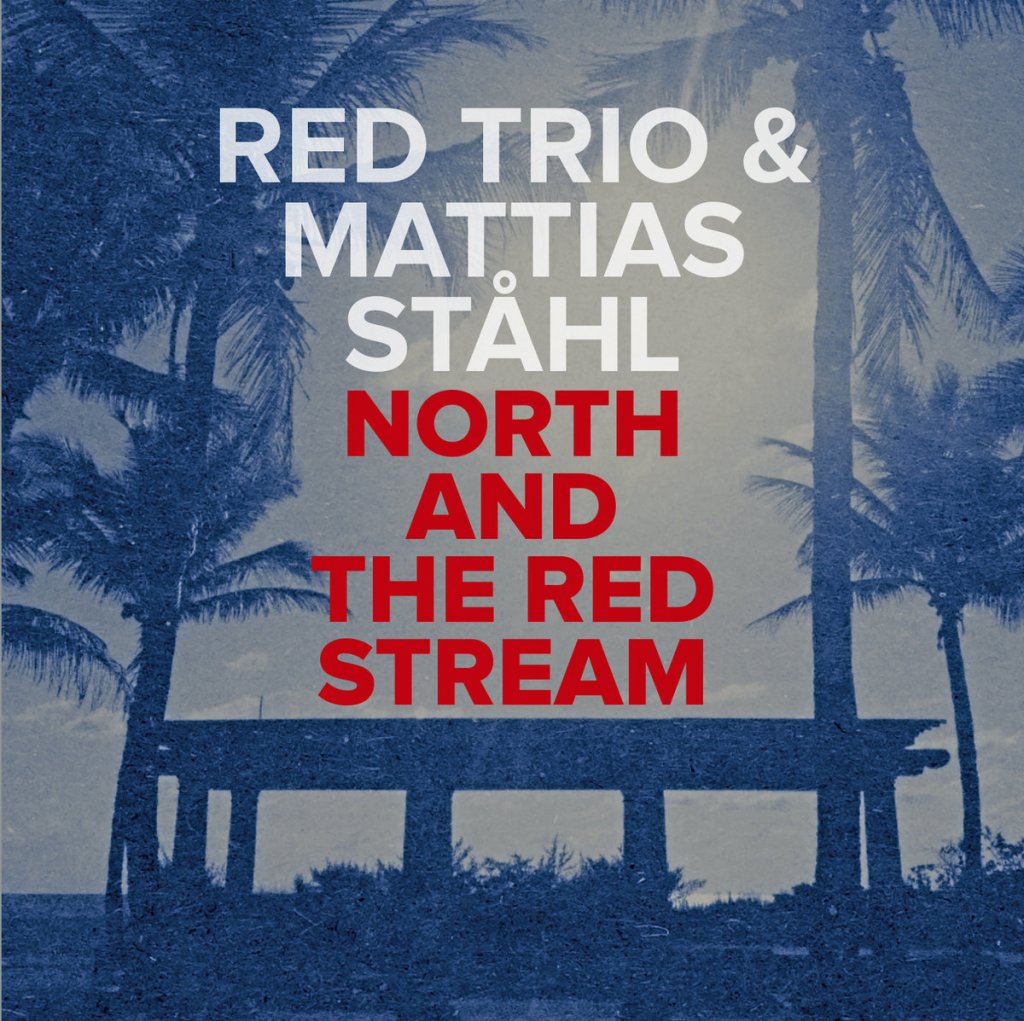
“The song’s advice said, “Play that funky music, white boy.” So, I took up the xylophone.”
-Jarod Kintz, The Lewis And Clark Of The Ozarks
Following Bobby Hutcherson’s amazing Blue Note albums, one can wonder what’s next for the vibraphone. One answer is the work of Jason Adasiewicz, who frequently worked with Peter Brotzmann. Seeing him live with the Mental Shake Quartet was an astonishing experience (so much so that I occasionally wasn’t looking at Brotzmann) as he flailed away at his vibraphone and produced fantastic energy music.
But is there another route? Mattias Ståhl would say yes, emphatically. I first discovered him through his work with Martin Kuchen’s band Angles, where I thought he was the most interesting player in the band. Downbeat magazine has called him “the wunderkind of the vibes”, and The Quietus has praised the “immediacy, grit, and churn” of his music. He is capable of sounding like Hutcherson, then bringing a modern chamber jazz touch to the music, and, yeah, he can bring the fire when needed as well. He’s a perfect partner for the Red Trio.
The Red Trio is a key component of the thriving Portuguese free jazz scene which also includes the great saxophonist Rodrigo Amado, who has already appeared on this list, guitarist Luis Lopes and violinist Zingaro. The Trio focuses on completely improvised music. It features Rodrigo Pinheiro on piano, Hernani Faustino on bass and Gabriel Ferrandini on drums. I hadn’t realized there was a Portuguese free jazz scene until I suddenly noticed how many times these three musicians were appearing in various combinations on the albums I was buying.
Their approach to improvisation is collective, with none of the members looking to take blazing solos. They see their music as communication, with themselves and their audience. They love to have guests join them and Stahl is a perfect guest. The album essentially has three percussion instruments and even Faustino is mostly plucking his bass rather than bowing. As such the music mostly has a fast pace to it but the musicians are so skilled that there is much beauty to be found as well. The last half of the final track Stream proves they can do energy music just as well.
The Red Trio also have collaborated on albums with John Butcher and Nate Wooley. They have an album on the Astral Spirits label, just the three of them, called Live In Munich. Pinheiro and Faustino collaborate on an album with the saxophonist Lotte Anker, called Birthmark. Fuastino and Ferrandini collaborate with Jon Irabagon on Absolut Zero. All these albums are well worth a listen.
99-Thurston Moore-Stovelit Lines
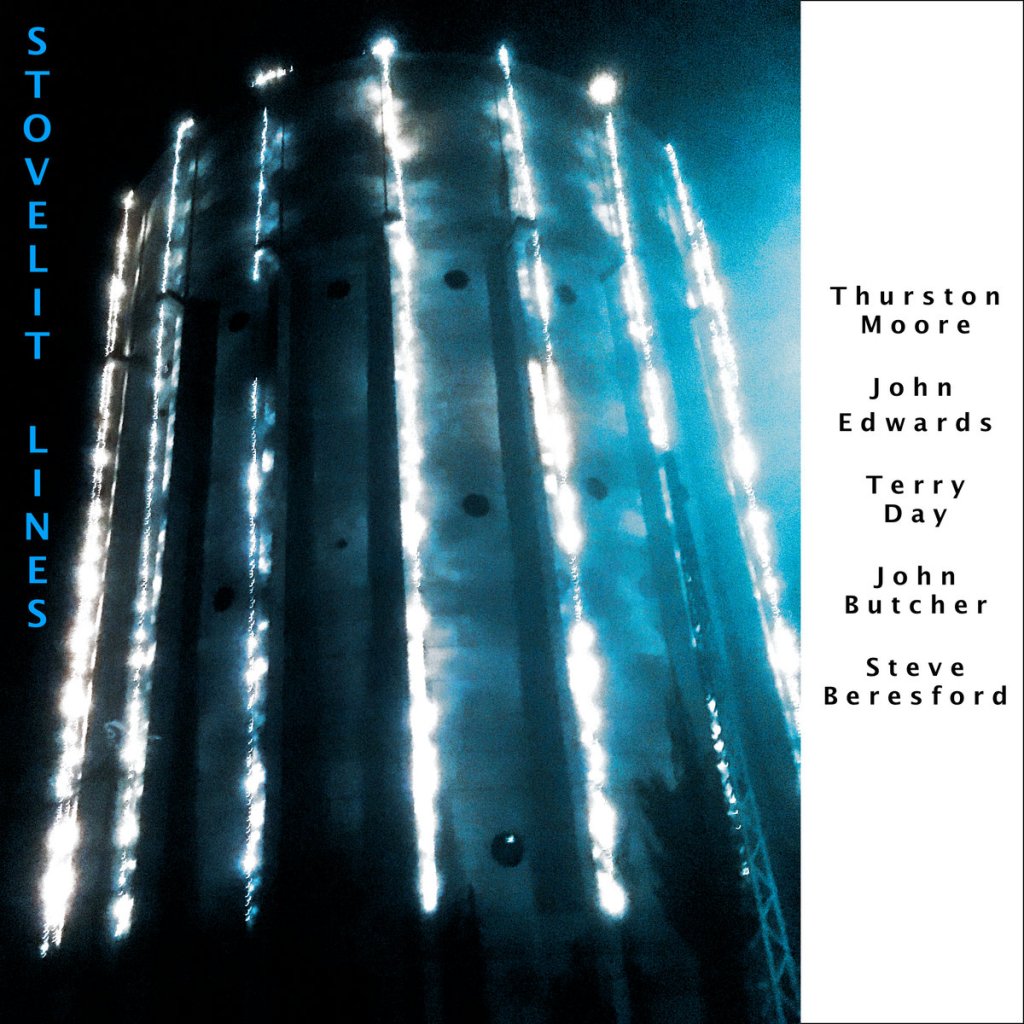
“I simply love the effect an instrument has on people. It is what you can do with it-the sounds created. It is a physical thing.”
-John Edwards
“When John Edwards plays his double bass, he is extraordinarily engaging. He plucks, tweaks, bows, hits and hums aloud. So engrossed is he that it is difficult to look away. One memorable gig, I overheard a member of the audience say “It’s almost pornographic what he does with that bass.”.”
-Sammy Stein, All About Jazz
Before their breakup, Sonic Youth had been experimenting with augmenting their band with some extreme noise artists, most famously on the album Andre Sider Af Sonic Youth, where they were joined by Mats Gustafsson and Japanese noise artist Merzbow.
Thurston Moore, guitarist for Sonic Youth, continued to explore this music after the dissolution of Sonic Youth, in particular working with Mats Gustafsson on a duo album Vi Ar Alla Guds Slavar, and a duo album with Alex Ward, Live At Café Oto. This wonderful album suggests his work fits very nicely in the border between improvised music and harsh noise.
He’s joined by one of my favorite bass players, John Edwards, who’s worked with most of the very best European improvisers, especially Peter Brotzmann. Then there’s British saxophonist John Butcher, a veteran of the improv scene who has produced some classic albums with Phil Durrant and John Russell. Check out Concert Moves in particular. Then there’s Steve Beresford, another veteran British free jazz musician with a long resume’ of great music. For a really good album featuring both Beresford and Edwards, check out Sarah Gail Brand’s All Will Be Said, All To Do Again. On drums is Terry Day, who you’ll be shocked to hear is another veteran British free jazz musician.
The music starts off low and ominous, with sounds you can’t quite place or even figure out what’s making them. There’s clearly electronics involved. I hardly ever like these electronic noises in improvisation. They usually remind me of the soundtrack to a lousy sci-fi movie. But they work here, probably because they’re paired with the gritty guitar of Moore. Throughout the album, the music ebbs and flows towards moments of roiling intensity and then back to a quiet moment. That’s not to say that the quiet bits are peaceful, they feel more like the lull before a storm. And the storm is coming.
The quotes at the top of the commentary are my tribute to John Edwards, one of my favorite musicians who I wish I could have had higher up on this list.
100-Coleman Hawkins with the Red Garland Trio
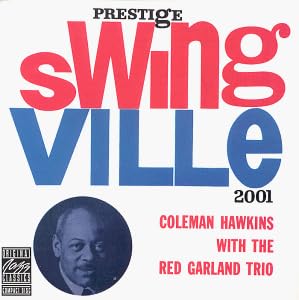
“If they think they are doing something new, they ought to do what I do every day – spend at least two hours every day listening to Johann Sebastian Bach and, man, it’s all there.”
-Coleman Hawkins
It’s been a long read/write and I wanted to end this list on something that’s just fun to listen to.
The first John Coltrane album I ever bought was Giant Steps and I was hooked instantly. I started buying anything with his name on it. One that I discovered early on was Soul Junction by The Red Garland Quintet featuring Trane and the trumpeter Donald Byrd. And while I mostly loved Trane’s Impulse! stuff, I would often find myself returning to Soul Junction. I dug the relaxed bluesy feel to it. Trane and Byrd had lots of space to show off. It was what critics would call a blowing session, and Garland takes some great solos himself.
Pianist Red Garland made his initial claim to fame as part of the first great Miles Davis Quintet. But he was just as successful as a leader, with a trio which was occasionally extended to a quintet as on Soul Junction, or a quartet as he does with Coleman Hawkins here.
Coleman Hawkins has a large place in the history of jazz for several reasons. He was one of the first jazz musicians to play the tenor saxophone. He started playing professionally in 1921, with The Fletcher Henderson Orchestra. He played alongside Lous Armstrong for part of his tenure there. He’s also famous for a recording of the standard Body And Soul he made in 1939. It’s remarkable because he almost entirely ignores the actual tune and just freely improvises after playing just the first few notes of the tune. It was completely unheard of at the time and was a precursor for a lot of the more freely improvised jazz of the future. Experts also claim that you can find the first hints of bebop in his soloing.
On this one, we get another blowing session and it’s the sort of thing Hawkins just eats up, especially as he doesn’t have a trumpeter to compete with. Garland shows off his style as well to great effect. This is an “end of an exhausting day” album or a “reminder that maybe all will be well” kind of an album.
For more Red Garland, there are 2 Red Garland Quintet albums with Trane, Soul Junction and Dig It. Soul Junction is much better. Or check out his work with the Miles quintet, especially the classics Cookin’, Relaxin’, Workin’ and Steamin’. For Hawkins, there’s lots to get. There’s The Stanley Dance Sessions, there’s Coleman Hawkins Encounters Ben Webster, Duke Ellington Meets Coleman Hawkins or one of my favorites, The Hawk Relaxes.
************************************************************************
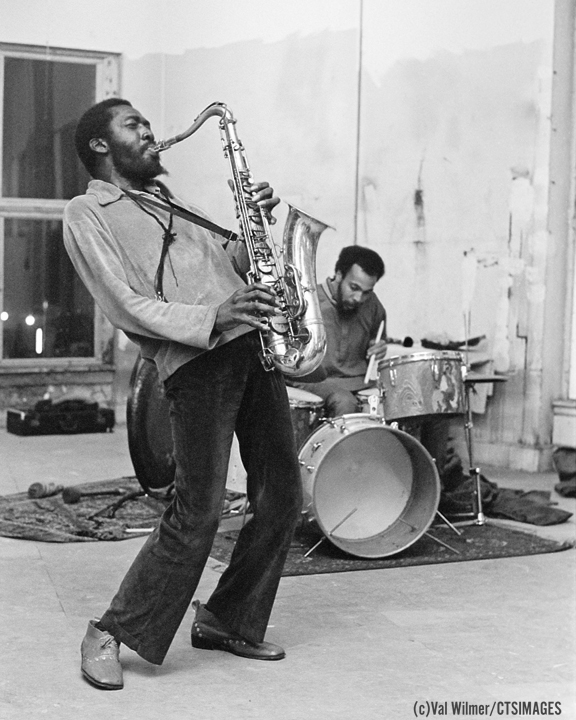
*****************************************************************************
What else?
***********
So what else should be here? I had a “rule” that an artist couldn’t have more than 2 entries.
Even with that rule, there are about 200 albums that deserve to be in the top 100.
I clearly broke the rule several times, for example for Elvin Jones and Evan Parker, but Jones was on so many essential albums of the 60s, there was no way to avoid it. Similarly, Parker has been such a fundamental part of the European free jazz scene for more than 50 years, there was no way to avoid his repeated presence either.
If I didn’t have the 2-entry rule, what else would be on (a longer version of) this list?
For Coltrane, I would have added Interstellar Space, his fantastic duo with Rashied Ali. I’d have added Live At Birdland, Elvin’s finest hour. I’d have added Sun Ship and probably one of his early Atlantic albums, maybe Coltrane’s Sound, and maybe First Meditations as well.
For Cecil, I’d have added Celebrated Blazons by The Feel Trio, Nefertiti, The Beautiful One Has Come and, what the hell, the 13 disc box set In Berlin ’88.
For Charlie Parker, I’d add The Complete Charlie Parker on Verve, a part of his career not covered by the set I chose.
For Braxton, I’d add Composition 96, For Alto, Quintet (Basel) 1977 and 12 Comp (Zim) 2017.
For Brotzmann, I’d add Mental Shake and Never Too Late, But Always Too Early and The Nearer the Bone, the Sweeter the Meat, from his trio with Harry Miller and Louis Moholo.
Despite the staggering number of times Evan Parker appears on this list, he should also be here for his solo album The Snake Decides and as part of the Parker-Guy-Lytton Trio for their album Imaginary Values.
For Monk, I’d add Brilliant Corners and one of his solo albums, maybe Alone In San Francisco.
For AvS, I’d add Monk’s Casino and his album Piano Duets: Live In Berlin 93/94, with Aki Takase.
For Miles, I should really have something from the second great quintet, either Nefertiti or ESP, and On The Corner just for the hell of it. Kind Of Blue should be here as well.
William Parker deserves a solo album on here, probably Crumbling In The Shadows Is Fraulein Miller’s Stale Cake.
Derek Bailey deserves another album on here, maybe Yankees with George Lewis and John Zorn or Soho Suites with Tony Oxley.
Mingus deserves another entry, say Pithecanthropus Erectus.
Andrew Hill’s Point Of Departure certainly deserves to be here.
Ken Vandermark’s great band Lean Left with members of The Ex deserves to be here, either with Medemer or Live At Café Oto. The Vandermark 5 should be here as well, say for Simpatico.
Wadada Leo Smith’s 4 disc boxed set 10 Freedom Summers deserves to be here.
Don Cherry’s here only for his work with Ornette. But his Complete Communion belongs here.
An album I love is John Edwards, Mark Sanders and John Tilbury-A Field Perpetually At The Edge Of Disorder, which I believe may have been written about my front lawn.
Jackie McLean only appears here on the Moncur album, he deserves to be here as a leader for, say, Destination…Out! or Let Freedom Ring.
John Butcher is only here for Stovelit Lines, but he should be here for one of his own albums, e.g. Concert Moves with Phil Durant and John Russell.
Dizzy Gillespie’s Birks’ Works belongs here.
Dave Brubeck’s Time Out should be here.
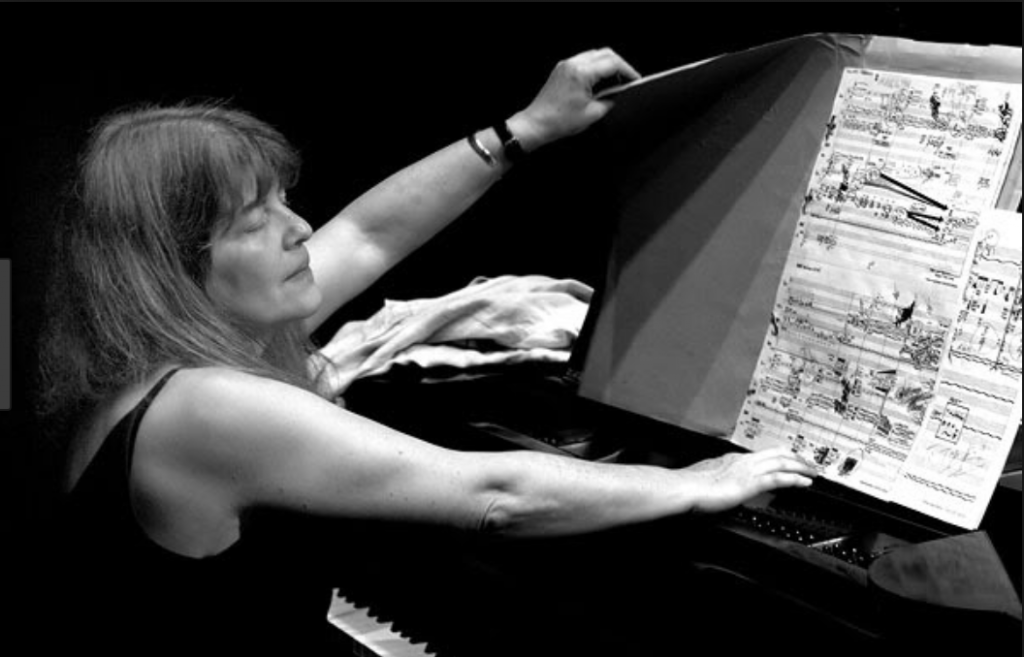
***************************************************************************
Who doesn’t appear above at all, but should be on the list?
I went back and forth on whether to have a Bill Evans album on here. I probably should, but I don’t. The Complete Village Vanguard Recordings would be the choice.
The great virtuoso Art Tatum should be here, and in fact was in earlier versions of the list. Check out The Solo Masterpieces, a 7 disc set, or The Group Masterpieces, an 8 disc box set with partners varying from disc to disc. All of these were published by the Pablo label.
Stef Gijssels, founder of The Free Jazz Collective website, coined a term called silencescape for a certain style of improvised music. To quote him:
“you can call [this music] minimalist acoustic soundscapes, or “silencescapes” if that word exists, in which the musicians’ incredible knowledge and control of their instruments lead to the most fragile and subtle interchange of almost isolated sonic ingredients to create one single overarching sound. Some call this noise, but it is basically its exact opposite.”
I’d love to have an example on this list. There are two obvious candidates, Skogen-Ist Gefallen In Den Schnee (which was on an earlier version of this list) and Silencers-Balances des Blancs.
Stan Getz isn’t on here. I’ve always liked his album Sweet Rain. Art Pepper Meets The Rhythm Section should be here. Dave Douglas’s Constellations should be here. Jimmy Smith’s Back At The Chicken Shack should be here. Oscar Nelson’s Blues And The Abstract Truth should be here. Ditto for Sonny Clark’s Cool Struttin’. And Modern Jazz Quartet’s Django. And Booker Ervin’s Freedom Book. And Rahsaan Roland Kirk’s We Free Kings. And Irene Schweitzer’s Piano Solo, Volumes 1 & 2. And The Incredible Jazz Guitar Of Wes Montgomery. And Lee Morgan’s The Sidewinder. And Horace Parlan’s Up And Down. And Sonny Criss’s This is Criss!. And Donald Byrd’s Chant. And Horace Tapscott’s The Dark Tree. And Paul Flaherty’s Dragonfly Breath. And Simon Fell’s The Ragging Of Time. And Joelle Leandre’s For Flowers. And Stanley Turrentine’s Never Let Me Go. And Ben Webster Meets Oscar Peterson. And Muhal Richard Abrams’s Blu Blu Blu. And Art Ensemble Of Chicago’s Urban Bushmen. And Marion Brown’s Three For Shepp. And Cannonball Adderly’s Somethin’ Else. And George Lewis’s Homage To Charles Parker.
Damn, that’s a lot.
I also wish I had more of the early greats like Jelly Roll Morton, Albert Ammons, Willie “The Lion” Smith, King Oliver, Kid Ory, Hot Lips Page, Lester Young, Bennie Moten, Teddy Wilson, Fats Waller, Chu Berry, Miff Mole, Benny Carter, Johnny Dodds, Eddie “Lockjaw” Davis, Illinois Jacquet or Henry “Red” Allen. They all have albums in the Complete Jazz Series I’d have loved to have on here.
 richardblute.ca